'Data is not just a fuel, it's also the GPS which helps navigate the digital landscape'
At the e4m Connected TV Conference, marketing leaders explored how data has evolved from being merely fuel for businesses to becoming the strategic GPS that navigates the complex digital landscape
 by
by
Published: Jun 14, 2025 8:21 AM | 8 min read
 Follow Us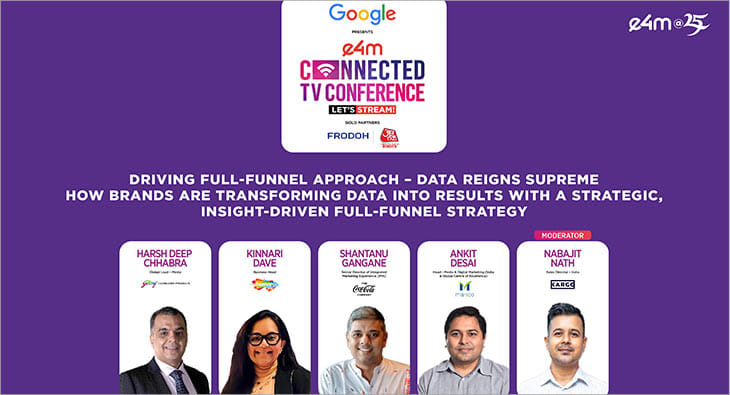

A panel of senior marketing executives at the e4m Connected TV Conference delved into the critical role of data in full-funnel marketing strategies. The discussion highlighted how brands are leveraging consumer insights and behavioural data to drive meaningful engagement across all touchpoints of the customer journey.
The panellists included Harsh Deep Chabra, Global Lead – Media at GCPL; Kinnari Dave, Business Head at ShemarooMe (OTT); Shantanu Gangane, Senior Director of Integrated Marketing Experience (IMX) at Coca Cola; and Ankit Desai, Head - Media & Digital Marketing (India & Global Centre of Excellence) at Marico. The session was moderated by Nabajit Nath, Sales Director – India at Kargo.
Setting the stage for the discussion, Nath explained how streaming platforms target audiences based on their consumption patterns. For e.g., action and crime content for some viewers, while completely different content appears on other screens based on the signals those users send to OTT platforms. Similarly, e-commerce brands leverage data to target users with strategic offers right at the point of cart abandonment, working on lower funnel metrics to drive conversions.
"Data is not just a fuel, but it's also the GPS which helps navigate all the digital landscape and all the chaos which is there in the digital landscape," Nath noted, emphasising that data's importance extends to each step of marketing.
Redefining Reach in the Digital Age
The conversation opened with Desai challenging traditional notions of reach in marketing. Drawing from his recent LinkedIn posts about reach being the most powerful marketing lever, he distinguished between superficial metrics and meaningful engagement. "As media planners, we are used to looking at reach in numerical terms. The plan has gotten 80 percent reach, 90 percent reach, all great on a dashboard, and I call it checkbox reach," he explained.
This checkbox mentality, according to Desai, leads marketers to focus on media weight in isolation rather than creating mental availability. The key transformation involves asking fundamental questions: "Can I actually start asking who I want to meet, why I want to meet them and when I want to meet them?" Today's media landscape provides this opportunity, he noted, adding that any growth, whether category penetration or market share increase, requires reaching "the right person in the right context the right number of times."
Balancing Emotion with Data Intelligence
Gangane addressed one of marketing's most debated topics: balancing gut-led creative thinking with data-driven decision making, particularly for emotional campaigns. For impulse categories like Coca-Cola's portfolio, emotions take precedence over everything else, he emphasised.
Rather than viewing it as gut versus data, Gangane suggested taking "a step back into inciting." At Coca-Cola, the process begins with identifying deep consumer emotions, which then provides talking points across different departments and stakeholders. "That gives us enough fodder for thought for all our departments to come back to us with a cohesive brand idea and a story to tell."
This approach recently manifested in Sprite's "Joke in a Bottle" campaign. The team identified that Gen Z consumers often seek escape through doom scrolling and refreshing content. "We created a platform where every Gen Z could come and watch refreshing content when away from home. It could be accessed through the bottle," Gangane explained. The campaign seamlessly integrated their product packaging with digital engagement, ensuring the pack remained central to consumer interaction.
Entertainment as the Fourth Basic Need
Making a striking entrance mid-session, Dave brought a philosophical perspective to the discussion. She expanded on her belief that entertainment ranks alongside roti, kapda, and makaan as fundamental human necessities. This isn't a modern concept, she argued, “from Roman gladiators to Indian classical dance forms like Bharatanatyam and traditional Ramlilas, entertainment has always been integral to human culture.”
"Entertainment is something that helps us transition the culture. There are so many nuances of culture that we pass through entertainment," Dave explained. In daily life, while clothing and food represent small changes, entertainment provides the largest variation in human experience. "Today you're watching something here, tomorrow you're watching crime, the day after you're watching romance. So I think from that aspect of human psychology, entertainment is more of a need as well."
Leveraging E-commerce Intelligence for Brand Strategy
Chabra shared insights on how legacy brands can harness e-commerce and D2C platform data to fuel top-of-funnel strategies. The real-time nature of e-commerce data provides significant advantages over traditional market research timelines. “Tools like ASOS deliver actionable insights immediately, eliminating the wait for off-take data that typically arrives months later.”
The GCPL executive illustrated this with an example from their sexual wellness portfolio. When they activated a specific variant of the Kama Sutra brand on e-commerce platforms, the impact was visible immediately through ASOS data. Supporting this with television advertising created measurable uplifts that could be tracked in real-time.
Perhaps more revealing was how granular data challenged geographical assumptions. "There are two different kinds of brands in our portfolio," Chabra noted, "and one that we were able to identify was appealing to audiences in Bandra and then another one, which is an extremely expensive brand but was doing extremely well towards Bhandup and Kanjurmarg." This pin code-level intelligence enabled more precise media deployment strategies beyond traditional broad-brush approaches.
From Spray and Pray to Sense and Serve
Desai described the evolution of precision marketing as moving "from spray and pray to sense and serve." The sensing mechanism operates through multiple data sources - platform partners provide the first layer of information, which is then enhanced with third-party signals for sharper targeting.
However, the real discrimination factor lies in building cohorts and extending insights into communication strategies. "For the same campaign today, we might actually have different narratives and comp designs for a beauty seeker versus maybe a wellness seeker," Desai explained. This contextual approach unlocks the power of reaching the right audience with relevant messaging.
The ultimate goal involves building intelligence within internal systems, gathering information that can be enriched over time to create richer use cases. These applications extend beyond creative execution to insights that can drive product innovation.
Measuring Success Across the Entire Funnel
Coca-Cola's measurement approach varies significantly as campaigns move deeper into the funnel. At the top, mind metrics like TOMS, bond gains, and salience serve as primary KPIs. Mid-funnel measurements focus on platform-specific metrics, with particular emphasis on view-through rates rather than clicks.
"Clicks are very vanity metrics, it's a reach, it's a very elusive number, but what happens to your ads, what happens to the content is very critical," Gangane noted. The brand also maintains weekly drinkers as a crucial KPI, requiring continuous effort to balance this metric.
Beyond traditional advertising measurement, Coca-Cola extends communication into passion points through initiatives like Coke Studio and Thumbs Up's Thunder Wheels adventure biking promotion. "We try to take our communication beyond one-way communication into passion points. And that's where we actually start measuring loyalty as well. We take it a little beyond the funnel as well to try and create fans for our brands rather than stopping at just conversions."
Granular Audience Intelligence
Dave detailed ShemarooMe's approach to viewer behaviour analysis. Since consumption happens directly on their platform, they possess comprehensive data on viewing patterns, which gets sliced into increasingly granular segments. The nuances of watch time and usage minutes vary dramatically across regions - Gujarat versus Mumbai versus the rest of Maharashtra show distinct patterns.
"We know what the hook points are in which a customer will drop off in Maharashtra versus a customer who will drop off in HSM markets," Dave explained. This granular analysis enables communication strategies tailored to specific cohorts, with different messaging for customers in Gujarat compared to HSM markets or international audiences.
The challenge lies in measuring social chatter around content, as consumer preferences shift rapidly in the digital space. "The consumer is always elusive in nature. What he likes today, he might not like tomorrow. His habits are changing extremely fast in the digital world," Dave observed. India's tendency to shorten adoption curves means trends from the West get implemented faster in the East, leading her to study Chinese markets for insights that could help leapfrog ahead of Western learnings.
Organisational Transformation for Data-Driven Marketing
Addressing internal transformation challenges, Chabra highlighted the substantial investments organisations make in business transformation units. The ability to scale solutions across different functions within the organisation creates significant value. Solutions working in the supply chain can be adapted for media applications with proper implementation.
Modern technology has made sophisticated solutions more accessible than ever before. Chabra referenced the traditional triangle of good, cheap, and fast, where typically only two out of three could be achieved. "Today, technology is able to give us good, cheap, fast solutions. The question is, are we orienting ourselves to think that a machine can do this?"
The transformation requires shifting from throwing people at problems to seeking technological solutions. Partner ecosystem support has proven invaluable, with many tech companies offering ready-built solutions for common marketing challenges. "A lot of solutions have already been built. It's just about applying ourselves, pushing ourselves to say, yeah, we should do it using technology rather than getting intimidated by technology."
Proof of concepts play a crucial role in gaining organisational buy-in. Once teams can demonstrate tangible results rather than future possibilities, adoption becomes significantly easier. “This approach has enabled GCPL to implement solutions that deliver quality at pace and cost-effective rates, proving that advanced marketing technology is no longer a distant future concept but a present reality.”
Read more news about Digital Media, Internet Advertising, Marketing News, Television Media, Radio Media
For more updates, be socially connected with us onInstagram, LinkedIn, Twitter, Facebook, YouTube & Google News