When preparation meets opportunity, that’s when you’re called lucky: Prasanth Kumar
In a wide-ranging conversation with Dr. Annurag Batra, Prasanth Kumar, CEO of WPP Media South Asia, lays out how consumer shifts, AI acceleration and outcome-driven models are reshaping media services
 by
by
Published: Apr 29, 2026 9:13 AM | 9 min read
 Follow Us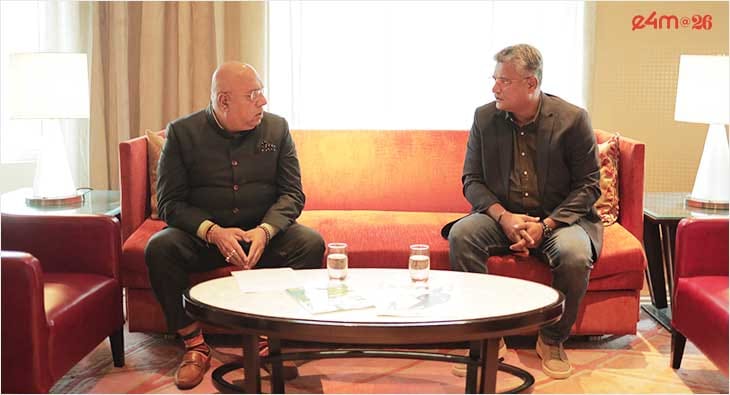

- Prasanth Kumar, CEO of WPP Media South Asia, emphasizes that the advertising landscape is evolving, with media becoming central to marketing strategies, driven by data and technology integration.
- He advocates for a culture of preparedness and adaptability within agencies, highlighting the importance of understanding client problems to deliver effective solutions amid increasing competition from consulting firms and platforms.
- Kumar notes a shift in the agency business model from traditional commissions to diverse remuneration structures, emphasizing accountability and ownership in achieving client growth.
- He identifies emerging areas such as commerce media and influencer marketing as key to diversifying agency offerings, while stressing the importance of integration and collaboration across functions to meet evolving client expectations.
At a time when India’s advertising market is expanding rapidly but the agency business model is under visible strain, Prasanth Kumar, CEO of WPP Media South Asia, is clear that the rules of the game have already changed. In a detailed conversation with Dr. Annurag Batra, Kumar lays out a vision where media is no longer a siloed function but the central operating layer of marketing itself, powered by data, technology and integrated thinking.
A culture built on constant preparedness
Kumar attributed WPP Media’s sustained leadership not to scale alone but to a deeply ingrained culture of readiness. Reflecting on his 22-year journey within the group, he frames success as a combination of discipline and adaptability. “When preparation meets opportunity, that’s when you’re called lucky,” he said. “We inhale and exhale the spirit of being prepared. The landscape is evolving very fast and solutions cannot remain the same every year.”
For Kumar, this preparation is not static. It is driven by curiosity and a willingness to continuously rethink solutions as consumer behavior shifts across platforms and formats. The implication is clear. “In a fragmented media ecosystem, yesterday’s playbook is already obsolete.”
Media at the centre of marketing transformation
One of the strongest themes emerging from the conversation is Kumar’s insistence that media is no longer a downstream execution function. It sits at the core of marketing strategy. “We strongly believe the media is the center. It has provided the opportunity to get stitched to the journey of consumer understanding, reaching them at the right time with the right message,” he said.
This shift is being accelerated by the convergence of content, commerce and data. Kumar describes a world where every media exposure can trigger a transaction and every transaction becomes a media signal. This blurring of lines is fundamentally redefining how agencies create value. “The mindset has expanded. It’s not just a media perspective anymore. It’s about solving the larger marketing problem,” he added.
The new agency mandate is problem-solving
As consulting firms, platforms and data companies move deeper into marketing, the competitive landscape for agencies has intensified. Yet Kumar does not see this as a threat. Instead, he believes it reinforces the need for agencies to focus on what matters most. “The most important thing is to know what you are really trying to solve. We are obsessed with customers,” he said. “If you have clarity on the problem, you will find the right solutions.”
This clarity, he argues, is often the missing link in client agency relationships. The quality of outcomes is directly linked to the quality of problem definition.
Reinventing the business model beyond commissions
The economic structure of the media agency business has undergone a dramatic shift over the past two decades. Traditional commission models have steadily declined, replaced by a mix of fees, performance linked contracts and outcome based remuneration. Kumar sees this not as a crisis but as a natural evolution.
“We are a subset of a larger ecosystem and we facilitate solutions for customers and partners. It has to mean growth for them,” he said. “There are multiple models today. Fee models, commission models, outcome-based models. Everything is a derivative of success.” His emphasis on accountability is unmistakable. Agencies, he believes, must embrace ownership rather than resist it. “You should not be afraid of accountability and ownership. That is something you should strongly define for yourself,” he noted.
Winning in pitches is about talent and integration
In a market where pricing often dominates pitch conversations, Kumar insists that WPP Media’s competitive edge lies elsewhere. Talent remains the most critical differentiator. “For us, the most important thing is our people. Talent is a very critical factor. One of the greatest opportunities of winning is talent and one of the biggest challenges today is also talent because it is constantly evolving,” he said.
Equally important is the ability to deliver integrated solutions. After years of unbundling, the industry is now moving back towards a more unified model where different capabilities work together seamlessly. “Specialisation and integration should not be seen as departments. They should be seen from the perspective of outcomes,” Kumar explained. “Like an orchestra, different specialists play different instruments but the magic comes when it all comes together.”
Clients want growth today and an edge for tomorrow
Through his interactions with CEOs and CMOs, Kumar identifies three consistent priorities shaping marketing decisions. The first is a relentless focus on growth. The second is the need to extract better performance from current investments. The third is building future readiness.“I call India not a market but an opportunity,” he said. “Leaders are thinking about how to generate sustainable demand, how to do better today and how to create an edge for tomorrow.”
This dual focus on immediate performance and long-term capability building is increasing the complexity of marketing mandates and, in turn, the expectations from agencies.
Kumar believes that delivering on these expectations requires a more collaborative approach between clients, agencies and the broader ecosystem of partners. “If you have clarity on the problem and brief your partners in the right way, you can collectively arrive at better solutions,” he said. “Give them the flexibility, empower them, review them and create continuous feedback.”
He also highlights the importance of bringing technology, data and content partners into the same conversation, arguing that innovation increasingly happens at the intersection of these capabilities.
Growth amid structural pressures
WPP Media’s recent run of business wins, including both large scale and emerging clients, reflects its ability to adapt to this changing landscape. Kumar points to a balanced portfolio strategy that values both scale and future potential. “New business is very important. It is like acquiring a new customer,” he said. “Small businesses of today are the big businesses of tomorrow.”
At the same time, he acknowledges the structural challenges facing the industry. While advertising spends are rising, agency profitability remains under pressure, particularly in a digital ecosystem dominated by a few large platforms.
Navigating the digital duopoly and diversification
With a significant share of ad spend flowing into digital, concerns around transparency, ad fraud and effectiveness have intensified. Kumar recognises both the strengths and limitations of the current platform dominated landscape. Kumar highlights, “It is both good and bad. Large platforms have scale and innovation but it also creates room for others to come in and build new solutions.” He further emphasises the need for continuous vigilance and investment in data governance. “We have to be on this 24 hours because something new will come every two days.”
Emerging areas such as commerce media, connected television and performance driven OTT are expected to play a larger role in diversifying the ecosystem. A significant part of WPP Media’s growth is now coming from non traditional areas such as content, data, analytics, commerce and influencer marketing. Kumar describes this as a structural shift rather than an incremental add on. “There is content, data, technology, analytics, consulting and commerce. These are not just services but businesses in themselves,” he said.
This diversification is helping agencies move closer to business outcomes rather than just media metrics.
Integration as a strategic imperative
Under WPP’s evolving global structure, integration is becoming central to its strategy. Platforms like WPP Open aim to unify data, technology and creativity, enabling more seamless collaboration across functions. “It is not just about strategy but about doing it in action,” Kumar said. “Partnerships, co creation and integrated solutions are where the real differentiation will come.”
Despite increased consolidation among competitors, Kumar maintains that WPP Media’s focus remains on execution rather than market share battles. “What matters is how well we play the game because today’s solution is not tomorrow’s solution,” he said.
On the rise of influencer marketing, Kumar takes a measured view. While acknowledging its growing importance, he sees it as part of a broader mix rather than a standalone solution. “It is an ingredient that is critical and will continue to evolve,” he said. “It has the ability to engage consumers deeply but how we use it will keep changing.”
Artificial intelligence, according to Kumar, is the most transformative force shaping the future of the industry. Its impact is already visible across planning, execution and optimisation. “There is no way today that you cannot be experiencing AI,” he said. “The interesting part is how you use the time saved to improve quality. It is not about doing things faster but about doing them better.” This shift from efficiency to effectiveness could redefine how agencies measure value in the years ahead.
Leadership rooted in ownership and humility
Kumar’s leadership philosophy reflects the same principles he advocates for the business. He emphasises ownership, contribution and continuous learning as core values. “You should take ownership. If you are not taking ownership, don’t waste time,” he said. “Focus on what you can contribute and be yourself. Enjoy the journey but also push people to get the best out of them.”
Looking ahead, Kumar is focused on sustaining momentum while pushing the organisation to evolve further. His priorities include delivering stronger outcomes for clients, building future ready talent and creating work that sets new benchmarks.
“We want to win as individuals and as a team,” he said. “We want to create great work, new models and new ways of looking at business. We will keep pushing ourselves to play at 100 per cent.”
In an industry where change is the only constant, Kumar’s vision underscores a simple but powerful idea. Success will not come from scale alone, but from the ability to stay relevant, stay accountable and stay relentlessly focused on solving real business problems.
Read more news about Internet Advertising India, Marketing News, PR and Corporate Communication News, Digital Media News, Television Media News
For more updates, be socially connected with us onInstagram, LinkedIn, Twitter, Facebook YouTube & Google News