We need the CMO to think like a CEO with the brain of a CFO: Harsha Razdan
In a wide-ranging conversation, Harsha Razdan, CEO of dentsu South Asia, spoke to Dr. Annurag Batra on the agency’s operating model, bundling of services, AI and more
 by
by
Published: Apr 28, 2026 8:51 AM | 9 min read
 Follow Us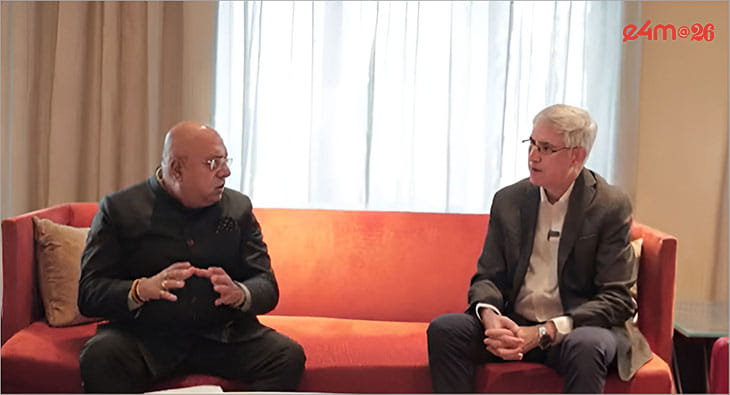

- Harsha Razdan, CEO of dentsu South Asia, emphasizes that the biggest competition for advertising agencies comes from startups, not rival agencies, and has focused on rebuilding dentsu India through stability, consolidation, and differentiation since his arrival from a consulting background.
- Razdan implemented the 'One dentsu operating model' to streamline operations by integrating top clients under a single profit and loss statement, aiming to shift the agency's focus from merely selling services to solving clients' growth challenges.
- He acknowledges the industry's trend of unbundling services but believes it is reverting to a bundled model, where larger clients prefer comprehensive solutions from a single partner, while smaller clients may still opt for specialized services.
- Looking ahead, Razdan plans to prioritize double-digit growth, expand new service lines, and adapt dentsu India's strategies as a model for other markets, all while navigating rapid advancements in AI and technology.
Very few CEOs of large advertising holding companies in India will tell you, unprompted, that their biggest competition is not a rival agency network, but the startup two floors below them in the co-working space. Harsha Razdan, CEO of dentsu South Asia, is one of them. In a wide-ranging conversation with Dr. Annurag Batra, Chairman and Editor-in-Chief of BW Businessworld and e4m, Razdan offered a frank account of three years spent rebuilding dentsu India, in his telling, for a differentiated leap.
Razdan came to dentsu not from within the advertising ecosystem but from consulting, having spent years at Accenture navigating technology-led transformation. That background, he says, fundamentally shaped how he diagnosed dentsu India's needs. The three phases of Harsha's journey have been stability, consolidation and now differentiation. "When I came in, the first mandate was to stabilise dentsu. We didn't have a CEO for some time, and it was about ensuring that the company and the people feel stable and secure," he told Batra.
The most structurally significant move Razdan made was what he calls the 'One dentsu operating model', a shift where the top 75 clients were brought under a single P&L from 2024 onwards, with dedicated teams and integrated appraisals. The insight for this came not from an internal audit but from something more direct: he went out and met 50 to 60 CEOs, one-on-one. "I believe that if you don't meet them one-to-one, you don't get good feedback," he said. "The insight was that we are trying to sell our services. We were not trying to understand client problems. And the client's problem was: Can I grow?"
That shift (from selling services to solving growth problems) runs through almost everything Razdan has done at dentsu. It also explains the talent strategy, which has been conspicuously cross-industry. dentsu India now has a BFSI industry head who was previously at Bain, a consumer and industrial lead from a Big Four firm, and hires from Amazon and Flipkart. The intention is to change the quality of conversation in a pitch. "I have had my sector head from consulting in the room, and I asked the client: Who will you give the pitch to? He said, 'This person who talked the language of business — because everything else was common, but this person was different.'" For Razdan, that is the point. Agencies do not lose pitches because of bad creative. They lose them because no one in the room is speaking the CEO's language.
The bundling comeback
The broader industry conversation has for years centred on the unbundling of agency services: the separation of media, creative, PR, data, and technology into distinct specialisms. Batra pressed Razdan on whether the pendulum is swinging back. His answer was unambiguous: it is. "It's going back a full circle. But you will have specialists within the bundling." The 'One dentsu' model, in a sense, is the operational expression of this thesis. Large clients want everything to come from one accountable partner. Smaller clients, with tighter budgets and specific preferences, may still operate with an unbundled, single-practice model. "Given India is growing fast, both will remain," said Razdan. "We are not going to stabilise our growth for the next 20 to 25 years."
This has implications for the broader industry. The e4m-dentsu Digital Advertising Report has consistently tracked India's AdEx on an upward curve. The total advertising expenditure is estimated at ₹1,75,000 crore, with digital commanding an increasingly dominant share. And yet, as Razdan acknowledged, agencies are not necessarily growing at the same rate. "On the creative side, there may be a little bit of struggle, as we always discuss. My question is: are we genuinely adding value to our clients?" The answer, he suggested, depends on whether agencies are willing to retool. "Don't look at the traditional competition. When you do, you think everything is moving slowly. Look the other side — where every small startup is running through and leaving you behind."
The Japanese connection and Indian ambitions
dentsu's India story has historically been intertwined with its Japanese heritage. The network's deep relationships with Japanese conglomerates like Sony, Toyota, and others gave it an early foundation in the market, but that anchor also meant the business risked being anchored too narrowly. Japanese clients today account for 14 to 15% of dentsu India's revenue mix. "We lost some traction in the 2020 to 2022 period. We have come back strongly," Razdan said, citing the involvement of new global CEO Takeshi Sano, who has visited India twice in two years to personally call on Japanese client CEOs. The expectation is that this segment grows faster than the dentsu India average.
But the bread-and-butter is Indian clients, accounting for 65 to 70% of revenue. Razdan has mapped large Indian conglomerates to dedicated relationship owners: someone assigned to the Tata group, another to Reliance, another to the Adani group. The logic mirrors what any sophisticated FMCG or consulting firm would do. "Are our Indian clients important? Extremely important. And you have to continue to explore and advance in these areas."
AI as companion, not threat
No conversation about agency strategy in 2026 can sidestep artificial intelligence, and Razdan did not try to. His framing was notably pragmatic: AI optimises, humans disrupt. The role of an agency (or any creative organisation) is to know which job belongs to which. "The winners are going to be people who know how to architect and use AI to win, rather than fearing what AI will do." He cited pushback from within his own teams on concerns about job security or about intellectual property as understandable but ultimately misplaced. The risk, as he sees it, is not acting too fast. It is acting too slowly.
To that end, Razdan has structured dentsu India's AI and open-source startup team to report directly to him. "If you keep it with anyone else, there are five different reasons why things will not move. Someone has built the tool, someone has been wedded to it for years." The implication is clear: in a network the size of dentsu, culture change only happens when it is driven from the top. He also drew a careful distinction between building proprietary tools and riding the ecosystem. "If you build too many tools of your own, someone will build a better one soon, and you will be outdated. Build enough to stay in the mix. But use the ecosystem."
On the question of why large clients should trust an established agency network over an AI-native startup, his answer was layered. Startups offer speed and innovation, but they carry the risk of collapse or IP vulnerability. "The same logic as to why larger agencies existed so many years — people thought you would take care of the brand and not do anything wrong for it — applies in this new world. Our role is to ensure we have the right balance of AI and speed."
Sports, experiential, and new service bets
Among the new services dentsu India has introduced under Razdan's tenure is a dedicated sports and entertainment practice, a natural fit given dentsu's globally unmatched position in the sports IP ecosystem in Japan, including deep ties to football, the Olympics, and emerging categories like anime. Razdan's pitch for the Indian practice is deliberately contrarian: "Our focus is not only about cricket. It's about yes, being there in cricket, but more about esports and non-cricket." He believes the non-cricket sports market is significantly underdeveloped and points to esports, e-motor racing, and gaming adjacencies as the real opportunity. He has placed a Japanese executive at the head of the practice specifically to channel global IP access into the Indian context.
Live events and experiential marketing also feature prominently in his thinking. As Batra noted, the more that AI and technology scale up, the more premium the human touch commands; a dynamic visible in the hospitality sector, in concert and gig culture, and increasingly in brand activations. "Live events are becoming events or locations in their own sense," Razdan said. "If someone is missing out on live events, they are missing a trick in their arm right now."
The CMO must think like a CFO
Razdan is equally demanding of clients as he is of his own organisation. A recurring theme in the conversation was the evolution of the CMO role, or rather, its necessary evolution. Client briefs, he said, are often still driven by standard procurement logic, focused more on buying services than on defining growth outcomes. "The more we get the CMO to think like a CEO with the brain of a CFO — spending money to drive growth — the better our briefs will become." He sees this shift happening among the most effective CMOs already. "The winning CMOs are upgrading to the task. They are doing a lot of the job that the CEO is doing."
For the industry to unlock its full potential, he argued, both sides of the table need to grow simultaneously. Agencies cannot self-improve their way to relevance if client mandates remain tactical. "It's a collaborative effort. Only agencies improving beyond a point may not help the case, because if marketers don't evolve, you have another problem."
The next 18 months
When Batra asked Razdan what to expect from dentsu India over the next year to year-and-a-half, the answer was striking in its epistemic humility. "If you ask me what my three-year plan is, I would not be able to answer. With the speed of AI and technology, I can't think beyond 18 months." His planning horizon has, by necessity, compressed. Within that window, the priorities are: continuing double-digit growth (dentsu India has grown in double digits across the last two to three calendar years), deepening the new service lines, expanding the talent cohort with outside-in hires, and activating dentsu India's potential role as a model for other markets within the global network.
Japan, he noted, is increasingly looking at India as an 'India out' market, a template that can be adapted and replicated elsewhere. That repositions dentsu India not just as a growth story within South Asia but as a potential proof of concept for the global network's transformation. "I hope that as a new agency model book is written, we are one of the principal authors," Razdan said. Coming from a man who was not, three years ago, part of the advertising industry at all, it is a statement with a certain clarity of intent.
Read more news about Internet Advertising India, Marketing News, PR and Corporate Communication News, Digital Media News, Television Media News
For more updates, be socially connected with us onInstagram, LinkedIn, Twitter, Facebook YouTube & Google News