The Creative Question: Neville Shah on strategy, festive ad and why relevance beats volume
FCB Kinnect’s Neville Shah believes the real measure of success lies in building work that lasts, not just wins that add up
 by
by
Published: Oct 23, 2025 9:23 AM | 6 min read
 Follow Us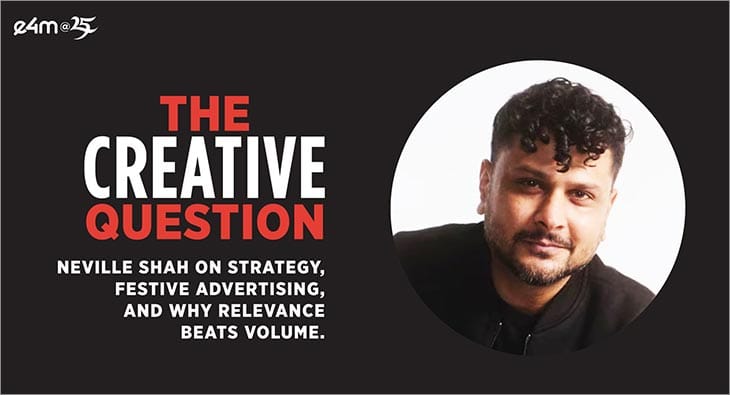

For Neville Shah, Chief Creative Officer of FCB Kinnect, the past year has been defined by focus rather than frenzy. In an industry often driven by volume and visibility, Shah believes the real measure of success lies in building work that lasts, not just wins that add up.
Over the last year, FCB Kinnect has added about ten to eleven new accounts, fewer than the previous cycle. But as Shah points out, the value of those wins is higher. “We’ve gone after fewer accounts, but each win carries more weight,” he says. “It’s not cherry-picking; it’s a strategic shift. If digital is now the new mainline, we must treat it with that same discipline and storytelling ambition.”
He credits this clarity to leadership choices, who made tough calls to prioritize quality over scale. “Sometimes you have to say no, even when it’s difficult. Those decisions protect bandwidth and preserve the creative standard. In the long run, that’s what sustains the agency.”
The change signals a broader reality within Indian advertising, a movement from chasing quantity to pursuing depth. As Shah puts it, “If the industry wants to stay relevant, it must start valuing consistency as much as creativity.”
The conversation when moved to festive advertising, that one season when almost every brand turns storyteller. Shah’s view is both candid and clear-eyed. “Festive advertising used to be about connection,” he says. “Now it’s about competition. Every brand is shouting ‘50% off,’ and the question isn’t who’s saying something meaningful, it’s who’s shouting louder.”
He believes the shift reflects a deeper transformation in how advertising is defined. “Festive time has become sale time. We’re seeing less brand building and more noise-making. In this environment, relevance has become more important than reach. The brands that stand out are the ones that still communicate emotion, not discounts.”
Many say advertising has moved away from emotional storytelling to humour, but Shah disagrees. “Fevicol has been funny since the beginning. Five Star was funny since the 90s. Humour isn’t new,” he says.
He argues that India’s advertising DNA has always contained both laughter and heart. “We’ve always done everything, humour, music, emotion, provocation. Our culture itself embraces every emotion. It’s not that we’ve shifted from emotion to humour; we’ve simply evolved in how we express both.”
With FMCG spends softening and the real-money gaming segment disappearing from screens, many assume a creative slowdown. Shah disagrees. “This industry runs in cycles. Every few years, someone says advertising is dying, it isn’t. Work continues. Briefs are coming in. Campaigns are being made. The form has changed, not the frequency.”
He explains that while the RMG exit impacted media investments, creative output remains strong. “When an entire category disappears, ad volume drops, but that doesn’t mean creativity slows down. There’s still as much work, just distributed differently. The perception of decline comes from how ads now reach us. Algorithms make our consumption narrower, so we only see what’s targeted to us.”
If there’s one trend that concerns Shah, it’s the rise of short-term thinking in brand communication. “Everyone wants to go viral everywhere,” he says. “No one says, ‘Let’s build something that lasts five years.’”
He calls it the dopamine economy of marketing, where every brief is built around instant visibility rather than enduring meaning. “Marketers have become reactive. We chase moments, not movements. The system rewards speed, not consistency,” he explains.
The best work, he insists, still comes from clients willing to build long-term platforms rather than short-lived posts. “The courage to hold on to a big idea is rare, but that’s how lasting brands are made.”
Inside the agency, Shah describes the creative balance with characteristic honesty. “Eighty percent of our work is what we call BAU, business as usual. That’s the everyday work that keeps a brand alive. The other twenty percent is the high-visibility creative work everyone talks about.”
He sees this ratio as essential, not unfortunate. “You can’t eat biryani every day,” he says. “You have to do the daily work, the brushing, the bathing, to earn that one great meal. The glamour exists because of the grind. Advertising is no different.”
As new technologies blur the boundaries between tribute and theft, Shah believes creative ethics must evolve too. “Using someone’s face or voice without consent is wrong. There’s no grey area there,” he says.
He acknowledges that parody and mimicry are legitimate creative forms, but draws a clear distinction when they cross into advertising. “You can’t use a public figure’s likeness to sell something without permission. That’s exploitation, not creativity.”
Shah also warns against what he calls “reference culture”, the habit of relying on nostalgia and borrowed personas. “We’ve overdone the nostalgia game. CRED’s early campaigns were refreshing because their references were built on original ideas. But when everyone copied the format, it lost its charm.”
His advice to creatives: surprise your audience. “The moment an ad feels predictable, it’s already forgotten. Great work always has an element of surprise.”
Shah rejects the idea that attention spans have collapsed. “People binge-watch series for hours. The problem isn’t attention, it’s relevance. If the content connects, people will stay.”
He believes short formats, six-second bumpers, 15-second digital spots, are products of platform economics, not human impatience. “Viewers aren’t demanding shorter ads. Platforms are defining the length based on cost and reach. As creatives, we adapt.”
For him, brevity is a creative discipline, not a constraint. “If your story needs time, take it. If it doesn’t, keep it short. But don’t reduce meaning for the sake of trends. The brief should define the duration, not algorithms.”
As for new business momentum, Shah says the festive quarter tends to be steady rather than aggressive. “Big open pitches rarely happen at this time of year,” he explains. “Most brands are in planning mode. The major movement happens at the start of the financial year.”
In the end, his perspective is less about nostalgia and more about renewal. “Advertising isn’t dying,” Shah says. “It’s just changing shape. Formats will evolve, emotional, humorous, short, long, but the work that stands out will always be the work that stands for something.”
Read more news about Internet Advertising India, Marketing News, PR and Corporate Communication News, Digital Media News, Television Media News
For more updates, be socially connected with us onInstagram, LinkedIn, Twitter, Facebook YouTube & Google News