Padma Bhushan posthumously awarded to Piyush Pandey: Voice that gave Indian advtg its soul
Guest Column: Ganapathy Viswanathan, Independent Communication Consultant & Author, shares how Piyush Pandey transformed advertising from polished corporate messaging into something deeply emotional
 by
by
Published: May 26, 2026 8:29 AM | 4 min read
 Follow Us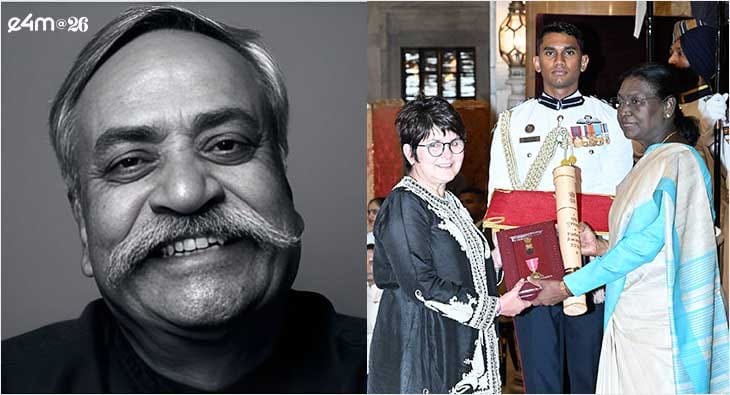

- Piyush Pandey, a legendary figure in Indian advertising, was posthumously awarded the Padma Bhushan, with the honor received by his wife at Rashtrapati Bhavan, symbolizing national recognition of his impact on Indian communication.
- Renowned for transforming advertising into a medium that resonated with human emotions and cultural relevance, Pandey emphasized simplicity and authenticity in storytelling, making brands relatable to everyday people.
- His campaigns, particularly for brands like Fevicol, became integral to India's cultural memory, reflecting the realities and aspirations of the nation while fostering a deeper connection between brands and consumers.
- Despite his global acclaim, Pandey remained grounded and focused on honesty in his work, leaving behind a legacy that continues to inspire future generations in the advertising industry.
The posthumous conferment of the Padma Bhushan on legendary advertising icon Piyush Pandey at Rashtrapati Bhavan is not merely a national honour for an extraordinary creative professional — it is an emotional moment for an entire generation that grew up watching India speak through his ideas.
For decades, Piyush Pandey was not just the face of Indian advertising; he was its heartbeat. He transformed advertising from polished corporate messaging into something deeply human, rooted and emotional. Long before the industry began discussing “vernacular storytelling,” “cultural relevance” or “Hinglish communication,” Piyush Pandey had already shown the country how powerful advertising could become when it spoke the language of real people and real emotions.
But to describe his brilliance simply as “thinking in Hindi” would be reducing the depth of his genius. Language was only his medium. His true gift was his ability to identify simple human truths and convert them into unforgettable stories that instantly connected with millions across India.
His campaigns never felt manufactured. They felt lived.
Whether it was humour, warmth, relationships, aspirations or everyday struggles, Piyush Pandey had an unmatched ability to observe India closely and reflect it honestly through brands. That sharp power of observation made him one of the rare creative minds who could instantly judge the pulse of the market and understand what would genuinely resonate with people beyond boardrooms and advertising awards.
He believed that the biggest ideas were often the simplest ones.
At a time when Indian advertising still leaned heavily towards western styles and urban sophistication, Piyush Pandey brought authenticity and Indian emotion back to the centre of storytelling. He made brands sound like people. Relatable, warm, conversational and memorable.
His influence on Ogilvy India and the advertising industry at large remains immeasurable. Under his leadership, advertising stopped speaking at consumers and started speaking with them. The campaigns he created became part of India’s cultural memory because they were not merely advertisements — they were emotions wrapped in storytelling.
Among the many iconic brands associated with him, Fevicol remains one of the strongest examples of his creative legacy. Even more touching was the recent tribute by Ogilvy and Fevicol celebrating the making of the final “Khurshi” film that Piyush Pandey had conceptualised before his passing last year.
That campaign carried immense emotional weight for the advertising fraternity because it represented not just another commercial, but the continuation of a creative vision left behind by a master storyteller. It reminded the industry that while creators may leave, their ideas continue to inspire and live on through generations.
What made Piyush Pandey even more respected was the fact that despite his global recognition and legendary status, he remained remarkably grounded and hands-on. People who worked with him often spoke about his simplicity, humility and his deep connection with ordinary India. He never chased complexity for the sake of appearing intellectual. He chased honesty.
And perhaps that is why his work touched so many hearts.
The moment became especially emotional when the prestigious Padma Bhushan was received by his wife, Neeta Joshi, on his behalf at Rashtrapati Bhavan. It was a reminder that India was not only honouring an advertising icon, but celebrating a creative force that changed the voice of Indian communication forever.
Piyush Pandey did not simply create advertisements.
He created memories, conversations and emotions that became part of everyday Indian life.
And even today, long after the campaigns fade from television screens, the warmth, humanity and truth in his storytelling continue to live on.
That is the legacy of a legend.
That is the legacy of Piyush Pandey.
Read more news about Internet Advertising India, Marketing News, PR and Corporate Communication News, Digital Media News, Television Media News
For more updates, be socially connected with us onInstagram, LinkedIn, Twitter, Facebook YouTube & Google News
