Negative Reach: Advertising’s next big problem?
Omnicom Media’s “negative reach” thesis signals a shift—where overexposure erodes impact, raising questions around content evolution, flawed metrics and frequency fatigue
 by
by
Published: Apr 27, 2026 8:35 AM | 8 min read
 Follow Us

- A new study by Omnicom Media India challenges the traditional advertising principle that repetition enhances recall, introducing the concept of "negative reach," where excessive ad exposure irritates consumers and diminishes brand impact.
- The report highlights that in today's digital landscape, consumers frequently see the same ads across platforms, leading to irritation rather than reinforcement of brand messages, particularly due to performance-driven media buying practices.
- It calls for a shift in advertising strategies from maximizing exposure to optimizing effective reach and attention quality, emphasizing the need for better targeting and reduced ad duplication.
- The study suggests that the current media environment requires adaptive frequency management and a reevaluation of effectiveness metrics, as excessive frequency can lead to consumer fatigue and brand aversion.
For decades, advertising has operated on a simple premise: the more often consumers see a message, the more likely they are to remember it. A new study by Omnicom Media India challenges that assumption, arguing that repetition—once a cornerstone of effectiveness—may now be undermining it.
In its latest report, Why Frequency Matters: Combating Negative Reach, the network introduces the concept of “negative reach,” where excessive exposure begins to irritate consumers and erode brand impact.
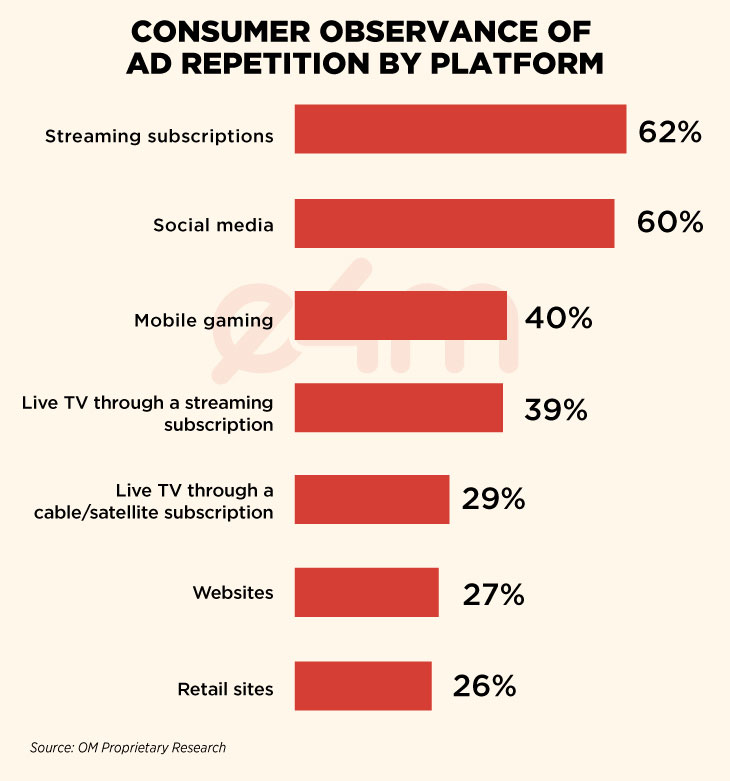
The study finds that in today’s platform-heavy ecosystem, a majority of consumers encounter the same ad multiple times within short timeframes, particularly across streaming and social platforms. Instead of reinforcing recall, this overexposure can trigger irritation—and in some cases, become counterproductive.
The report attributes this to performance-led media buying, where algorithmic systems prioritise conversion signals and concentrate delivery on a narrow set of high-propensity users. While this may optimise short-term outcomes, it limits audience expansion and creates duplication across platforms. As a result, traditional metrics such as reach and impressions risk overstating effectiveness, masking the gap between delivered volume and actual incremental impact.
In response, the report calls for a shift in planning frameworks—from maximising exposure to optimising effective reach and attention quality. Managing frequency, reducing duplication and diversifying audience pools will be critical in restoring balance. In an increasingly fragmented ecosystem, the challenge is no longer just to deliver ads, but to ensure that exposure enhances rather than erodes consumer experience and brand value.
From Effective Frequency to Excess Frequency
The idea of optimal frequency is not new. Traditional media planning has long relied on thresholds—often pegged between three and seven exposures—to balance recall with efficiency. However, these benchmarks are proving less reliable in a fragmented media environment, the study points out.
“Effectiveness today is far more contextual, shaped by platform dynamics, audience behaviour and creative quality. In some cases, wear-out can begin after just a few exposures, especially in high-frequency environments such as connected TV, where ad loads are limited but repetition is high. The result is a narrowing margin between optimal exposure and overexposure—turning frequency from a lever of amplification into a potential source of inefficiency,” the report notes.
Content Has Evolved. Advertising Hasn’t Kept Pace
As content across OTT and creator platforms becomes sharper, more immersive and personalised, advertising is no longer benefiting from adjacency—it is competing directly for attention. In that context, repetition without relevance is increasingly being rejected rather than recalled, industry experts share.
Advertising has always had a shelf life—there’s a point beyond which repetition starts irritating consumers, says Virat Tandon, Founder and CEO of Curativity, marketing services platform, adding, “Earlier, ads could ride on the back of content, but today content—from OTT to creators—has become far more engaging and superior in quality. Advertising hasn’t kept pace. Hence, consumers find most ads misplaced and irritating.”
His observation captures a broader structural shift in the attention economy. Anything that feels intrusive, repetitive or out of sync risks immediate rejection.
“The consequence is not just lower recall, but a widening disconnect between media exposure and meaningful engagement,” quips Tandon.
Finding the Optimal Threshold
At the heart of the issue is the changing structure of the media itself. The proliferation of connected TV, walled gardens and privacy-led restrictions has weakened identity resolution across platforms. As a result, advertisers are often unable to track unique audiences effectively, leading to duplication and uneven distribution of impressions.
The study highlights that consumers are more tolerant of ads encountered across different platforms than repeated exposures within the same environment—a nuance with significant implications for media planning. Without unified frequency management, campaigns risk clustering impressions among a narrow set of users while missing others entirely.
Asif Mulla, Chief General Manager of Khushi Advertising, illustrates the problem with a simple example. “While binge-watching a series on a popular OTT platform, I’m hit with the same sunscreen ad every 15 minutes—same brand, same creative, same faces—with no relevance to me,” he says. “It’s pure wastage of impressions and builds frustration.”
He argues that the issue is not just frequency, but poor targeting. “Show me a gimbal ad instead—I’m actively looking to buy one. Impressions may be cheap, but agencies need to be far more mindful of how they spend client budgets. Smarter targeting and varied personas are essential.”
The fallout, he warns, is immediate. In an attention-constrained environment, overexposure leads to irritation and even brand aversion. “Bombarding the same message creates negativity to the point where you may avoid the brand altogether,” he says. “We once worked with a frequency of three for effective recall. Today, it feels like 300.”
Mulla adds that while digital attention spans are shorter, the answer is not higher frequency but better calibration. “There has to be an optimal threshold. Beyond that, it’s just ad fatigue. The only way forward is to use multiple creatives and avoid repeating the same message endlessly.”
When Metrics Become the Problem
If frequency is the symptom, some argue the real problem lies deeper—in the way effectiveness itself is measured.
Arvind Krishnan, Co-founder and Chief Executive Officer at Manja, an advertising agency, argues that “negative reach” goes beyond traditional ideas like ad wear-out or frequency fatigue. “Those terms either blame the creative, the audience, or reduce the issue to economics. Negative reach blames the metric itself,” he says.
He explains that every ad is designed to leave an impression—but that impact is inherently fragile. “The third time you hear a joke, it stops being funny. The fifth time, it starts to feel hollow,” he notes.
In an ecosystem driven by algorithmic media buying, frequency has lost its sense of rhythm. “Algorithms optimise for delivery, not for when an idea has been spent. When that happens, the media stops amplifying creativity and starts cannibalising it. At that point, we are no longer building brands—we are building fatigue,” explains Krishnan.
An Old Challenge, Reimagined
The tension between reach and frequency is not new. It dates back to the era of linear television, when planners worked within relatively predictable viewing patterns. What has changed is the speed and scale at which frequency now accumulates.
Programmatic buying and algorithmic optimisation have made it easier to deliver impressions at scale—but not necessarily to distribute them efficiently, industry experts say. “In a fragmented, multi-platform environment, campaigns can quickly oversaturate the same audience pockets, often without real-time visibility, amplifying the risk of negative reach,” an ad executive of a global agency shared.
This becomes even more relevant as advertisers across the globe shift budgets towards digital and streaming platforms, where measurement remains fragmented and standardisation is still evolving. The challenge today is no longer just about reaching audiences—it is about reaching them the right number of times.
Precision Over Volume
The implications of this shift are both tactical and philosophical. The report calls for a move away from static frequency caps towards more adaptive, cross-platform strategies that prioritise audience-level planning over channel-level optimisation.
More broadly, it reflects a shift in how effectiveness itself is defined. As marketing becomes increasingly performance-driven, the focus is moving from maximising impressions to optimising user experience and outcomes. In that context, excessive frequency is not just inefficient—it can be counterproductive.
Industry executives say this aligns with a wider reset underway in media planning. With rising costs and tighter scrutiny on ROI, advertisers are being forced to rethink long-held assumptions. “It’s no longer about how many impressions you can buy, but how intelligently you can distribute them,” says an agency executive.
Why This Matters Now
The timing of the report is significant. As brands navigate economic uncertainty, evolving consumer behaviour and growing pressure to justify spends, inefficiencies in media planning are coming under sharper focus. Frequency—once treated as a secondary metric—is now emerging as a critical determinant of effectiveness.
The idea of “negative reach” reframes a fundamental question for marketers. Is advertising losing effectiveness because audiences are overexposed—or because it has failed to evolve alongside the content it surrounds?
In an ecosystem defined by algorithms, fragmentation and attention scarcity, the answer likely lies in both. More exposure no longer guarantees more impact. Increasingly, it risks doing the opposite.
Read more news about Internet Advertising India, Marketing News, PR and Corporate Communication News, Digital Media News, Television Media News
For more updates, be socially connected with us onInstagram, LinkedIn, Twitter, Facebook YouTube & Google News