Digital is now 'table stakes'; differentiation lies in trust: Pidilite MD Sudhanshu Vats
At e4m TechManch, Sudhanshu Vats, MD, Pidilite Industries, said marketers need to look beyond technology-led differentiation and focus on building enduring brands rooted in trust and relevance
 by
by
Published: Jul 27, 2026 6:48 PM | 4 min read
 Follow Us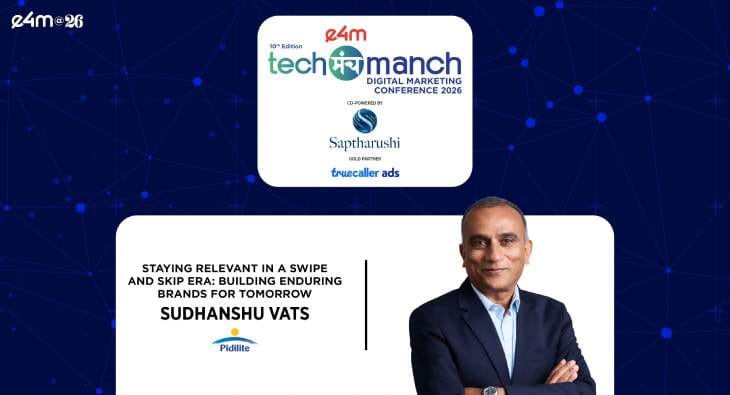

- Sudhanshu Vats, Managing Director of Pidilite Industries, emphasized at the TechManch conference that digital capabilities are becoming standard in marketing, urging marketers to prioritize building enduring brands based on trust and meaningful consumer connections rather than solely relying on technology for differentiation.
- Vats highlighted the need for marketers to adapt to the changing consumer journey, where awareness, consideration, and purchase occur simultaneously, and to focus on creating engaging content that captures consumers' attention rather than conforming to short formats.
- He discussed the importance of influencer ecosystems, noting that professional users of Pidilite's products serve as key advocates, and emphasized the role of first-party data in fostering consumer communities for long-term brand engagement.
- Vats concluded by stressing that while content creation has become easier due to AI, building trust remains a significant challenge for brands, advocating for a focus on credibility and lasting relationships over fleeting metrics.
As artificial intelligence reshapes business and marketing, digital capabilities are becoming a baseline rather than a source of competitive advantage, according to Sudhanshu Vats, Managing Director, Pidilite Industries. Speaking at exchange4media's TechManch, Vats said marketers need to look beyond technology-led differentiation and focus on building enduring brands rooted in trust, relevance and meaningful consumer connections.
Addressing the conference theme around staying relevant in a "swipe and skip" era, Vats argued that while AI and digital technologies are transforming the marketing landscape, the core responsibility of marketers remains unchanged.
"The era may be swipe and skip, but our job as business builders, as brand builders, as marketeers, is always to build enduring brands, endearing brands. Digital and technology are becoming hygiene and table stakes. They are unlikely to deliver differentiation,” he said.
Vats began his keynote by reflecting on how AI, climate change and geopolitical developments have reshaped the world in just a few years. While acknowledging the unprecedented pace of change, he said he remains optimistic, comparing the current AI wave to earlier technological revolutions such as the steam engine, electricity and the internet, all of which ultimately advanced human progress.
He maintained that while technology will continue to evolve, the fundamentals of brand building remain constant.
Vats further urged marketers to focus on relevance, storytelling and consumer value rather than relying on any single platform or format.
Challenging the widely discussed narrative around shrinking attention spans, he argued that consumers are not unwilling to spend time with content but are unwilling to waste it.
According to Vats, this shift in perspective should influence how brands approach creativity. Rather than assuming every campaign must be compressed into a few seconds, brands should focus on creating content that earns consumers' attention.
To illustrate the point, he showcased several campaigns from Pidilite's portfolio, including Fevicol's long-format advertisements. Referring to one of the brand's earlier campaigns, he said it generated significant engagement across social media despite industry scepticism around long-form advertising.
He also cited Fevicol's recent 60-second IPL commercial, recalling that broadcasters initially questioned airing a minute-long advertisement during the tournament because such formats were uncommon. The campaign, he said, remained rooted in the brand's signature blend of humour, storytelling and cultural relevance.
Vats also demonstrated how different brands within Pidilite's portfolio require different communication strategies. While WD-40 relied on short, product-led digital creatives, Fevikwik's AI-powered QuickGPT campaign encouraged users to create AI-generated creative outputs through an interactive platform, driving large-scale consumer participation around the idea of instant creativity.
Summarising this approach, Vats said there is no universal creative formula for marketers.
He added, "there is no one format that wins. It's basically only the format that fits the context."
Another major theme of his address was the changing consumer journey. According to Vats, the traditional linear marketing funnel has collapsed, with awareness, consideration and purchase increasingly happening simultaneously as consumers remain constantly connected across digital platforms.
Instead of treating these as sequential stages, he said marketers now need to build awareness, consideration and purchase intent in parallel while remaining focused on the fundamentals of brand building.
Vats also highlighted the growing importance of influencer ecosystems beyond social media creators. Drawing on Pidilite's business model, he said the company's strongest influencers have long been its professional users, including carpenters and plumbers, who advocate for its products through everyday use.
He added that the company is increasingly using AI to make such communication more scalable by enabling multilingual content with local language adaptation.
Highlighting the role of data in modern marketing, Vats described first-party data as central not only to marketing but to business growth. He said building consumer communities enables brands to strengthen long-term relationships, citing Pidilite's art and craft ecosystem as an example of how communities can drive sustained engagement.
In conclusion, Vats said trust would become even more important as AI makes content creation increasingly accessible to everyone.
While creating content has become easier, he argued that building credibility remains significantly harder and will become increasingly important for brands.
He said, "Content has become easier to create. Everybody is a content creator. But it's building trust which is harder, and trust takes time to build." Vats added that, much like Pidilite's philosophy that strong bonds take time to build but last forever, brands too must invest in building lasting trust.
Vats concluded by urging marketers not to get carried away by swipes, skips and measurement metrics, but instead focus on building credibility, belief and trust while expressing hope that India continues to build brands for the world.
Read more news about Marketing News, Advertising News, PR and Corporate Communication News, Digital News, People Movement News
For more updates, be socially connected with us onInstagram, LinkedIn, Twitter, Facebook, YouTube & Google News