Consumer First. Channel Second
Vinod Thadani, CGO, Dentsu Media Group & CEO, iProspect, speaks with Shripad Kulkarni on the death of demographic planning, the rise of behavioural signals — and why the brief must now decide the mix
 by
by
Published: May 29, 2026 8:52 AM | 8 min read
 Follow Us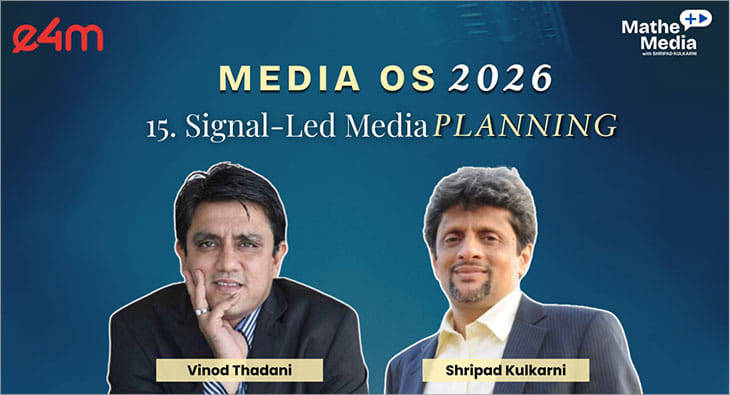

- The traditional demographic-based advertising approach, focusing on age, gender, and location, is being replaced by more precise behavioral signals that reflect consumer preferences and behaviors.
- The shift to a mobile-first market has led to the development of an integrated Audio-Visual (AV) planning strategy that encompasses linear TV, connected TV, and mobile platforms, aligning with how consumers interact with media.
- The advertising mix is evolving, with many brands now allocating a higher percentage of their budgets to digital platforms, particularly in sectors like Direct-to-Consumer (D2C) and Banking, Financial Services, and Insurance (BFSI).
- The industry faces challenges in measurement and accountability, as there is currently no comprehensive method to trace the effectiveness of spending across different media channels, highlighting the need for collaboration within the advertising ecosystem.
There is a brief that used to work.
Twenty-five to forty. Metros only. Gender: female. Category: FMCG. Medium: television. GRPs: as many as the budget allows.
For a long time, that brief was the job. You filled in the boxes, you ran the numbers, you bought the spots. The plan looked clean on paper because the world it described was clean — or at least clean enough.
That world is gone.
“Gone are the days where it’s 25 to 40 only metros, gender only female. Currently, you don’t need those things. Let me actually tell you where the consumer is.”
— Vinod Thadani
People Are Not Demographics. They Are Signals.
The old demographic boxes did not break down because the data stopped working. They broke down because something better replaced them. The consumer left a trail — and that trail is far more precise than any age-gender bucket ever was.
“You can do audience cohorting. You can actually size the audience by the kind of handset, the year of handset she has, the travel history, international or not, the kind of transaction history the person is doing. You have an affluent audience there. Or you can also talk basis content preferences.”
A handset vintage is a proxy for income. Travel history is a proxy for aspiration. Transaction data is purchase intent, made visible. Content preferences signal category interest before a single ad is served.
Age, gender, SEC was working with an approximation. The planner who builds on behavioural signals is working with the actual person. That shift — from demographic assumption to behavioural signal — is the foundation of everything that follows.
The Consumer Moved. The AV Plan Followed.
The consumer did not wait for the industry to catch up. She moved to mobile. She moved to connected TV. They scroll and stream and search and shop — sometimes on the same screen, sometimes across three. The idea that a single channel plan could capture that arc stopped being defensible some time ago.
The response, at iProspect, is not a new channel strategy. It is a new planning philosophy.
“We’re talking about an AV plan. We don’t talk about a connected TV plan or a linear TV plan or a fast plan. We talk about an AV plan. It’s because India is now a mobile-first market. The affordability, accessibility, content — everything is on the device. We firmly believe we need to see it from a consumer’s lens and hence AV planning is something which we always present to the client.”
The AV Plan does not choose between linear, CTV, and mobile. It plans across all three as a single surface — because the consumer does not experience them as separate. The channel follows the consumer. Not the other way around.
The Brief Is the Brief
Once you start from the consumer and the signal, the brief rewrites itself. Every category has a different objective. Every objective has a different funnel moment. Every funnel moment has a different media configuration. And messaging and media must be in complete synch.
“From an agency’s perspective, we need to start from the consumer at the centre and see how we can maximise reach. Hence the AV plan — because consumers today behave completely differently on different platforms. If it’s an FMCG Plan, an Automobile plan, BFSI Plan, I think all of them are looking at an audience which are today or tomorrow going to buy their product. So, you also need to plan for the right number of leads or purchases. And we have seen that people today are behaving differently on different platforms. To top it all, the reach creative and the shoppable creative are different.”
BFSI wants leads. FMCG wants purchase timing. An automobile brand wants consideration. A D2C brand wants conversion today. Each brief points to a different moment. Each moment points to a different media configuration. And, in synch with the creative. The planner who arrives at the meeting with a pre-built plan has already made the wrong first move.
This sounds obvious. It is not yet standard practice.
The Mix Has Already Flipped
The consequence of brief-led planning is visible in the numbers. The 70-30 rule — seventy percent television, thirty percent digital — was the settled wisdom of FMCG media for years. Then it shifted to 50-50. Then it crossed over.
“I in fact see on certain categories it’s 70-30 - 70% digital and 30% linear media — because of the bottom of the funnel, because of outcome-based marketing, because of e-commerce. For D2C brands it was actually 100-0 or 90-10. I’m talking 90 to 100 towards digital.”
The D2C brands that launched in the last five years did not inherit a TV habit. They built their entire customer acquisition architecture on digital. Now, as they scale, they rediscover the need for mass reach — and begin to reintroduce linear. But the starting point is no longer television.
For BFSI, the logic is different, but the direction is similar.
“There are certain BFSI clients which are 70-30 or 80-20 on digital because it allows you to do segmenting, targeting, hyper personalisation — it allows you to give leads, and now with AI, it allows you to actually replace your call centre agent.”
The formula is dead. The brief decides the mix, every time.
The Regional Economy Is the Next Frontier
Scale is not just a Hindi-market game anymore. Brands are asking for the top five, top seven, top ten micro and nano influencers in every priority market — Bihar, West Bengal, Maharashtra, South India. The creator economy at the regional level has arrived.
“This is an economy which is here to stay. Lots of our brands are now looking at micro, macro, nano influencers. With, say, a Bihar following of 3 million — that’s a huge following with solid local connect right?”
And the regional influencer’s job is no longer just awareness. Commerce has entered the creator economy at the regional level.
“They will tell you — if you want to try this pack, take this discount, click here. So that’s also kind of e-commerce — or what they call social commerce, nicely being bundled.”
The reach and the transaction are converging at the regional, local level. That is not a future trend. It is already the present.
But Where Is the Proof?
Here is where the honest admission has to be made. The AV Plan is the right architecture. The measurement to prove it — to draw a clean line from every rupee spent to every unit sold across linear, CTV, and mobile — does not fully exist yet.
“From a full funnel when we are talking about mass to bottom of the funnel — can I actually map the entire flow? You invested a hundred dollars on television and a hundred on digital. Is the total revenue traceable to 200 dollars? The answer is no. There are lots of breaks in measurement. I don’t have one view on digital. There are walled gardens.”
The plan is ahead of the proof. That gap is the industry’s most consequential open problem. And it will not be solved by any single advertiser, agency, or publisher working alone.
“It’s not about only the advertisers, agencies or publishers. It’s about the entire ecosystem sitting together and saying — what should be that sweet spot about measurement? We are only going to grow. And if they don’t come together, they will lose that.”
The Future: One DSP, One View, Performance Everywhere
The near horizon has three features, says Vinod — and all three point in the same direction: more integration, more accountability, more precision.
The first is consolidation of buying.
“What will happen is on one platform, on one DSP, you could actually buy linear, CTV, mobile.”
When linear, CTV, and mobile all live on a single platform, the incremental reach curve becomes visible for the first time. The measurement gap begins to close.
The second is the evolution of the influencer contract.
“Currently we are talking about influencers getting paid when they are showcasing your product. But what if we talk about performance-based influencers? That’s another model which we will come up with.”
Flat fees give way to outcome-linked models. The influencer becomes part of the performance stack.
The third is personalisation at scale.
“It’s about getting mass production with hyper personalisation. When we get into vernacular and talk about different kinds of creatives for the same audiences — that’s something which is gaining a lot of traction.”
Brief first. Consumer next. Then the Channel. Message completes the arc. It is the only approach that makes sense in a market where the consumer has already moved, the measurement is still catching up, and the planner who can hold all of it together is still being built.
The ones who get there first will not be the ones who filled in the most boxes. They will be the ones who stopped filling boxes altogether.
Vinod Thadani is a contributor to the Media OS 2026 Report, examining how Indian advertising is being rebuilt from the ground up. This piece has been curated by Shripad Kulkarni based on the conversation for the MatheMedia Podcast Series.
Read more news about Marketing News, Advertising News, PR and Corporate Communication News, Digital News, People Movement News
For more updates, be socially connected with us onInstagram, LinkedIn, Twitter, Facebook, YouTube & Google News