Performance gets you to 100. Only brand will take you to 1000
Pawan Sarda, Marketing & Sales Leader, in conversation with Shripad Kulkarni on why the performance obsession is scary — and why the 1-to-100 journey is not the same as 100-to-1000
 by
by
Published: May 12, 2026 8:33 AM | 5 min read
 Follow Us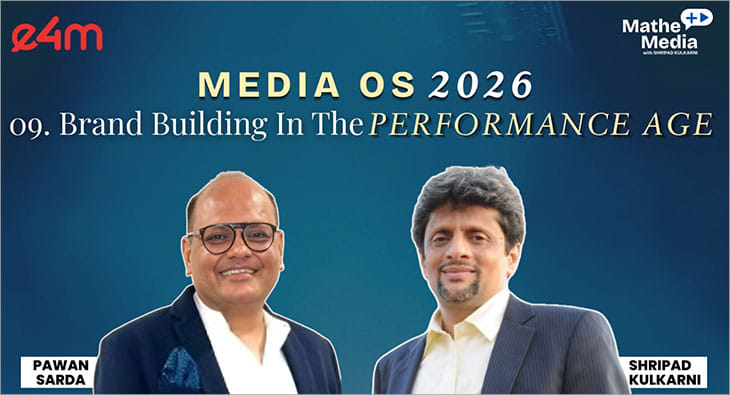

- Indian marketing is experiencing a shift towards greater accountability and performance marketing, leading to confusion among brands about their strategies and growth trajectories.
- Pawan Sarda emphasizes the importance of understanding the distinction between performance marketing as a tool and brand building as a long-term strategy, noting that brands cannot rely solely on performance metrics for sustained growth.
- The traditional consumer purchasing patterns have become more fragmented and individualistic, complicating marketing strategies that previously relied on predictable consumer behaviors.
- Authentic content and credibility are now critical for brand success in a complex market, as brands that focus solely on paid visibility risk disappearing when spending stops.
There is a shift happening in Indian marketing that most organisations are feeling but few are naming clearly. Accountability arrived. Performance marketing arrived. And the two got conflated — with consequences that are now showing up in growth curves that flatten and brands that cannot explain why.
Pawan Sarda has spent his career in retail and real estate marketing — categories where the distance between brand and sale is measured in seconds, not months. When he speaks about the performance trap, he is not speaking theoretically. He is speaking from the inside.
Marketing Now Has Skin in the Game
Not long ago, marketing life was comfortable. Four or five campaigns a year. Brand building at altitude. A seat at the table that did not come with accountability to business outcomes. That world is gone — and Pawan believes the change is fundamentally right.
“You’re no longer just about building brands at a very, very top level, but you’re also being part of the consumer moment. What is marketing skin in the game? I think that’s kind of built in here.”
— PAWAN SARDA
Marketing should be accountable. Marketing should be inside the consumer moment. That is not the problem. The problem is what happened next — when accountability arrived at exactly the same time as performance marketing, and many brands treated them as the same thing.
The result, in Pawan’s assessment, is unsettling.
“The marketeers have also got very obsessed with the whole performance and business side of things. I feel that’s scary.”
The World Beneath the Numbers
To understand why the obsession is scary, you have to look at what changed beneath the surface — not in the tools, but in the consumer.
The monthly list that structured all of FMCG planning has quietly disappeared. The housewife’s grip on the household purchase basket was the foundation of a decade of media planning. It is no longer the reality.
“Again, coming from retail, we as a marketer, we were obsessed with the monthly list of our housewife. I think it’s just gone away.”
But this is not a story of consumer simplification. Indian consumers did not become less complex. They became more individual, more fragmented, but remained culturally specific. The data misses this.
“India also has a huge amount of cultural nuance. Shopping and marketing is a big, big part of the household chore. When I go to smaller towns, I still see women dressing up and going for shopping. It’s an occasion.”
The occasion has not disappeared. What has disappeared is the predictable architecture around it. The consumer is no longer moving through a sequence that any single plan fully anticipates.
“There is no sequence in the way the consumer is exploring. Therefore, it’s very important that you need to be where the customers are.”
Authentic Content Is the Only Currency That Works
In a fragmented, non-sequential world, the question becomes: what actually travels? Not the biggest spend. Not the most targeted campaign. What travels is the most credible voice.
The algorithms, the platforms, the discovery mechanisms that now mediate between brand and consumer are — at their core — looking for the same thing. Authenticity. Credibility. A voice that feels real. Performance spend can buy visibility. It cannot manufacture either of those things.
“Authentic content is extremely important. Building brand is extremely important. That’s what will bring you that credibility.”
The system rewards authenticity structurally, by design. Brands with genuine credibility get discovered. Brands built only on paid visibility disappear when spend stops. That is the trap. And performance marketing, by design, requires the spend to never stop.
1 to 100 Is Not the Same Journey as 100 to 1000
This is where Pawan is most direct — and most precise. Performance marketing is not wrong. It is a tool. A precise, efficient, measurable tool. The danger is when it becomes the strategy.
“A performance side of marketing or a business side of things can take you to one to hundred, but it’ll never take you to hundred to thousand. Hundred to thousand will take you to the things which marketing stands for, building the brand, creating its authenticity and creating that voice. If you don’t do it, my belief is that from hundred to thousand, it’s an impossible journey.”
The brands that are stuck know this, even if they cannot say it out loud. They are optimising a metric that was never designed to take them where they need to go. The tools that built the first hundred are the wrong tools for the next nine hundred. And the quarterly accountability cycle — with its CMO tenure of thirty-two months — makes it almost impossible to make the case for the longer journey.
Brand Management Is Going to Become Sexy Again
The pendulum is swinging back. Not because performance does not work — it does, precisely and efficiently, up to a point. But because the brands that survive the next decade will be the ones that understood the difference between the two journeys and invested in both simultaneously.
“I again think the brand management is going to become sexy again and I truly believe in that.”
That belief is not nostalgia. It is a reading of where the market is heading — a world where authentic content travels, where credibility compounds, and where the consumer moment belongs to the brands that showed up consistently, not just efficiently.
The 1-to-100 journey has a thousand optimisation tools. The 100-to-1000 journey has one: the brand.
Pawan Sarda is a contributor to the Media OS 2026 Report, examining how Indian advertising is being rebuilt from the ground up. This piece has been curated by Shripad Kulkarni based on the conversation for the MatheMedia Podcast Series.
Read more news about Marketing News, Advertising News, PR and Corporate Communication News, Digital News, People Movement News
For more updates, be socially connected with us onInstagram, LinkedIn, Twitter, Facebook, YouTube & Google News