Colgate’s Gunjit Jain on building an oral care health tech brand
At the e4m India Brand Conclave, Gunjit Jain, Executive Vice President Marketing, Colgate-Palmolive India, shared how Colgate was using AI, digital commerce and creating a product services loop
 by
by
Published: Feb 12, 2026 8:55 AM | 5 min read
 Follow Us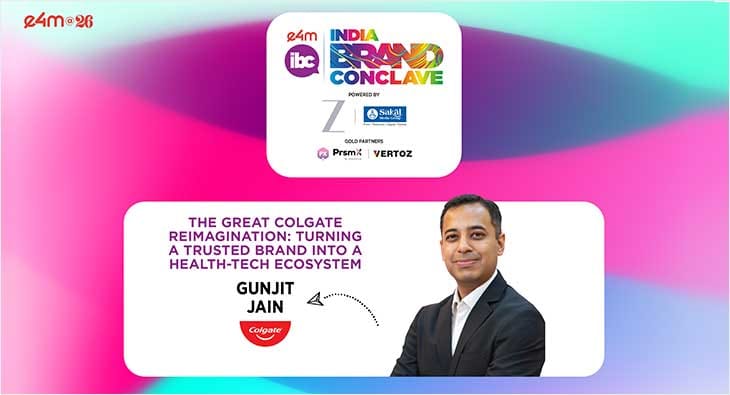

A 100 per cent category penetration, 1.2 billion users and 9 out of 10 Indians brushing first thing in the morning - Colgate’s footprint is unmatched, asserted Gunjit Jain, Executive Vice President Marketing, Colgate-Palmolive India, as he took stage at the e4m India Brand Conclave held in Mumbai on February 11.
“There is no other brand in this country which is more penetrated than Colgate is.”
Gunjit Jain outlined how the 89-year-old oral care major is repositioning itself from a toothpaste brand to what he called “India’s number one oral care health tech brand”.
Addressing a large audience at the e4m conclave, Jain set the context with Colgate’s scale and legacy. “We represent an organization which has been entrenched truly in the heart of this country for the last 89 years with one single mission of helping improve India’s oral health and beauty,” he said.
“Whether it’s the billionaires of Bombay or the businessmen of Bareilly… we are dentist-recommended, we are trusted by mothers,” Jain continued.
Yet, beneath the scale lies a structural challenge. Despite near-universal toothpaste access, oral health indicators remain weak. Jain pointed out that 80 per cent of urban Indians brush only once a day, 55 per cent of rural Indians brush occasionally, and nine out of 10 Indians suffer from at least one oral care issue. Only one in 10 visited a dentist in the last year, largely in moments of acute pain.
“The business challenge for us as market leaders is how do you nudge people to move from reactive repair to proactive care,” he said.
AI as a utility, not a gimmick
Colgate’s answer has been an AI-led diagnostic tool embedded directly on its packs. Consumers scan a QR code, answer a few questions, upload three images of their mouth and receive a personalised dental screening report via email or WhatsApp. The report flags risk across cavities, gums and stains, and connects users to one of 55,000 partnered dentists by pin code for a free consultation.
Within three months of launch, 4.5 million Indians across nearly 100 per cent of pin codes completed screenings. One in six went on to consult a dentist.
“The lesson is simple. If you remove friction and you provide free utility, behaviors can change,” Jain noted. “Here the consumers got a free dental screening report and a consultation with the dentist while sitting at home.”
For marketers, however, the deeper story lies in data. At a cost of roughly 30 cents per screening, Colgate built a first-party health data pool of 4.5 million Indians, unlocking what Jain described as “millions of dollars of lifetime value”.
From national heat maps to pin code precision
The screenings revealed that 73 percent of Indians are at risk of at least one oral problem. Forty-four percent are at risk of gum issues, 41 percent cavities and 14 percent stains. Crucially, the data is now mapped at state and pin code levels.
“UP is a hotbed for stains. Odisha is a hotbed for cavities. Gujarat is a hotbed for gum problems,” Jain shared. In Mumbai’s Santa Cruz, stain risk is twice the city average due to higher tobacco consumption, while in Powai, where over 80 percent brush twice daily, risk loads are a quarter of the city average.
This granularity, he said, drives sharper innovation, communication and on-ground execution.
Rewiring the consumer journey
Colgate has also activated this data across digital commerce. In partnership with Amazon through data clean rooms, high-risk gum consumers are served Colgate Perioguard ads, while others see Colgate Total. The same logic applies across search, display and performance media, extending to Meta and Google.
“It is these kinds of consumer journeys which have become so personalized,” Jain said, adding that the work has been recognised globally, including at Amazon’s US headquarters.
Beyond acquisition, the brand is building what Jain described as “the first of its kind oral health tech CRM program”. Machine learning-curated cohorts are nudged to brush twice daily, replace toothbrushes more frequently and upgrade to condition-specific products. The objective is dual: improved oral health outcomes and category premiumisation.
“As habits improve, category value improves. As people buy superior products, there is premiumization. As people move from products to a regimen, there is AOV to be unlocked,” he explained.
The product-services loop
Drawing parallels with consumer tech, Jain described Colgate’s emerging “product services loop”. Consumers buy the hardware, access free diagnostic services, receive personalised nudges and eventually upgrade within the ecosystem, much like smartphone users upgrading devices and paid services.
“Isn’t this very similar to consumer tech companies?” he asked. “A product services loop, not only for consumer tech companies, but now also for Colgate.”
Closing his session, Jain reiterated the brand’s expanded ambition: “I represent Colgate, India’s number one oral care brand. I represent Colgate, India’s now number one oral care health tech brand.”
For the marketing and advertising ecosystem, the takeaway was clear: even the most penetrated heritage brands can unlock new growth by fusing utility, data and technology into a seamless consumer experience.
Read more news about Marketing News, Advertising News, PR and Corporate Communication News, Digital News, People Movement News
For more updates, be socially connected with us onInstagram, LinkedIn, Twitter, Facebook, YouTube & Google News