#e4mExclusive: Bigger sample won’t fix TRPs: AAAI Chief Srinivasan Swamy flags rising costs, low gains
Srinivasan Swamy, Executive Group Chairman of RK Swamy, talks to e4m on global consolidation, measurement challenges, growing role of tech and a host of other developments in the ad industry
 by
by
Published: Apr 13, 2026 9:20 AM | 10 min read
 Follow Us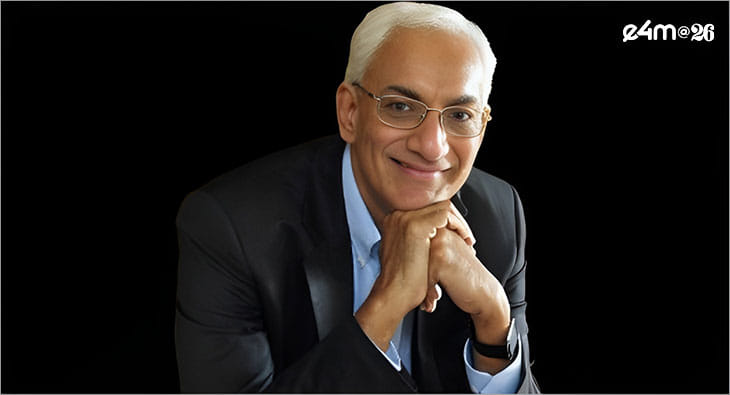

In an industry witnessing the steady unraveling of long-standing client-agency partnerships, Srinivasan Swamy, Executive Group Chairman of RK Swamy and President of the Advertising Agencies Association of India, argues that the churn is less about declining capability and more about shifting power centres within client organisations.
In this conversation with e4m, Swamy unpacks how leadership changes, creative fatigue, and the evolving expectations of marketers are reshaping agency dynamics—while also weighing in on global consolidation, measurement challenges, and the growing role of technology in redefining the future of advertising.
R K Swamy on reverse auctions - First Part
Excerpts from the conversation:
We’re seeing several long-standing client-agency relationships come to an end. What’s driving this churn in the industry?
The fundamentals of the business haven’t really changed. At its core, advertising remains a relationship-driven industry where proximity to the client and responsiveness to their needs are critical. What has changed, however, is the composition of decision-making teams within client organisations.
In most cases, when you see a long-standing agency losing a client, it is not because the agency has suddenly become less competent or incapable. It is typically because a new leader has taken charge on the client side. With that change comes a shift in perspective, priorities, and often, a preference for working with partners they are already familiar with.
This is a very human dynamic. People tend to trust those they have worked with before, especially in a business where outcomes are subjective and require a high degree of confidence in the partner’s thinking. Therefore, agencies must continuously invest in building relationships across multiple levels within a client organisation—not just with the current leadership, but with emerging stakeholders as well.
If you fail to do that, even a strong legacy relationship can be disrupted overnight.
Does that mean the agency ecosystem is increasingly becoming a ‘relationship game’ rather than one driven by innovation and capability?
I wouldn’t reduce it to just a relationship game. Relationships in our industry are built on trust, and that trust is anchored in perceived competence. Clients don’t choose partners only because they like them—they choose them because they believe those partners can deliver results.
At the same time, there is another important dimension: fatigue. In long-term partnerships, there can sometimes be a sense of creative stagnation. The agency and client may get too comfortable with each other, leading to a situation where new ideas are not emerging as strongly as they should.
When a new decision-maker comes in, they often seek fresh thinking, new approaches, and a different lens on the business. That desire for change, combined with existing relationships elsewhere, can trigger a shift.
So yes, relationships matter—but they are deeply intertwined with trust in capability, the need for fresh ideas, and the evolving expectations of clients.
How do you view global consolidation moves like the IPG–Omnicom merger? What does it mean for clients and agencies?
These mergers are largely financial decisions. They are driven by the need to improve profitability, optimise costs, and deliver better returns to shareholders.
If you look at the mechanics of such mergers, the immediate focus is on eliminating duplication—whether that is in leadership roles, administrative functions, or operational infrastructure. Expensive senior positions are rationalised, and economies of scale are pursued aggressively.
However, from a client servicing perspective, I don’t believe these mergers inherently create better outcomes. In fact, they often introduce uncertainty. Clients may worry about continuity, changes in teams, or potential conflicts of interest.
So while these consolidations may make sense from a balance sheet standpoint, they don’t necessarily translate into improved client experience. In many cases, clients are actually unsettled by such developments.
Does this disruption open the door for independent or boutique agencies?
It certainly can, although not always immediately. The first and most visible impact of consolidation is on talent. When large organisations merge, there is inevitably some level of restructuring, which results in experienced professionals becoming available in the market.
Many of these individuals, especially those with strong client relationships and proven track records, choose to set up boutique agencies. These smaller firms operate with lean teams, lower overheads, and a sharper focus on specific client needs.
From a client’s perspective, such setups can be very attractive. They offer senior-level attention, agility, and often more cost-effective solutions. As a result, clients may begin by allocating a portion of their business to these boutiques before making larger shifts.
We are already seeing a steady stream of such agencies emerging, and I believe this trend will continue.
Have you seen any direct business gains at RK Swamy due to this churn?
Not in a dramatic sense, at least not yet. The immediate fallout of consolidation is more visible on the talent side rather than client movement.
There is definitely a larger pool of experienced professionals available in the market today. However, we are being cautious in our hiring approach because the broader market conditions are not particularly buoyant.
Client shifts tend to lag behind organisational changes. They take time to materialise, as clients evaluate their options carefully before making decisions.
What is your perspective on the recent developments around TV ratings and measurement systems?
The ratings system has always had its limitations, particularly when it comes to certain segments like English news channels, where the sample size is relatively small. This naturally raises questions about statistical robustness.
That said, the temporary suspension of ratings does not fundamentally disrupt the advertising ecosystem. Advertisers continue to rely on historical data and established patterns to guide their decisions.
What concerns me more is the directive to significantly expand the sample size. From a statistical standpoint, experts have clearly indicated that beyond a certain threshold, increasing the sample size does not meaningfully improve accuracy. Instead, it leads to a substantial increase in costs.
So the question we need to ask is whether we are solving a real problem or simply adding complexity and expense without corresponding benefits.
With entry barriers being lowered, do you see new players entering the ratings space?
In theory, lowering financial barriers could encourage new entrants. But in practice, this is a highly capital-intensive and complex business. Beyond the initial investment, there is the question of market viability. Who will subscribe to multiple rating systems? Will advertisers and broadcasters be willing to pay for parallel data sources?
At the moment, I don’t see strong demand for multiple systems. Without that demand, it becomes very difficult for new players to sustain themselves.
Could organisations like yours - Hansa Research - consider entering the ratings business?
From a capability standpoint, yes—we have the expertise to undertake such work. We have the infrastructure, including large-scale data collection systems like computer-aided telephone interviews, which could be adapted for measurement purposes.
However, capability alone is not enough. The bigger question is whether the business is viable and whether the risks are justified.
At this point in time, we see more risk than opportunity in this space. Unless the market structure changes significantly or there is a clear mechanism to de-risk the investment, it is not an area we are looking to enter.
How do you see the future of measurement evolving, especially with digital and OTT platforms gaining ground?
The industry needs clarity and stability, not fragmentation. Historically, we have seen that multiple measurement systems create confusion rather than value.
Today, the bigger shift is not about having more systems—it’s about having better, integrated measurement. Consumption has moved beyond linear television to digital platforms, connected TVs, and on-demand content. The future lies in unified measurement frameworks that capture this entire ecosystem. That is where the industry needs to focus its efforts.
With OTT platforms publishing their own data, does that create confusion for advertisers?
It certainly has the potential to. Each platform has access to highly granular data and can present it in a way that supports its own narrative.
Unless there is a standardised methodology or third-party validation, advertisers may find it difficult to compare performance across platforms.
While OTT platforms have a technological advantage in terms of data collection, transparency and consistency in reporting will be crucial for building trust.
How is RK Swamy adapting to technological shifts, particularly AI?
We view AI not as a standalone tool, but as a foundational operating system. It is embedded across our processes and workflows, driving efficiency and enabling better decision-making.
Beyond AI, we have invested significantly in building marketing infrastructure. This includes customer experience centres, outbound engagement capabilities, and advanced CRM systems.
We have also developed voice-based solutions to complement traditional chatbots, allowing for more natural and effective customer interactions.
The idea is to create an integrated ecosystem that enhances both operational efficiency and customer engagement.
What role does a unified industry voice play in today’s environment?
The marketing communications industry is inherently fragmented, with different bodies representing advertisers, agencies, broadcasters, and other stakeholders.
The Advertising Council of India serves as a platform where all these stakeholders can come together to address issues of common interest.
It does not replace existing bodies but complements them by providing a unified voice when needed. This is particularly important when engaging with policymakers or addressing industry-wide challenges.
What have been your key priorities at AAAI since taking over as president?
When I assumed this role, the association was dealing with a complex matter involving the Competition Commission of India. My immediate priority was to stabilise the situation and ensure that the industry’s interests were adequately represented.
We have made significant progress on that front, and the matter is currently in a relatively stable phase, although we remain vigilant.
Reverse auctions continue to be a contentious issue. How do you resolve this issue?
Reverse auctions are deeply problematic. They reduce a complex, value-driven service to a price-based competition, which ultimately undermines quality.
When agencies are forced to continuously undercut each other, it becomes unsustainable. You cannot deliver high-quality work at unviable prices.
While we can advise our members to approach such situations cautiously, we cannot dictate market behaviour. Ultimately, both clients and agencies need to recognise the long-term implications of such practices.
Are advertisers becoming more price-sensitive at the cost of quality?
In certain commoditised areas, that is certainly the case. However, for high-value, strategic work, clients still recognise the importance of quality and expertise.
You cannot procure premium outcomes through a lowest-bid model. Serious clients understand this and are willing to invest accordingly.
What reforms are you driving within AAAI to strengthen the ecosystem?
One of our most significant reforms has been to make the association more inclusive.
Historically, there was a perception that AAAI was an exclusive body with high entry barriers. We have addressed this by restructuring our membership framework—reducing entry fees and introducing multiple tiers based on agency size.
This makes it easier for smaller and emerging agencies, including digital and data-driven firms, to become part of the ecosystem.
Our objective is to create a more representative and inclusive body that reflects the diversity of today’s industry.
What is your broader vision for the industry going forward?
The industry is at an inflection point. Technology, changing media consumption patterns, and evolving client expectations are reshaping the landscape.
To navigate this effectively, we need greater collaboration across stakeholders, more robust measurement systems, and a shift from commoditisation to value creation.
Ultimately, the focus must be on delivering meaningful outcomes for clients while building a sustainable and progressive industry ecosystem.
Read more news about Internet Advertising India, Marketing News, PR and Corporate Communication News, Digital Media News, Television Media News
For more updates, be socially connected with us onInstagram, LinkedIn, Twitter, Facebook YouTube & Google News