Richard Edelman on why AI Search makes earned media more critical
At Cannes Lions 2026, Edelman CEO Richard Edelman discusses AI search, earned media, trust, brand credibility and why marketers can no longer rely solely on paid visibility
 by
by
Published: Jun 24, 2026 10:11 PM | 8 min read
 Follow Us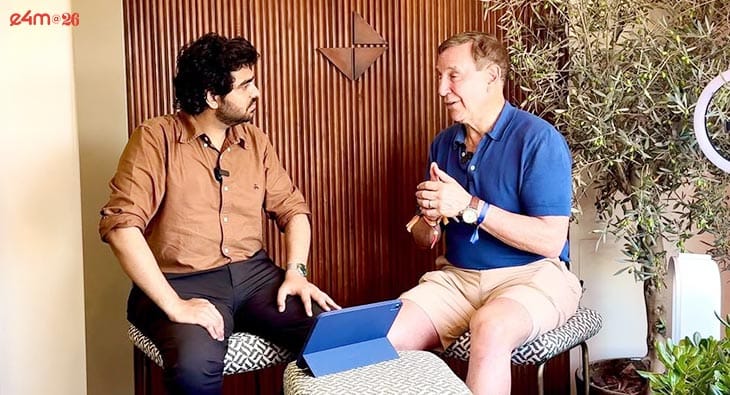

- Richard Edelman, CEO of Edelman, emphasizes a significant shift in brand strategy at Cannes Lions 2026, highlighting that brands can no longer rely solely on paid visibility but must focus on earning credibility through action and trust.
- Edelman advocates for a reallocation of marketing budgets, suggesting that earned media should constitute 20-25% of expenditures, contrasting with the traditional model that heavily favors paid media.
- He stresses the importance of localizing marketing efforts in India, urging brands to connect with local aspirations and narratives rather than relying on Westernized datasets and generic campaigns.
- Edelman notes the evolving role of creators in the marketing landscape, describing them as news creators rather than just influencers, and highlights the need for brands to adapt to the diverse and complex market of India.
This interview was originally published on MartechAI.com
Speaking to Brij Pahwa for MartechAI.com, BW Businessworld and exchange4media, Edelman said the conversation at Cannes reflects a larger change in how brands are thinking about credibility and growth.
At Cannes Lions 2026, where conversations around creativity, artificial intelligence, influence and the future of marketing are shaping the global industry agenda, Richard Edelman, President and CEO, Edelman, believes one major shift is becoming impossible to ignore: brands can no longer depend on paid visibility alone. Edelman is officially listed as CEO of Edelman, a global communications firm, and Cannes Lions 2026 is taking place in Cannes from June 22 to 26.
“What I see actually is a massive opportunity for Edelman as a communications firm because everybody is talking about earned first. It’s not paid first anymore and that’s a huge switch in mentality and also for budgets,” he said.
For Edelman, this shift is closely tied to trust. Asked why some companies are trusted more than others, even when many have existed for decades, he said the answer lies in action rather than legacy.
“I think it’s action,” he said, citing the example of eBay and its work in recommerce, where products such as sneakers are checked and warrantied for authenticity. “Trust drives growth but action earns trust.”
That view runs through Edelman’s larger argument: trust cannot be built only through messaging. It has to be backed by proof, behaviour and visible action. In a media environment shaped by journalists, creators, communities and now AI platforms, he believes brands need to earn credibility repeatedly.
The rise of large language models, he said, has made earned media even more important for communicators. As more users move from traditional search engines to AI-led discovery, the sources that shape a brand’s reputation are also changing.
“I think the most important part of AI for communicators is LLM search is driven by earned media,” he said. “Results that are in high quality publications like yours, also in owned channels from the company and finally in important social networks such as Reddit.”
He added that brands need to be present consistently across credible channels, especially because disinformation can spread quickly in the AI-led information ecosystem.
“We need to be there constantly also to make sure that when there’s disinformation that we counter it quite quickly,” he said.
For marketers, Edelman said the implication is clear. The old assumption that brands could buy their way to attention is weakening.
“I just don’t think you can buy your way forward anymore. You have to earn it,” he said.
India, according to Edelman, has a critical role to play in this new environment. During his visit to India three months ago, where he met clients in Mumbai and Delhi, he said he observed that AI search is still heavily influenced by English-language media, while Indian-language media remains underrepresented.
“I learned when I was in India three months ago visiting clients in Mumbai and Delhi that a lot of LLM search so far is driven by English speaking media. Too little from the Indian speaking media,” he said. “We really need to localize our campaigns to make sure that you’re the first people we speak to, not necessarily just the global media.”
Asked how Indian marketers can avoid being boxed into Westernised datasets and generic AI-led campaigns, Edelman said the answer lies in combining human intelligence with artificial intelligence.
“The human intelligence part of this must be tied to the artificial intelligence,” he said.
He said Indian brands need to build communication around real local aspirations and challenges. From home insurance and retirement savings to diet and lifestyle, he said India’s growing middle class is entering a stage where brands can tell stories around optimism, progress and better living.
“If you’re brands, tell Indian stories. Tell stories that are important to people who want to hear optimism and want to see how they can get ahead,” he said.
Edelman was also direct in his criticism of modern marketing’s obsession with efficiency. Asked whether marketing has become too focused on efficiency at the expense of distinctiveness, he replied, “Absolutely, yes.”
He challenged the traditional PESO model, which stands for paid, earned, social and owned, and said he prefers to think of it as ESOP: earned, social, owned and paid.
“Earned creates the runway for the paid to take off,” he said. “Earned is where you can win the people who really matter. The young creators, the people who are opinion formers, and then you can get repetition with paid.”
He also argued that budgets must change if brands are serious about earning trust.
“They can’t anymore be 5% earned, 90% paid. Mistake. It needs to be 20-25% earned, the rest paid,” he said.
For younger brands that struggle to secure earned media despite doing meaningful work, Edelman said the solution is not to talk only about the brand. Instead, the brand must find its place within a larger social or consumer story.
“I think it can’t just be about the brand itself. It’s what the brand does within the society,” he said.
He said brands should connect their product to broader trends, whether that is helping women feel better about themselves or enabling people to save for the future.
“You may only get two paragraphs about the product. That’s enough. You’re in a context that’s important,” he said.
At Cannes Lions, Edelman said the presence of Edelman House itself symbolises how the communications business has evolved. He said the fact that a communications company has a house at Cannes shows a major shift from where the industry was a decade ago.
He also pointed to a change in the creator economy. According to him, many young creators at Cannes are not simply influencers or celebrities. They are increasingly behaving like news creators.
“All these young creators who are here are news creators. They’re not just influencers and sports celebrities. They are people who are here to get news,” he said.
On India, Edelman said global business leaders often misunderstand the country by seeing it as one market. He compared India’s diversity to the regional complexity of the United States and said global brands need to appreciate the scale, languages, states and differences within the country.
He also said Edelman is setting up a content hub in Delhi because of the quality of creative work coming out of India.
“The work that comes out of your country is stunning,” he said. “We only see it India for India. Nope. India is that good that it can do for the UK or do for the US.”
He added that this is not about traditional outsourcing.
“It’s not the classic kind of outsourcing which is cheaper is better. Overnight is better. Nope. This is just better. It’s really good,” he said.
Looking ahead, Edelman said the next phase for his firm is not only about becoming more efficient through AI, but about doing better work. He said AI and content studios are expanding the canvas for communications firms and allowing them to compete in areas traditionally owned by advertising agencies.
“We now can compete with ad agencies,” he said, adding that Edelman can produce large volumes of content through studios in ways that were earlier handled by advertising agencies. “I like the broader canvas that it enables us to do.”
In a rapid-fire round, Edelman named eBay as a brand he admires, Doug McMillon of Walmart as a CEO he admires, Unilever as a company that understands trust well, United Airlines as a brand that recovered from crisis brilliantly, Microsoft as a company handling AI responsibility, Dove as a brand he trusts, India as a country global brands underestimate, Glossier as a startup he is excited about and Under Armour as an underrated brand. Walmart’s official leadership page now lists Doug McMillon as former President and CEO, with John Furner listed as President and CEO of Walmart Inc.
Asked about a career he might have chosen had he not joined Edelman, he said he may have gone into politics, public service or become a history professor.
“I don’t care so much for money but I like living well but I love American history. So that would have been fun,” he said.
His message to Indian marketers was clear and ambitious.
“I want you to be more ambitious about your marketing sector,” he said. “I think you are very oriented to India as a manufacturer now. I want you to be India as a maker. That’s a big story.”
Read more news about Marketing News, Advertising News, PR and Corporate Communication News, Digital News, People Movement News
For more updates, be socially connected with us onInstagram, LinkedIn, Twitter, Facebook, YouTube & Google News