‘The stronger AI gets, the stronger our human creativity needs to be’
John Mescall, Global Chief Creative Partner, Dentsu Creative, shares why he believes that now is the time to double down on human creativity
 by
by
Published: Jun 24, 2026 9:10 AM | 8 min read
 Follow Us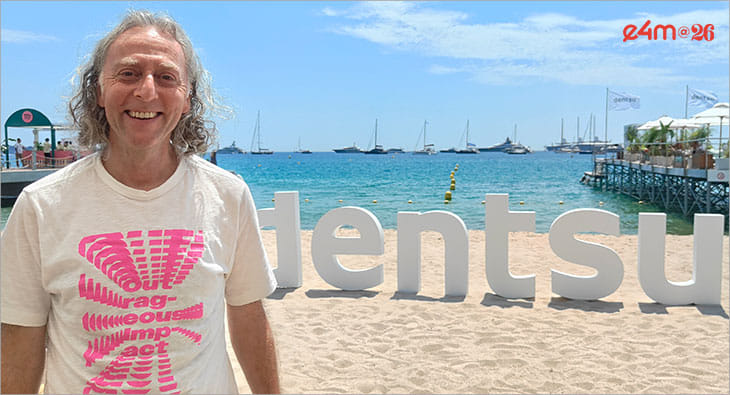

- John Mescall, appointed as Global Chief Creative Partner at Dentsu Creative in September 2022, has introduced the "Outrageous Impact" philosophy to enhance the company's creative approach, emphasizing the importance of creativity's purpose and impact rather than its appearance.
- Mescall aims for Dentsu to excel in three key Cannes Lions categories: Titanium, Innovation, and Craft, which he believes are essential for establishing the agency's creative identity and competitive advantage in an AI-driven industry.
- He expresses concerns about the impact of AI on entry-level jobs, suggesting that traditional roles may diminish as AI takes over routine tasks, necessitating the creation of new pathways for young talent in the industry.
- Mescall highlights the value of collaboration between in-house creative teams and external agencies, arguing that agencies provide essential outside perspectives that foster innovation, while also calling for a greater celebration of India's cultural richness in creative work.
It’s been a busy time for John Mescall since he took over as the Global Chief Creative Partner at Dentsu Creative in September last year. Since then, he introduced the idea of "Outrageous Impact", in line with the company’s mission of "Innovating to Impact." He told e4m why he gives importance to three Cannes Lions categories: Titanium, Innovation, and Craft and his goal of winning in these categories in the future.
Mescall stated that the need of the hour is to double down on human creativity in the AI era while figuring out how humans and AI can coexist and the need to focus on new talent entering the industry. He also shared his take on brands that have built in-house creative teams and his expectation from team India.
Edited excerpts:
You've been at Dentsu Creative for about eight to nine months now. How has the journey been so far? Have you achieved any of the priorities you set when you joined, particularly around creative excellence and craft?
It's been an exciting journey, although there are still a million things to do. One of the first things I focused on was giving Dentsu a creative philosophy that complements our core mission of "Innovating to Impact." I introduced the idea of "Outrageous Impact", which is now embedded across the organization. We needed an executional philosophy of our mission that defined the way we think about what creativity is and what it should be designed to do.
The "Outrageous Impact" philosophy is simple: creativity should not be judged solely on what it looks like, but on what it is designed to do in the world. Great ideas only matter if they create powerful meaningful impact. So instead of asking, "Do we like this idea?" we ask, "What is this idea designed to achieve, and can it create extraordinary outcomes?" "Outrageous Impact" is the philosophy that Dentsu is working towards and what I am proud of.
When I think about measuring progress, I focus on three Cannes Lions categories: Titanium, Innovation, and Craft. Titanium recognizes ideas that show the way forward, it’s something we haven’t seen before. Innovation focuses on technology used meaningfully for people and brands. Craft celebrates the human craft and skill, something our industry has lost over the last 15 years due to increasing pressure for speed and cost efficiency.
My ambition is for Dentsu to consistently compete and win in all the above three categories because together they calibrate us as the kind of creative network we aspire to be.
AI is transforming the industry, with many companies using it to create content faster and more efficiently. Is AI truly creative? And what role does the agency play in this new landscape?
My view is very clear: AI is not creative and will never be. Humans are creative. AI is an aggregator of human creativity. AI can get better at delivering fast and acceptable work but it will never be more than just acceptable work.
We need to double down on human creativity. When everyone has access to the same powerful tools, where does competitive advantage come from? The whole point of advertising is to gain an advantage over your competitors, and the advantage comes from human creativity and we need to get better at that.
The stronger AI gets, the stronger our human creativity needs to be. Creativity must always lead. Over the last decade, creativity has often been devalued by algorithms modelling and speed-to-market. Ironically, we are starting to see a renaissance of human creativity.
The challenge now is figuring out how humans and AI coexist. It's almost like a marriage — and we need couples therapy to learn how to work together, but humans must remain in charge.
What impact will AI have on young talent entering the industry?
This is one of my biggest concerns. Traditionally, entry-level jobs involved a lot of, the so-called "grunt work." AI is great at doing the grunt work, at taking over the task that doesn't need a lot of experience or skill, but just be accurate. There is a real chance of AI taking over these tasks leading to many of the traditional entry-level roles disappearing.
I worry that we're entering a phase where we are going to need to create entirely new entry level jobs for the young. I don't know what the solution is but we need to create a new pathway for young people who lack the experience and the judgement to make decisions. No company will employ a human to do work that AI can perform faster and is cheap, and it will not remain cheap forever.
So, will the talent pipeline one be one of the industry's biggest challenges in the AI era?
It's certainly one of them. The broader challenge is understanding our relationship with AI. We need to determine how the marriage will work together and where human creativity fits into the equation and is in charge. That’s the bigger
For years, technology platforms and algorithm-driven models suggested that creativity was becoming less important and you didn’t need creativity. I don’t believe that. AI is now proving that and is now also highlighting there’s nom replacement for human creativity and has now opened the door for human creativity again. As automation becomes more common, the value of uniquely human ideas becomes more apparent.
What's surprised me and is encouraging is how quickly people have reacted to AI-generated creativity. There has already been significant demand for work that feels genuinely human. That tells me there is a strong appetite for creativity created by people.
Many brands have built in-house creative teams. With AI making content creation easier, how can agencies remain indispensable?
In-house teams definitely offer advantages, especially around efficiency and deep knowledge of the business. But they also lose two critical things when they don’t work with an external creative partner: perspective and distance.
When you're inside a company, it's easy to become siloed and it is harder to innovate when you are inside the company. Creativity often entails a contrarian point of view, an outside perspective, curiosity, and even a degree of naivety. Agencies bring fresh viewpoints and challenge conventional thinking. An agency by definition can have multiple capabilities and different points of view that in-house can't.
It's also difficult to be truly brave when the people you're challenging are the same people who sign your paycheck. I have worked with many in-house agencies and while the team has the institutional knowledge and expertise, the agency contributes outside perspectives and fresh creative energy. The best model is often a partnership between an in-house team and an external agency.
How do you view India's creative potential? What are your expectations from the market?
I have very high expectations for India. The country has an extraordinary combination of intelligence, creativity, cultural richness, and ambition. I want to see what that confidence and capability can bring to our industry.
What I'd love to see more of is the spirit of India itself reflected in the work. A lot of work today follows a familiar formula: identify a problem and have the brand solve it. I'd like to see more celebration of India's culture, spirit character, and people in the work.
India has one of the most fascinating and vibrant cultures in the world. I'd love to see more of that celebration expressed creatively.
Influencer marketing has become a dominant force. Does it reduce the need for creativity?
It depends on how you define creativity. To me, creativity is about bringing something new, something that has not happened before. The first influencers were the Kardashians, they created reality TV, that is creativity. The rest of the millions of influencers are simply replicating existing formats, that’s not creativity.
Having said that, influencers can be highly effective, but it only works to a certain degree. Influencers don't build brands on their own. What is a brand? If not an idea of what this product is? Brands are built through ideas, creativity and advertising. Influencers amplify and support existing brands, influencers are brands themselves, it’s like one brand helping another but they aren't a substitute for brand-building.
At the end of the day, influencers are brands themselves. What you're really seeing is one brand helping another.
With increasing margin pressures, how can companies continue investing in creativity?
It's a constant battle, but creativity wins in the long term as it about short term gain versus medium and long-term gains.
Many companies focus on short-term gains through cost-cutting. While those decisions may improve immediate results, they often damage long-term growth and brand health. Once you kill a brand, it's very hard to bring it back.
A great example is the gaming industry after COVID. Many companies laid off large numbers of developers when demand softened. However, Nintendo chose not to.
When asked why, Nintendo's leadership explained that laying people off would hurt morale and reduce creativity. More importantly, they would lose the very people responsible for creating the next generation of products that will bring in future revenue.
That's the difference between short-term thinking and long-term thinking. The organizations that continue investing in creativity and talent are the ones most likely to win over time.
Read more news about Cannes Lions Festival, Advertising, Marketing, Digital Media, PR & Corporate Communication News
For more updates, be socially connected with us onInstagram, LinkedIn, Twitter, Facebook YouTube , WhatsApp & Google News