Rs 200 Crore & Counting: Why Auto still bets big on Print
BFSI, Retail, Clothing, Fashion and Jewellery, and E-commerce have also stepped up investments in Print, PMAR 2026 reveals
 by
by
Published: Mar 5, 2026 9:18 AM | 5 min read
 Follow Us

India’s print medium has come a long way from the pandemic-induced turbulence with recent data showing that key sectors, especially automobiles, continue to anchor its growth story.
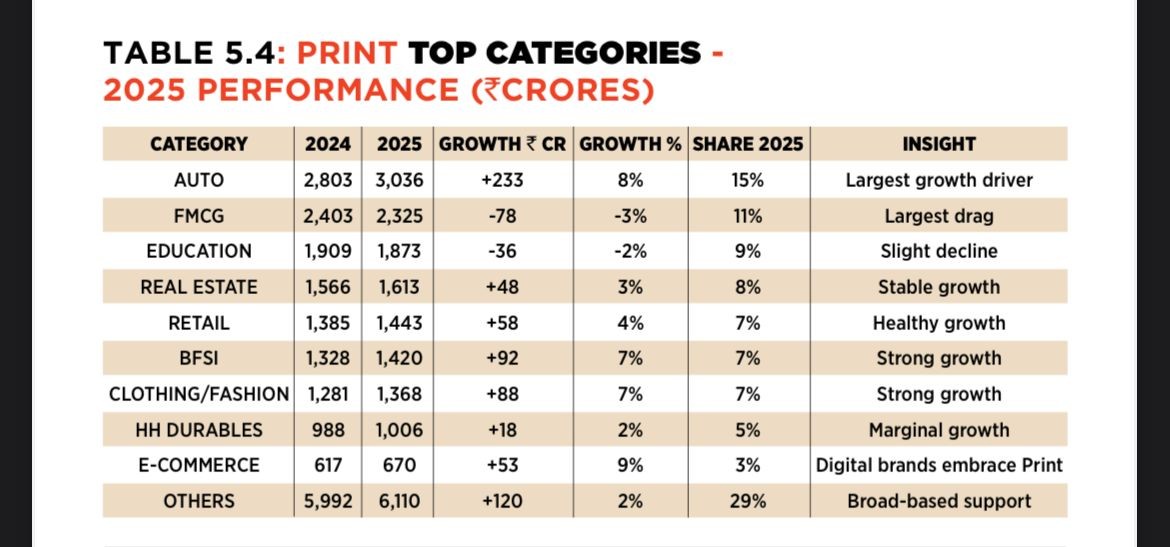
According to TAM AdEx data for 2025, the Auto sector retained the top spot in print advertising, accounting for 16 per cent of total ad space. Within this, Cars emerged as the leading category, commanding a 9 per cent share of print ad space. The numbers reinforce the continued relevance of newspapers for high-value, high-involvement categories.
The findings are echoed in PMAR 2026, which notes that growth in print is being driven largely by credibility- and information-sensitive sectors. Auto was the single largest growth driver, adding over Rs 200 crore in incremental spends and lifting its overall share. BFSI, Retail, Clothing, Fashion and Jewellery, and E-commerce also stepped up investments, underlining the medium’s appeal among sectors where trust and detailed information play a decisive role in consumer decision-making.
Trust, scale and local depth
For auto marketers, print offers a combination of scale, credibility and contextual depth that is difficult to replicate elsewhere.
Mohan Wilson, Director of Marketing & Corporate Strategy of Nissan, believes comparisons with European markets often miss the unique dynamics of India. “People often ask why we continue to invest in print when many European markets have moved away from it. The reality in India is very different. Print here is multifold in its impact. Unlike some markets where newspaper purchase is limited, in India newspapers are widely circulated and reach households directly. That gives us assured reach at scale,” he says.
Auto ad spends up in the festive season
Beyond reach, Wilson points to the signalling effect of print. “It builds confidence. It signals that the brand is investing in the market and is here for the long term. That visibility matters not just for consumers but also for our dealer partners, who draw confidence from seeing the brand prominently represented.”
This confidence factor is particularly relevant for automobiles, where the purchase cycle is longer and dealer networks play a critical role in conversions. In that sense, print functions not just as a consumer-facing medium but also as a reassurance tool within the trade ecosystem.
At the same time, brands are evolving how they use the format. Wilson stresses that print is no longer treated as a silo. “We do not release a print ad without a clear call to action. Every print execution is integrated with digital. Whether through QR codes, website redirects or social media links, we ensure there is a seamless bridge from print to digital platforms. It is no longer just a print ad, it is part of an ecosystem.”
Regionalisation is another key lever. Nissan uses national English dailies for high-impact launches but leans heavily on vernacular publications for deeper engagement in specific states. During a recent launch, the brand rolled out 22 editions of the same core creative, customising backgrounds for each state while retaining a unified national narrative. The move demonstrated how print can blend scale with hyperlocal relevance.
A similar calibrated approach is visible at Volvo. The Head of Brands & Marketing Communications, Rohan Mascarenhas, explains that regional print is central to the brand’s expansion into Tier 2 and Tier 3 markets. “We invest significantly in regional print because it helps us expand our reach into Tier 2 and Tier 3 markets, where local language publications play a crucial role in influencing purchase decisions. For us, regional newspapers are a strong vehicle for deeper market penetration,” he says.
However, regional scale is only one part of the mix. “When the objective is broader industry visibility or targeting auto enthusiasts, we invest in auto-specific and niche publications. Our print strategy is about choosing the right platform based on the objective, either regional publications for scale and depth in emerging markets, or niche auto titles for sharper audience targeting,” Mascarenhas adds.
Together, these strategies indicate that auto brands are not spending on print out of habit, but with defined objectives, whether that is launch impact, regional penetration or enthusiast targeting.
The measurement question
Even as spends rise, the absence of updated readership data remains a point of discomfort within the industry.
Pratip Francis, Head- Brand Marketing of MRF Tyres, has publicly called for the revival of the Indian Readership Survey, which was last conducted in 2019. “As marketers across organisations and at different stages of growth, I believe the time has come for all of us to come together and demand the return of the Indian Readership Survey. The last IRS was conducted in 2019. Then COVID happened and print reportedly crashed by nearly 50 per cent. The question is, what are we relying on today?” he asks.
Francis points out that most other media formats offer some level of measurement. “In digital, we have access to data. Even in DOOH and other traditional formats, there are trackers and mechanisms to gather some level of measurement. In print, however, we do not have an updated, credible, industry-wide readership study.”
Drawing a parallel with television’s BARC ratings, he questions why there has been limited collective push for a fresh IRS. For him, the issue is not about undermining print, but about bringing back accountability and transparency at a time when media decisions are increasingly data-led.
Balancing momentum and modernisation
The story of print in 2025 is therefore layered. On one hand, TAM AdEx and PMAR 2026 data clearly show that sectors such as Auto are not only present but leading growth. On the other, the industry faces a measurement vacuum that could shape future planning and budget allocations.
For now, the numbers indicate that automobiles continue to find strong value in print’s combination of reach, credibility and regional depth.
Whether that momentum can be sustained in the long term may depend as much on restoring robust audience measurement as on creative innovation and integrated media strategies.
Read more news about Print Media, TV Media, Advertising India, Digital Media, Marketing
For more updates, be socially connected with us onInstagram, LinkedIn, Twitter, Facebook, YouTube & Google News