'Asha Bhosle didn’t merely sing songs, she inhabited them'
Singer-composer Sonam Kalra paid a heartfelt tribute to legendary singer Asha Bhosle
 by
by
Published: Apr 13, 2026 7:17 PM | 4 min read
 Follow Us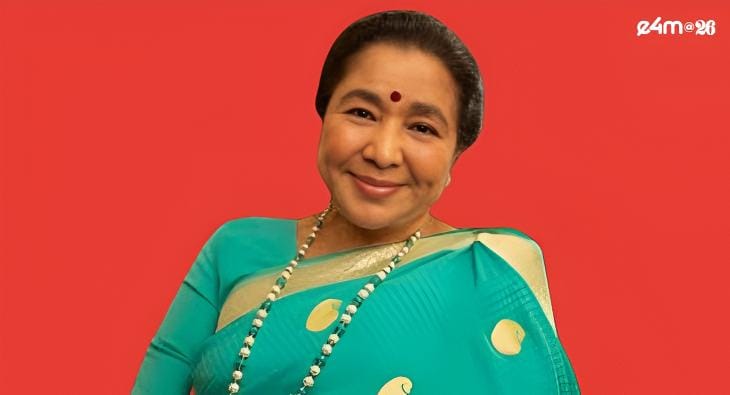

There are some voices that don’t just belong to a person, they belong to time itself. And they are music. Asha Bhosle was one of those rare voices.
To speak of Asha ji is to speak of an artist that music rarely witnesses. An artist who was not confined by genre, by mood and most importantly, by expectation. An artist who lived by her own rules.
An artist who pushed herself to be playful, making the music flirtatious, mischievous, a secret shared. And then, in the very next breath, one who could be hauntingly vulnerable, carrying a depth of longing that felt almost too intimate to witness. That was her gift, not just range, but truth. She didn’t merely sing songs, she inhabited them.
As a singer myself, what always inspired me most about Asha ji, was her fearlessness.
At a time when singers were often placed into neat, predictable boxes, she refused to stay in one. She boldly explored, experimented and took risks. Whether it was the sensuous sophistication of ‘Pia tu, ab to aaja’, or the aching stillness of ‘Dil cheez kya hai’, the teasing allure of ‘Aaiye Meherbaan’, or the intoxicating grace of ‘In aankhon ki masti mein’, the rebellious abandon of ‘Dum maaro dum,’ or the timeless romance of ‘Chura liya hai tumne’, Asha ji gave herself completely to the moment, trusting the music to take her where it needed to go. And in doing so, she expanded what it meant to be a playback singer, but more importantly paved the way for so many female playback singers.
At a time when female playback singers were expected to sound pure and restrained, she broke the ‘good girl’ voice stereotype and embraced songs that were bold, seductive, cabaret inspired and deeply Western-influenced. She reclaimed feminine sensuality as expression, not something to be hidden. Think ‘Yeh mera dil’ and ’Aao Huzoor Tumko’ -songs that didn’t just push boundaries, they quietly redefined them.
She also reinvented herself with R. D. Burman. Her collaboration with Panchamda wasn’t just musical, it was transformative. With him, she experimented with new sounds - jazz, rock, funk and experimental rhythms. She adapted fearlessly, even when it risked criticism. She was bold, fierce, unapologetic- a woman who was not just keeping up with change, but leading it.
There was also, in her voice, an unmistakable sense of play. A lightness. A joy. Even in the most intricate compositions, there was a certain ease, as though she was reminding us that music, at its heart, is meant to be joy, meant to be felt, not just perfected. And yet, beneath that effortlessness was an extraordinary command of craft, years of riyaaz, discipline and an intuitive understanding of emotion that cannot be taught.
For so many of us, Asha ji’s songs are not just melodies, they are memories. They are moments we return to, again and again, because they hold something of us within them. A first love. A quiet heartbreak. A fleeting joy. Her voice has been the background to countless lives, weaving itself into the fabric of our stories so seamlessly that it feels impossible to separate the two.
And perhaps that is her greatest legacy. Not just that she sang thousands of songs, across languages and generations, but that she made each one feel personal. As though it was being sung just for you.
So how does one say goodbye to Asha ji? Goodbye to all that she was? For a voice like hers doesn’t really leave us. It lingers in the air, in memory, in our hearts, in the quiet spaces of our minds where the music continues to play long after the record player has stopped turning.
Read more news about Digital Media, Television Media, Out of Home Advertising, Print Media, Latest Advertising India
For more updates, be socially connected with us onInstagram, LinkedIn, Twitter, Facebook, YouTube & Google News