Kedar Ravangave concludes defining chapter at Kotak, says marketing needs reinvention
After leading Kotak’s brand relaunch and several customer- and AI-focused initiatives, Ravangave says the future of marketing will be shaped by better organisations—not merely better campaigns
 by
by
Published: Jul 27, 2026 11:46 AM | 4 min read
 Follow Us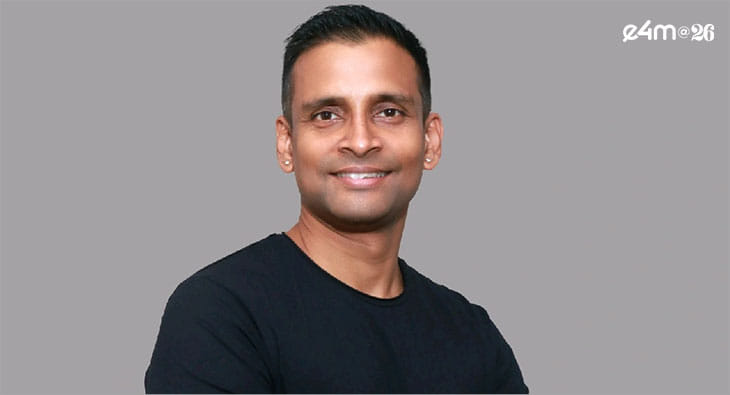

- Kedar Ravangave has completed his nearly two-year role as Head of Marketing at Kotak Mahindra Bank, where he led significant initiatives including the brand relaunch and the introduction of new customer propositions.
- He emphasized that his key learning was about organizational design rather than just marketing strategy, advocating for the integration of marketing functions to enhance competitiveness.
- Ravangave highlighted the importance of embedding AI into marketing operations to improve agility and decision-making, rather than merely adding AI tools to existing structures.
- Looking ahead, he plans to focus on enterprise transformation and AI-native operating models, suggesting that the future of marketing leadership will center on organizational capability rather than traditional brand building.
Kedar Ravangave has concluded his nearly two-year stint at Kotak Mahindra Bank, where he served as Head of Marketing for the Consumer and Commercial Banking businesses.
During his tenure, Ravangave was associated with several significant initiatives, including the relaunch of the Kotak brand through the “Hausla Hai Toh Ho Jayega” platform, the introduction of Kotak Solitaire for affluent customers, the expansion of platforms such as Kotak BizLabs, and the development of new growth and marketing operating models.
As he closes this chapter, Ravangave believes his biggest learning at Kotak was not limited to marketing strategy or brand communication but centred on the way marketing organisations are designed and operated.
“The biggest insight from my Kotak journey wasn’t about marketing strategy. It was about organisational design,” Ravangave told exchange4media.
“We spend enormous energy trying to improve campaigns, but far less time improving the organisation that creates those campaigns. The future of marketing won’t be defined by better campaigns. It will be defined by better organisations,” he said.
According to Ravangave, marketing has progressed considerably through better channels, richer customer data and more sophisticated technologies. However, the internal structures of most marketing organisations have not evolved at the same pace.
“Research, creative, media, analytics and customer experience continue to function in silos. They are connected by hand-offs rather than shared intelligence. That is where the next competitive advantage will come from—not just better campaigns, but better organisations,” he explained.
Ravangave’s perspective has been shaped by a career of more than 15 years across Marico, Amazon India and Kotak Mahindra Bank. He said each organisation contributed differently to his understanding of brands, consumers and scalable business systems.
“Marico taught me the discipline of building enduring brands. Amazon reinforced the power of customer obsession, experimentation and scalable operating mechanisms. Kotak gave me the opportunity to bring those principles together inside a large and complex institution,” he said.
At Kotak, the challenge was to make the brand, business, technology and customer experience work as parts of one integrated system, he added.
Whether it was strengthening Kotak’s master brand, introducing differentiated customer propositions or developing AI-enabled marketing capabilities, Ravangave said the common objective was to position marketing as a core business capability.
“The consistent focus was to build marketing as a business capability, not just a communications function,” he said. “That requires marketing to become more closely connected with customer growth, technology, data and business outcomes.”
Another key priority during his tenure was reimagining how marketing teams operate. Ravangave worked on using technology, AI and automation to reduce execution bottlenecks, enable faster decision-making and make the marketing organisation more agile.
“The objective was not simply to adopt AI. It was to embed AI into the operating fabric of marketing,” he said.
Ravangave believes that many companies are attempting to add AI-driven marketing tools to organisational structures that were created before the emergence of artificial intelligence.
“Most organisations are trying to build AI-powered marketing on top of operating models that were designed long before AI existed,” he said. “That may improve efficiency, but it won’t fundamentally change competitiveness. The organisations that lead the next decade will redesign themselves around AI, not simply deploy it.”
He believes this transition will also reshape the role of the chief marketing officer.
“Yesterday’s CMO built brands. Tomorrow’s CMO will build capability—designing organisations that learn, decide and execute faster than competitors,” Ravangave said, adding that marketing leadership is increasingly becoming as much about organisational design as it is about communication.
Describing his Kotak stint as a validation of these ideas, Ravangave indicated that his next chapter would focus on enterprise transformation, AI-native operating models and growth on a broader scale.
“Every generation of business leaders gets one defining shift. The last generation built digital businesses. This generation will build AI-native organisations,” he said.
“Marketing simply happens to be where that transformation begins.”
Read more news about Marketing News, Advertising News, PR and Corporate Communication News, Digital News, People Movement News
For more updates, be socially connected with us onInstagram, LinkedIn, Twitter, Facebook, YouTube & Google News