A new look, a larger shift: Decoding Godrej Industries’ rebrand
Guest Column: Ganapathy Viswanathan, Independent Communication Consultant & Author, examines Godrej Industries’ rebranding and what it signals today
 by
by
Published: May 1, 2026 1:08 PM | 5 min read
 Follow Us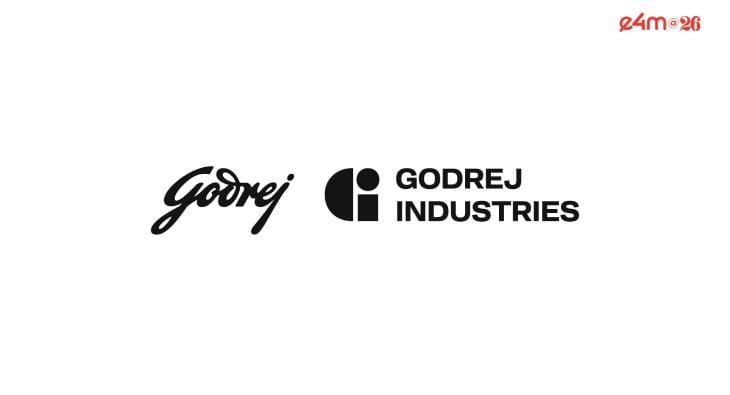

- Godrej Industries has undergone a rebranding to reflect its evolution across diverse sectors, including chemicals, agriculture, and consumer goods, necessitating a more flexible and contemporary identity.
- The new visual identity aims to support the company's broad range of operations, moving away from a rigid representation to a more expressive and adaptable design that aligns with modern digital platforms.
- While the previous branding had recognition and trust, it was seen as a constraint; the update is intended to maintain the strength of the Godrej name while ensuring relevance in a changing business landscape.
- Initial reactions to the rebrand have been mixed, with some comparisons to the Australian design agency Guerrilla; however, the intent and application of Godrej's identity are focused on unifying a complex enterprise rather than standing out in a competitive creative field.
Rebranding is often described as a design exercise, but in reality, it usually signals something deeper. It reflects a point where a business begins to outgrow the way it has been presenting itself. That’s what makes the recent identity shift by Godrej Industries interesting. It’s not just about how the logo looks—it’s about how the company wants to be understood today.
When the new identity was unveiled, reactions were immediate. Some people appreciated the fresher, more contemporary feel. Others were more critical, even comparing it to Guerrilla—an Australia-based branding and design agency. That kind of split response isn’t unusual. Visual changes are easy to react to. But the more meaningful question sits beneath that surface—why was this change needed now?
A Business That No Longer Fits One Box
The answer lies in how much the business itself has evolved. Godrej Industries today operates across very different sectors—chemicals, agriculture, and consumer-facing businesses. Some parts of it are industrial and behind the scenes, while others are part of everyday life.
That kind of range makes it difficult for a single, rigid identity to hold everything together.
The new visual language seems to respond to that challenge. It feels more open and less restrictive. The colours are more expressive, and the form is more fluid, suggesting movement rather than stability alone. This is important, because the company is no longer defined by one category. It needs an identity that can stretch without feeling forced.
In a way, this is about removing limitations. When a business grows, the brand has to grow with it.
Why Move Away From Something Familiar?
What makes this shift interesting is that the earlier identity wasn’t necessarily outdated in terms of trust. It had recognition. It had familiarity. And those are valuable assets.
But familiarity can also become a constraint.
As organisations expand, their identities need to do more than just represent them—they need to function across multiple platforms, formats, and audiences. Today, a brand has to work just as well on a mobile screen as it does on physical assets. It has to remain consistent while being flexible.
Seen from that perspective, the change doesn’t feel dramatic. It feels necessary. Not a rejection of what existed before, but an update to keep pace with how the business operates now.
The Strength of the Name Remains
Through all of this, one element continues to anchor everything—the name “Godrej.”
It carries decades of trust and recognition, and that kind of equity doesn’t need to be rebuilt. If anything, it needs to be protected.
The new identity doesn’t try to compete with the name. Instead, it works around it, giving it a more contemporary frame without changing its meaning. The name still does most of the heavy lifting, and the design plays a supporting role by making it more adaptable.
That balance feels deliberate. Because when a brand name already holds strong credibility, the goal isn’t to overshadow it—it’s to help it stay relevant.
Looking Beyond the Similarity Debate
The comparisons with Guerrilla—a branding and design firm based in Australia—surfaced quickly, and they are understandable at a glance. Both identities use bold, geometric construction, with letterforms built from solid shapes rather than traditional typography. There is also a shared emphasis on minimalism and modularity, where the design can scale and adapt across different contexts.
However, the similarities begin to thin out when you look more closely at intent and application. Guerrilla’s identity is built for a creative agency context, where distinctiveness and visual punch are central to positioning. Its form feels more compact and emblematic, almost like a stamp.
In contrast, the Godrej Industries mark appears designed for breadth and flexibility. Its form is more open, supported by a broader visual system that includes colour variation and fluid extensions. Rather than acting as a standalone emblem, it functions as part of a larger identity language meant to unify diverse businesses.
This distinction matters. While the structural resemblance has fueled discussion, the underlying design problems being solved are fundamentally different. One is about standing out in a competitive creative field; the other is about holding together a complex, multi-sector enterprise.
In today’s design landscape, where many brands are moving toward simplified, digital-friendly systems, such overlaps are increasingly common. What matters more is whether the identity works in its intended context.
What Will Define Success Over Time
Initial reactions, whether positive or critical, rarely determine the success of a rebrand. Those tend to fade.
What really matters is how the identity performs over time. Does it remain consistent across different businesses? Does it feel natural across touchpoints? Does it become easy to recognise without effort?
A strong brand identity doesn’t rely on a single moment. It builds familiarity gradually.
And at some point, it stops feeling new. It just feels right.
Not a Break, But an Evolution
Seen in totality, the new identity of Godrej Industries doesn’t feel like a break from its past. It feels more like an evolution—one shaped by changing realities.
The legacy is still intact. The name still carries weight. What has changed is the way the company expresses itself in a more complex and fast-moving environment.
And perhaps that’s the real purpose of a rebrand.
Not to create something entirely different overnight, but to ensure that the brand continues to make sense as the business grows—without losing what made it trusted in the first place.
Read more news about Marketing News, Advertising News, PR and Corporate Communication News, Digital News, People Movement News
For more updates, be socially connected with us onInstagram, LinkedIn, Twitter, Facebook, YouTube & Google News