Jewellery retail future will be driven by ability to stay relevant: Sandeep Kohli, Indriya
At e4m RetailEX conference, Sandeep Kohli, CEO of Indriya, outlined a playbook that moves jewellery from investment to identity, blending design, culture & digital to build a modern retail brand
 by
by
Published: Apr 15, 2026 7:07 PM | 5 min read
 Follow Us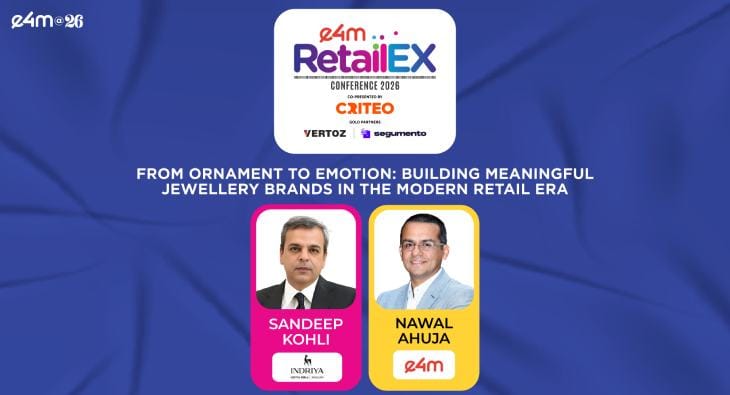

In a category as old as civilisation itself, disruption is rare and often resisted. Yet, in less than two years, Indriya, the Aditya Birla Group’s jewellery venture, has moved with unusual speed and clarity, positioning itself not just as another entrant but as a brand attempting to rewrite how jewellery is understood and consumed in India. Speaking at the e4m RetailEX conference in a fireside chat with Nawal Ahuja, Co-Founder, exchange4media Group, Sandeep Kohli, CEO of Indriya, framed the shift in stark terms, arguing that jewellery is increasingly being seen less as an investment and more as an expression of beauty and identity.
“More and more jewellery is a beauty product than an investment in gold,” Kohli said, pointing to a significant behavioural change among consumers. This shift is subtle but profound. For decades, gold jewellery in India has been anchored in its financial value, often bought for security as much as adornment. That balance, Kohli suggested, is now tilting decisively towards aesthetics, self-expression and emotional connection.
The speed of Indriya’s expansion reflects how strongly this proposition is resonating. The brand began with four stores across Indore, Jaipur and Delhi, deliberately experimenting with different formats and catchments. The response, Kohli said, was strong across the board, giving the company the confidence to accelerate its rollout. Yet he was quick to underline that store count is not the metric that defines success. “The number of stores is never the target. The target is delighting as many consumers as we want,” he said.
Central to that ambition is a conscious departure from how jewellery has traditionally been designed and sold. Unlike many legacy players that rely heavily on vendor-led design ecosystems, Indriya has invested in building in-house design capabilities, with nearly 60 percent of its offerings created internally. The outcome, according to Kohli, is immediately visible in consumer feedback. “They look fresh. It feels like it is designed for me,” he said, describing how shoppers are responding to the brand’s collections.
This focus on design is closely tied to a deeper understanding of India’s cultural complexity. Jewellery buying in the country is not merely transactional but deeply embedded in rituals, festivals and community traditions. Indriya’s strategy has been to lean into this diversity rather than flatten it. Each store’s assortment is tailored to its local catchment, reflecting specific cultural preferences even within the same city. The ambition, Kohli explained, is to operate as a regional brand with a national footprint, rather than the other way around.
If design and localisation form one pillar of Indriya’s strategy, the other is its approach to younger consumers. Jewellery has historically struggled to appeal to younger audiences, often perceived as a category associated with older generations or life milestones. Kohli dismissed the idea that this requires a separate strategy. As a brand born in the current decade, he argued, Indriya is inherently aligned with Gen Z sensibilities. The shift is less about targeting a demographic and more about recognising that ideas of beauty, self-expression and spending on oneself are emerging earlier in life than before.
This repositioning also influences how the brand uses digital. While Indriya describes itself as digital first, it does not sell jewellery online. Instead, it treats digital platforms as discovery engines, acknowledging that consumers prefer to complete high-involvement purchases in physical stores. Kohli pointed out that jewellery, unlike categories such as electronics, cannot be reduced to specifications and comparisons. It requires touch, trial and an emotional connection that is difficult to replicate online.
That emotional dimension is perhaps most evident in the brand’s marketing. Moving away from conventional advertising that centres on social validation and occasion-led dressing, Indriya’s campaigns focus on intimate, personal moments. Kohli described the brand’s first campaign, which showed a woman alone after a party, quietly admiring her jewellery in front of a mirror. The narrative, he said, captures the private relationship between the wearer and the piece, rather than how it is perceived by others.
Behind this consumer-facing strategy is the challenge of building a startup within a large and established conglomerate. Kohli, who spent over three decades at Unilever, acknowledged that while the fundamentals of business remain unchanged, understanding consumer needs, solving pain points and avoiding being a me too brand, the task of creating a new organisational culture is critical. At Indriya, this has involved co-creating a shared ethos with employees rather than imposing it from the top, especially as the company scaled rapidly from a small team to several hundred people in a short span.
The broader market context makes this transformation even more significant. India’s jewellery industry, valued at roughly 90 billion dollars, remains highly fragmented, with a large portion still dominated by unorganised players. At the same time, external pressures such as rising gold prices have begun to reshape consumer behaviour. Kohli noted that while consumers cannot exit the category due to its cultural importance, they are becoming more discerning, demanding greater transparency, better design and stronger value.
For Indriya, this evolving consumer mindset presents an opportunity rather than a constraint. By focusing on design, trust and emotional resonance, the brand is positioning itself to meet these heightened expectations. Kohli’s broader thesis is that the future of jewellery retail in India will not be driven solely by scale or legacy, but by the ability to stay relevant in a rapidly changing cultural and consumer landscape.
In reframing jewellery as an expression of identity rather than merely an asset, Indriya is tapping into a deeper shift underway in Indian consumption. The success of that bet will depend on how consistently it can deliver on its promise of personalisation, authenticity and emotional connection. But if early momentum is any indication, the category may be entering a phase where what people wear matters as much as what it is worth.
Read more news about Marketing News, Advertising News, PR and Corporate Communication News, Digital News, People Movement News
For more updates, be socially connected with us onInstagram, LinkedIn, Twitter, Facebook, YouTube & Google News