When logos lose their identity
Guest Column: Veteran adman Prabhakar Mundkur writes on whether minimalist branding is making logos lose their distinct identity
 by
by
Published: Apr 28, 2026 12:27 PM | 3 min read
 Follow Us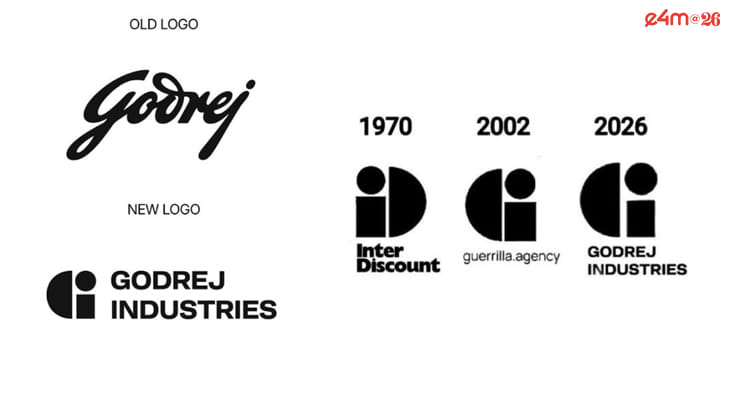

- Godrej Industries' new logo has sparked debate over the increasing visual interchangeability of modern logos, particularly due to its similarity to existing designs from brands like Guerrilla and Interdiscount.
- The company defended its redesign as an intentional move towards a minimalist geometric form that complements its historic signature, acknowledging the prevalence of similar designs globally.
- The article highlights a broader trend in branding where convenience and minimalist aesthetics lead to logos becoming generic symbols rather than unique identities, raising concerns about originality in design.
- Historical examples of branding controversies illustrate the ongoing challenge of visual imitation in corporate identities, emphasizing the importance of distinctiveness in logo design.
The unveiling of the new identity for Godrej Industries has triggered a familiar debate in the world of branding: in an era dominated by minimalist geometry and downloadable vector libraries, are modern logos becoming visually interchangeable?
The controversy began almost immediately after the new “GI” mark was released. Observers pointed out its striking resemblance to the identity of Guerrilla, an independent Australian creative agency that has reportedly used a nearly identical geometric symbol since 2002. Comparisons were also made with the Swiss retailer Interdiscount and several lesser-known brands across industries.
Godrej defended the redesign by explaining that the symbol was intentionally reduced to an “elemental geometric form” so that it would sit beside the historic Godrej signature without competing with it. The company also acknowledged that many similar geometric compositions already exist globally.
And therein lies the larger issue.
Today’s designers operate in a visual ecosystem flooded with pre-made vectors, icon packs, logo generators and AI-assisted design tools. Minimalist branding trends have further compressed the available “design space.” A circle, rectangle and half-disc can only be rearranged in so many ways before similarities become inevitable. When creativity is replaced by convenience, logos risk becoming recycled geometry rather than original identity systems.
The problem is not inspiration; design has always evolved through references and shared visual language. The danger arises when brands merely export a ready-made vector shape with little conceptual development. In such cases, the logo stops being a distinctive trademark and becomes a generic symbol that could belong to almost anyone.
This is not the first time a global corporation has faced accusations of visual imitation.
The logo for Microsoft was once criticised for resembling older window-grid motifs already widely used in technology branding. Pepsi faced ridicule after its expensive redesign was compared online to everything from political campaign graphics to supermarket labels. The 2010 rebrand of Gap was withdrawn within days after consumers pointed out its generic resemblance to countless Helvetica-based startup logos. Similarly, the emblem introduced by Airbnb sparked comparisons with several pre-existing symbols from unrelated companies and even app icons.
Automobile companies too have struggled with convergence. The flattened monochrome identities recently adopted by brands like Volkswagen, BMW and Nissan increasingly resemble one another because all are chasing the same digital-first minimalism.
Ironically, older logos often possessed greater individuality because they were hand-crafted rather than software-generated. The classic handwritten Godrej script, for example, carried personality, heritage and unmistakable recognition. The new GI mark may be modern and scalable, but critics argue that it sacrifices distinctiveness for geometric efficiency.
The Godrej episode therefore represents more than a branding controversy. It is a warning signal to the global design industry. As corporations increasingly rely on simplified forms, stock geometry and AI-assisted workflows, originality itself risks becoming endangered. A logo is not merely an arrangement of shapes; it is the visual soul of a brand. And when too many brands begin sharing the same soul, identity loses its meaning.
Disclaimer: The views expressed here are solely those of the author and do not in any way represent the views of exchange4media.com.
Read more news about Marketing News, Advertising News, PR and Corporate Communication News, Digital News, People Movement News
For more updates, be socially connected with us onInstagram, LinkedIn, Twitter, Facebook, YouTube & Google News