FMCG players recalibrate Q1 FY26 ad spends; some remain sluggish, others scale back
Financial reports of India’s top FMCG players signalled renewed marketing aggression with increased advertising and promotional investments suggesting a cautiously optimistic stance
 by
by
Published: Aug 7, 2025 9:04 AM | 7 min read
 Follow Us

As one of the biggest advertising sectors in India, the fast-moving consumer goods (FMCG) industry plays a defining role in shaping media revenues across print, television, and digital. According to the Pitch Madison Advertising Report 2025 (PMAR), FMCG accounted for 33% of ad spends on traditional media platforms like TV, print, and radio in 2023, slipping slightly to 32% in 2024. Will this downward trend persist through FY26?
Early indicators from the April–June quarter of FY26 suggest a mixed outlook. India’s top FMCG players posted varied financial performances, but many signalled renewed marketing aggression with increased advertising and promotional investments suggesting a cautiously optimistic stance.
While companies like Marico and Emami raised their marketing spends year-on-year, HUL reported a quarter-on-quarter rise despite a minor annual dip. In contrast, P&G sharply cut its ad expenditure during the same period. Godrej Consumer Product too reduced its consolidated ad expenditure by 5% to Rs 313.83 crore.
Godrej Consumer Product ad spends
Even as firms flagged macroeconomic challenges, from tepid discretionary consumption to inflationary pressures, many reiterated their long-term growth conviction, hinting at continued strategic bets on brand building and consumer engagement.
Advertising and promotion expenses
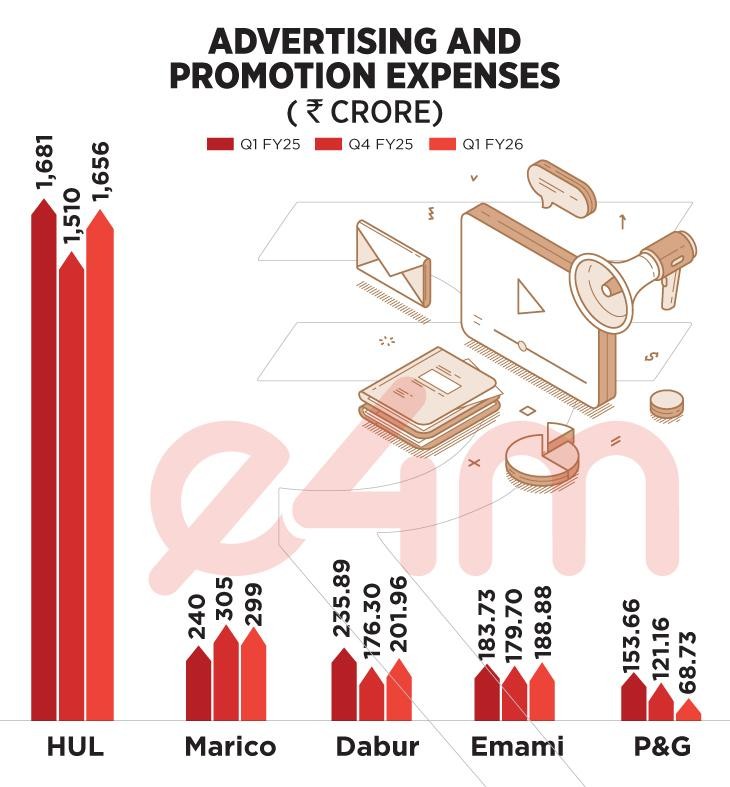
A closer look at Q1 FY26 numbers reveals how individual FMCG majors have navigated the evolving demand landscape. While some brands doubled down on advertising to support portfolio pivots and category expansion, others took a more conservative route amid inflationary and operational headwinds.
Hindustan Unilever for instance spent Rs 1,656 crore on advertising in Q1 FY26, down 1.5% year-on-year from Rs 1,681 crore but up 9.6% sequentially over Rs 1,510 crore in the March quarter.
According to CEO and Managing Director Rohit Jawa, the FMCG demand environment remained stable during the quarter with a gradual uptick in recent months.
“Encouraged by favourable macro-economic indicators, we strategically stepped up our investments to effectively advance our portfolio transformation agenda in this quarter,” Jawa said.
Then there is Marico. One of India’s leading FMCG companies known for brands like Parachute, Saffola, and Set Wet stepped up its advertising investments in Q1 FY26, signalling its focus on core brand strength and diversification despite commodity cost pressures.
The FMCG major raised its ad spends to Rs 299 crore, a 24.6% increase from Rs 240 crore in Q1 FY25. Though slightly lower than the Rs 305 crore spent in Q4 FY25, the company stated that it had maintained investments to strengthen its core franchises and accelerate growth in new businesses, despite sharp inflation in key commodities.
“Despite these constraints, A&P spends were up YoY as we maintained investments to adequately strengthen our franchises and accelerate diversification,” the company said.
MD & CEO Saugata Gupta added, “The improving trajectory of our core portfolios, coupled with accelerated growth in foods and digital-first portfolio, have driven underlying volume growth in the India business closer to double digits.”
Other key FMCG players showed a mixed approach to advertising investments in Q1 FY26, reflecting differing strategies amid ongoing macroeconomic pressures.
Dabur spent Rs 201.96 crore on advertising, down 14.4% year-on-year from Rs 235.89 crore but up 14.5% from the previous quarter.
Emami posted an ad spend of Rs 188.88 crore, reflecting a 2.8% rise year-on-year and 5.1% growth sequentially.
P&G slashed its ad and promotional spends to Rs 68.73 crore from Rs 153.66 crore in Q1 FY25, a 55.3% decline, and 43% lower than the Rs 121.16 crore reported in Q4 FY25.
Kumar Venkatasubramanian, Managing Director of Procter & Gamble Hygiene and Health Care, said, “Despite the continually challenging operating environment, our team came together to execute our integrated growth strategy.”
No comparable ad spend data was reported for ITC, Tata Consumer Products (TCP), or Nestlé India.
Revenue from operations
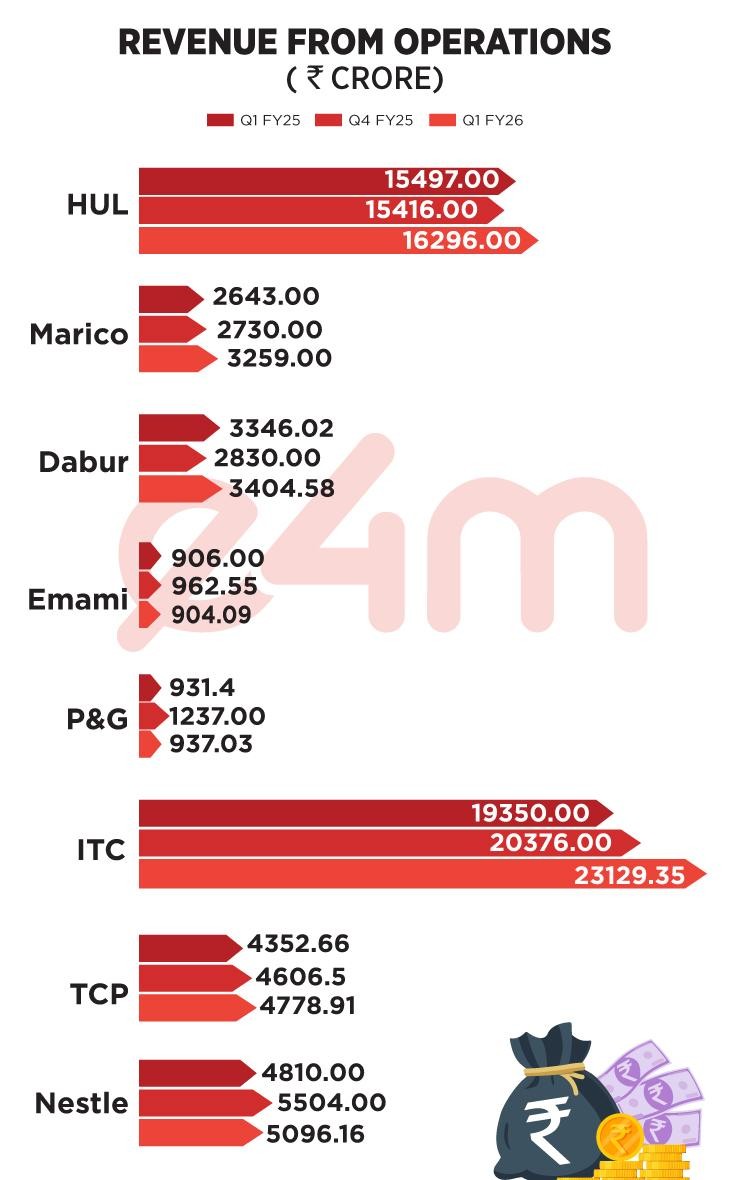
Top FMCG companies also reported varied revenue performances in Q1 FY26, shaped by factors ranging from input cost inflation to seasonal disruptions and shifting consumer demand. While some players posted strong double-digit growth, others faced pressure from muted discretionary spending and volatile macro conditions.
After all, advertising spend is only one part of the equation, it ultimately boils down to how much the company earned overall. And just like advertising spends, revenue for Q1 also showed a mixed bag.
To start with, HUL’s revenue from operations rose 5% year-on-year to Rs 16,296 crore in Q1 FY26, from Rs 15,497 crore.
Marico recorded a 23.3% jump to Rs 3,259 crore compared to Rs 2,643 crore in Q1 FY25, and a 19.4% increase over Q4 FY25. The company noted that revenue growth was aided by price hikes in core portfolios in response to sharp input cost inflation. It also reported strong offtake growth and market share gains across most of its portfolio.
ITC posted revenue of Rs 23,129.35 crore, up 19.6% from the year-ago period and 13.5% sequentially. TCP reported Rs 4,778.91 crore in revenue, a 9.8% rise year-on-year and 3.7% increase over the previous quarter.
Nestlé India registered a 5.9% year-on-year growth to Rs 5,096.16 crore but saw a 7.2% sequential decline. Chairman and Managing Director Suresh Narayanan noted that the quarter was impacted by elevated commodity prices and increased operational costs stemming from recent manufacturing expansions.
“The company also faced higher finance costs owing to temporary borrowings from commercial banks,” Narayanan added.
Dabur’s revenue reached Rs 3,404.58 crore, marginally higher by 1.7% year-on-year and up 20.3% sequentially. P&G’s revenue stood at Rs 937.03 crore, a slight increase of 0.6% over Q1 FY25.
Emami posted Rs 904.09 crore in revenue, slightly lower by 0.2% year-on-year and 6.1% below the March quarter.
Whole-time Director Mohan Goenka acknowledged that the overall demand environment in the quarter remained challenging, with urban discretionary consumption under pressure and rural demand only showing early signs of recovery.
“The unusually soft and shortened summer season driven by unseasonal rain and the early onset of the monsoons adversely impacted consumption across our summer-focused portfolio. Despite these headwinds, we maintained a stable top line with overall revenue remaining broadly flat,” said Goenka.
He also added that the company remains confident on the margin front and does not foresee significant input cost pressures in the near term.
Net profit
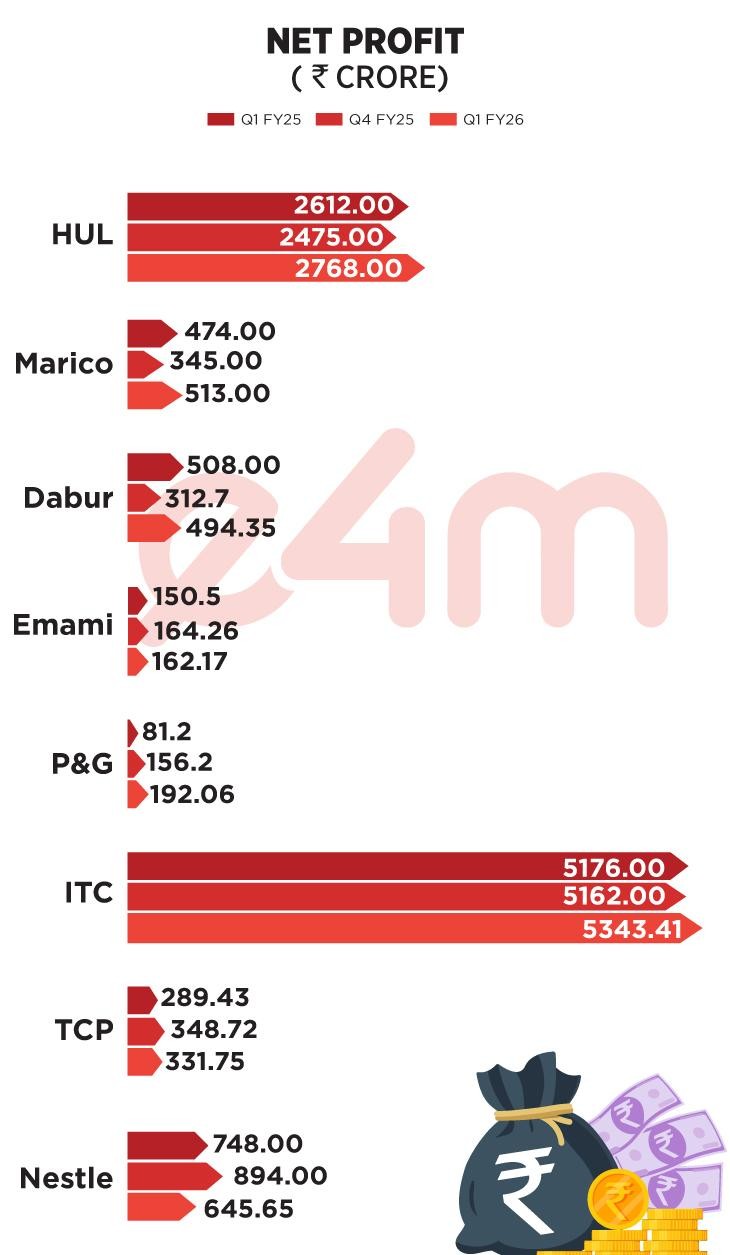
Despite a mixed demand environment, several companies in the sector managed to post healthy bottom-line growth in Q1 FY26, aided by improved operating leverage, price-led strategies, and selective cost management.
Here’s how the net profit numbers panned out for some key players.
HUL for instance, reported a 6% rise in net profit to Rs 2,768 crore, up from Rs 2,612 crore in Q1 FY25. Marico’s profit rose 8.2% year-on-year to Rs 513 crore, and 48.7% sequentially over Rs 345 crore. The company attributed this performance to both India and international businesses registering solid growth.
ITC posted a net profit of Rs 5,343.41 crore, a 3.2% increase from Q1 FY25 and up 3.5% from the previous quarter.
TCP’s net profit grew 15% year-on-year to Rs 331.75 crore, though down from Rs 348.72 crore in Q4. Nestlé India reported a net profit of Rs 645.65 crore, down 13.7% year-on-year and 27.7% sequentially.
Dabur posted a profit of Rs 494.35 crore, marking a 2.7% year-on-year decline but a strong 58.1% sequential jump.
Emami’s net profit stood at Rs 162.17 crore, up 7.7% year-on-year but slightly down from Rs 164.26 crore in Q4. Goenka expressed optimism for the coming quarters, stating, “We believe the macro environment will gradually improve, supported by a buoyant monsoon, stabilizing inflation and ongoing consumption recovery.”
P&G’s net profit surged 136.6% year-on-year to Rs 192.06 crore, and rose 23% sequentially.
While ad spends and revenue trends varied across companies, the broader signals from Q1 FY26 point to a cautiously optimistic outlook for the FMCG sector. Stable rural demand, easing input costs, and strategic marketing investments are expected to drive growth in the coming quarters.
However, companies remain watchful of macroeconomic headwinds, discretionary spending patterns, and the impact of an extended monsoon season. As brands recalibrate for the festive quarter ahead, their ability to balance profitability with brand-building will be critical in defining the trajectory of both topline and advertising momentum.
Read more news about Marketing News, Advertising News, PR and Corporate Communication News, Digital News, People Movement News
For more updates, be socially connected with us onInstagram, LinkedIn, Twitter, Facebook, YouTube & Google News