Cinema ADEX stabilises at ₹877 crore in 2025, signals post-recovery plateau: PMAR
As per the Pitch Madison Advertising Report, cinema advertising has normalised after the pandemic rebound, with growth slowing to 3% and share stuck at 0.8%
 by
by
Published: Feb 24, 2026 5:10 PM | 3 min read
 Follow Us

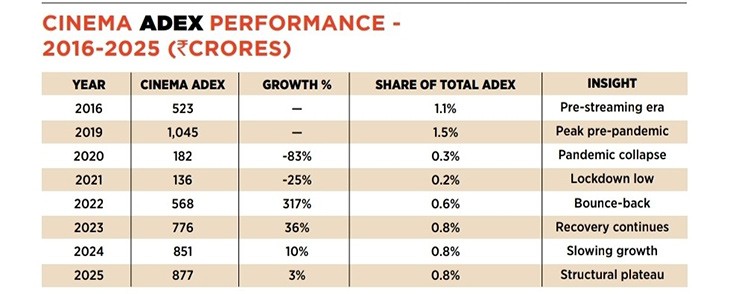
India’s cinema advertising market has entered a phase of post-recovery normalisation, with revenues stabilising at ₹877 crore in 2025, according to the Advertising Report 2026 by Pitch Madison World. The report notes that the sharp rebound seen after the pandemic has largely played out, and the medium has now reached a structural plateau.
Cinema ADEX grew 3% year-on-year in 2025, up from ₹851 crore in 2024. However, its share of total advertising expenditure remained unchanged at 0.8%, underscoring the medium’s limited scale compared to television, digital and out-of-home (OOH). The findings suggest that while cinema has recovered from pandemic-era lows, it has not regained the prominence it enjoyed in the pre-COVID period.
The longer-term trajectory illustrates the volatility of the medium. In 2019, cinema ADEX peaked at ₹1,045 crore with a 1.5% share of total ADEX. The pandemic triggered a steep collapse in 2020, when revenues plunged 83% to ₹182 crore. In 2021, the slide continued, falling another 25% to ₹136 crore amid prolonged lockdowns and restricted theatre operations.
A dramatic rebound followed in 2022, when cinema advertising surged 317% to ₹568 crore as theatres reopened and audiences returned. Growth continued in 2023 with a 36% rise to ₹776 crore, followed by a slower 10% increase in 2024. The 3% uptick in 2025 indicates that the recovery curve has flattened, with the medium settling into a narrower performance band.
According to the report, cinema’s performance is heavily dependent on content cycles. A handful of tentpole releases (particularly big-budget Hindi and regional films, along with select Hollywood titles) drive disproportionate spikes in advertising demand. Strong box office quarters translate into revenue surges, while weak or inconsistent film slates quickly dampen advertiser interest.
This inherent volatility makes cinema difficult to rely on for sustained, predictable brand presence. Unlike television or digital, which offer steady reach and frequency, cinema’s impact is tied directly to the theatrical pipeline. As a result, marketers increasingly view it as a tactical rather than foundational medium.
The report positions cinema’s strategic role as sharply defined: high-impact, context-rich bursts instead of ongoing frequency-driven campaigns. The immersive large-screen environment continues to offer premium attention and storytelling opportunities. Categories such as auto, premium FMCG, technology, BFSI, fashion and entertainment benefit most from this setting, particularly when campaigns are timed to coincide with major film releases.
However, cinema is unlikely to reclaim a structurally larger share of total advertising spend. For 2026, the outlook is one of stabilised performance rather than renewed expansion. Advertisers are advised to treat cinema as an “add-on impact layer” within broader attention systems that include large screens and digital video, rather than as a core reach medium.
The broader ADEX landscape further contextualises cinema’s position. Under the legacy definition, traditional media accounts for 54% of total ADEX, with digital at 46%. Under the revised definition, digital expands to 60% while traditional falls to 40%. Within this shifting mix, cinema remains a niche but valuable component: small in scale, yet capable of delivering concentrated impact.
In essence, 2025 marks the consolidation phase for cinema advertising. The dramatic recovery story has concluded, replaced by a steady-state model defined by content-led spikes and moderated growth. While the medium retains its premium aura and immersive advantage, its future lies in strategic bursts aligned with blockbuster moments, not in broad-based share gains.
Read more news about Marketing News, Advertising News, PR and Corporate Communication News, Digital News, People Movement News
For more updates, be socially connected with us onInstagram, LinkedIn, Twitter, Facebook, YouTube & Google News