IPL 2026 Moments: The AI game of ads is afoot. Are brands playing along?
While some industry leaders say AI-triggered ads are driving higher engagement, others acknowledge that separating the impact of the ad from the impact of the moment could prove difficult
 by
by
Published: Apr 22, 2026 8:35 AM | 8 min read
 Follow Us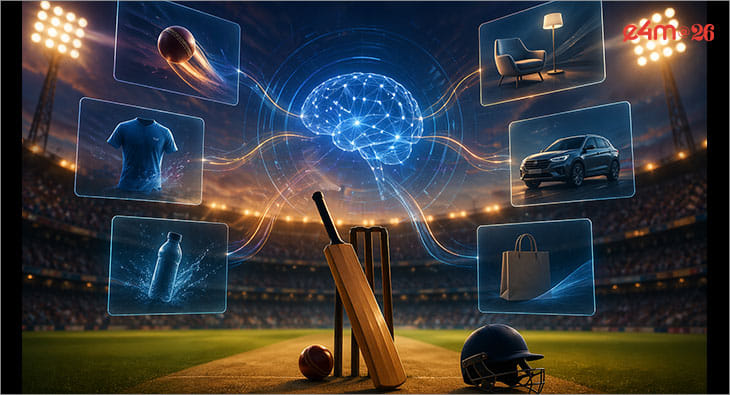

- The Indian Premier League (IPL) is adopting AI-driven moment-based advertising, allowing real-time match events like wickets and boundaries to trigger ads, transforming live sports into a performance marketing platform.
- Despite the potential for increased engagement and advertising effectiveness, many brands remain hesitant to publicly endorse this new approach, viewing it as an ongoing experiment rather than a fully established strategy.
- The IPL is projected to generate significant advertising revenue, with estimates of Rs 7,000 to Rs 8,000 crore for IPL 2026, driven by a growing connected TV audience, particularly from smaller towns.
- Challenges persist in measuring the effectiveness of moment-based ads, as separating the impact of the ad from the excitement of the match remains difficult, leading to concerns about proving incremental business outcomes.
The six is struck. The crowd rises. And, somewhere between the ball clearing the boundary and the replay rolling in, an ad is triggered, bought and served.
Welcome to the newest layer of the Indian Premier League, where the moment is no longer just spectacle. It is all inventory.
Broadcasters and adtech players are increasingly experimenting with AI-driven moment-based advertising this season, using real-time match context such as wickets, boundaries and powerplays as triggers or planning signals. On paper, it sounds like a natural evolution of contextual advertising. In practice, it may be something more consequential. It may be the closest Indian media has come to turning live sport into a performance marketing engine.
The only problem is, most brands don’t seem to want to talk.
Multiple advertisers approached for this story declined to comment, saying they were still reviewing their IPL strategies or were in the middle of active campaigns and or negotiations. The silence is telling. Because while agencies and adtech firms are eager to frame this as the next leap forward, marketers themselves appear to be treating it as a live experiment they are not yet ready to publicly endorse.
That caution sits against a backdrop of scale that is hard to ignore. IPL 2026 is expected to attract between Rs 7,000 and Rs 8,000 crore in advertising spends across broadcast and digital in just two months, with digital alone projected at Rs 3,800 to Rs 4,400 crore, up 20 to 30 percent year on year. Even as the advertiser pool consolidates, ad volumes are reportedly up around 10 percent, signalling that fewer brands are spending more, not less.
At the same time, the infrastructure supporting this shift has quietly matured. India’s connected TV ecosystem has expanded rapidly, with estimates ranging from 45 million households and over 129 million viewers in 2025 to as many as 50 to 60 million households by mid-2026. More importantly, this is no longer a metro-only phenomenon, with over half of CTV audiences now coming from smaller towns.
IPL: The CTV premium reset. Read more
For broadcasters, this is not just scale. It is addressability.
That combination is beginning to reshape how IPL inventory is being sold. JioStar alone has lined up 27 sponsors for IPL 2026 across categories ranging from FMCG to EVs and AI, underlining how the tournament is now being positioned as a testing ground for new-age advertising formats rather than just a legacy branding platform.
JioHotstar and JioAds had not responded to queries at the time of publishing.
The inclusion of Google’s AI-powered Search mode as a partner further signals that AI is not just powering ads around the IPL, but increasingly becoming part of the viewing experience itself.
Within this environment, the shift from campaign-led to moment-led planning is becoming visible.
“Brands are moving from campaign planning to moment planning,” said Arnab Mitra, Founder and Managing Director at Liqvd Asia. “AI-triggered ads are driving higher engagement because they’re contextual and real-time. Early signs show strong interaction spikes, especially for categories like quick commerce and gaming, but direct sales attribution is still evolving.”
That shift is not just about timing. It is about structure.
“IPL 2026 is probably the first time we’re seeing AI-triggered ‘moment’ ads move from experimentation to planned line items in media strategies,” said Rajiv Dingra, Founder and CEO at ReBid. “Brands are building pre-programmed creative libraries mapped to match events like wickets, sixes, powerplays and even player-specific moments.”
The spontaneity of sport, in other words, is being engineered into something premeditated.
Dingra points to higher engagement rates compared to static ads, stronger recall due to contextual synchronisation and improved click-through rates for categories such as quick commerce, fantasy gaming and QSR. But he also notes that the real unlock lies in combining moment-based triggers with audience data, where behavioural signals such as past purchases or intent can amplify outcomes.
Retail media advertising: The hidden flaw
That intersection of moment and intent is where the IPL begins to resemble a performance channel.
“AI-triggered ads are not only limited to external moments but also take into consideration the behaviour of the user,” said Vedavyas Badri, VP – Programmatic at LS Digital. “Programmatic platforms capture real-time intent and activate ads at the intersection of high-attention moments and high-intent users.”
This is a meaningful departure from how IPL advertising has traditionally worked. For years, the tournament has been the ultimate branding playground, driven by reach, recall and cultural relevance. The emerging model suggests something else. A system where a six is not just a highlight, but a trigger, and where the value of that trigger depends on who is watching.
Industry data is beginning to reinforce that narrative. JioStar’s analysis of IPL 2025 campaigns found that FMCG advertisers saw an average 5.7 percent uplift in sales value, rising to 6.3 percent for cross-screen campaigns and 8.4 percent for brands spending more than Rs 10 crore. Its broader playbook claims that new brands on live cricket can see up to 6.9 times higher awareness and as much as 10.8 times higher purchase intent.
Taken together, these numbers begin to position IPL not just as a reach vehicle, but as an outcome-driven medium.
But that is precisely where the consensus begins to break.
“Every inefficiency in how brands measure the return on that spend is expensive,” said Pratham Hegde, Co-founder at Truelift.ai. “Moment advertising is currently running well ahead of the measurement infrastructure brands need to evaluate it honestly.”
Across agencies and adtech players, the central concern is not whether moment-based ads work, but whether their impact can be isolated.
“The bigger challenge right now is proving incrementality, not just measurement,” said Dingra. “Platforms can show engagement spikes during a moment, but the real question is whether that moment ad actually drove incremental business outcomes versus what would have happened anyway.”
Mitra echoed a similar view, noting that while engagement is easy to track, proving that these ads are driving additional business over existing IPL-driven demand remains unclear.
The problem is structural. Live sport is an environment of constant spikes. Wickets, boundaries, close finishes and narrative swings all drive attention independently of advertising. Separating the impact of the ad from the impact of the moment becomes inherently difficult.
“In a live environment like the IPL, there are multiple overlapping spikes,” said Badri. “It’s unclear whether the conversion should be credited to the moment itself or the ad served during that moment.”
Hegde frames the issue more bluntly. If brands cannot separate the lift generated by the ad from the ambient excitement of the match, they are effectively spending on faith.
That contradiction sits at the heart of IPL 2026’s AI ad push: the technology is precise. The measurement is not.
On one side, platforms can trigger ads in milliseconds, personalise them based on user behaviour and deliver them across devices at scale. On the other, they struggle to answer the most fundamental question in marketing. Did it actually drive incremental outcomes?
Programmatic advertising: Rewriting the rules
There are early attempts to bridge this gap. Hegde points to approaches using time-stamped delivery data and machine learning models to isolate incremental impact across geographies and time windows, effectively using the variability of match events as a testing framework. But these remain early-stage solutions, dependent on data sharing, infrastructure and advertiser maturity.
For now, IPL remains less a solved system and more a large-scale experiment. And that may be the real shift.
Because if moment-based advertising can reliably tie a six to a sale or a wicket to an app install, it does more than just improve targeting. It begins to collapse the long-standing divide between branding and performance.
For decades, the IPL has been where brands went to be seen. Performance marketing lived elsewhere, in channels where intent could be captured and measured. AI-triggered moment ads suggest a convergence, not a replacement, but a blurring of roles.
The risk is what gets lost along the way.
When every moment becomes a trigger and every trigger a metric, the creative itself begins to change. Less storytelling, more modularity. Less narrative, more responsiveness. Advertising becomes less about what a brand wants to say and more about when it can say it. Whether that makes for better marketing, or simply more efficient marketing, is still unclear.
For now, the IPL rolls on. The ads trigger. The dashboards fill with spikes, lifts and correlations. And somewhere behind all that data, an entire industry is still trying to answer a deceptively simple question.
Was it the moment that worked? Or the ad.
Read more news about (internet advertising India, internet advertising, advertising India, digital advertising India, media advertising India)
For more updates, be socially connected with us onInstagram, LinkedIn, Twitter, Facebook YouTube & Whatsapp