The biggest field that generative AI is going to disrupt is marketing: Deepak Oram
Deepak Oram, Head of Martech at HDFC Bank, said AI’s greatest value will come from breaking long-standing bottlenecks in marketing operations, particularly in testing and personalised communication
 by
by
Published: Dec 10, 2025 7:30 PM | 4 min read
 Follow Us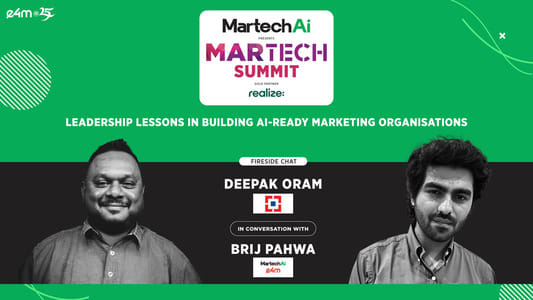

Speaking at the Martech Summit 2025 in New Delhi, held under the theme Agentic AI and Beyond – Redefining the Future of MarTech, Deepak Oram, Head of Martech at HDFC Bank, offered a grounded but expansive view of how artificial intelligence is redefining marketing inside one of India’s largest financial institutions.
“The biggest field that generative AI is going to disrupt is marketing,” he said, framing the conversation around the scale and urgency with which financial institutions must adapt.
Avoiding generalised optimism that often dominates industry discussions, Oram underlined that the application of AI in banking has fundamentally different constraints compared with consumer-internet categories. He said that while sectors such as travel or e-commerce deploy conversational AI with relative ease, banks operate in a trust-laden environment where users are cautious about automated decision-making involving their money. This, he emphasised, changes the entire frame through which MarTech leaders must evaluate emerging capabilities.
Over the past five years, Oram noted, the most dramatic shift has been the recognition that generative AI will disrupt marketing more deeply and more rapidly than most other functions. For HDFC Bank, however, this disruption is less about producing mass-market advertising and more about enabling precision-led, personalised communication that reflects the complexity of its customer base.
Instead of large, persuasive brand campaigns designed to trigger bank-switching behaviour, a rarity in India’s financial sector, the bank has moved decisively toward micro-cohort communication. Customer engagement is now tailored at increasingly narrow levels: city-based professional groups, specific occupational clusters, or niche behavioural segments. Hyper-personalised emailers, dynamic video messaging, and multi-modal communication formats are becoming core to the bank’s marketing strategy.
This strategic pivot, Oram explained, is grounded in the understanding that service experience and relevance drive financial decision-making far more than conventional advertising. AI enables rapid testing, creative iteration, and segmentation at a scale previously impossible. The shift also reframes marketing from episodic campaigns to continuous experimentation. The bank now evaluates long-running communication, such as credit card usage nudges or weekend offer reminders, through ongoing A/B testing rather than static performance assumptions. The results, he said, reveal meaningful scope for improvement even in decade-old automated campaigns.
Oram argued that generative AI is beginning to close this gap by dramatically simplifying tool operation. Earlier, organisations required large marketing operations teams proficient in analytics platforms, segmentation engines, and personalisation tools. Today, AI systems generate audience segments, reports, and recommendations autonomously, leaving human teams to vet outputs rather than execute technical workflows.
This recalibration has implications for hiring. Traditional marketers, even from specialised institutes, often struggled with advanced analytical tools, but AI-driven interfaces now reduce dependence on hard technical skillsets. Instead, new creative and aesthetic proficiencies are becoming essential. The rise of AI-generated imagery and video demands deeper understanding of concepts rooted in cinematography, photography, scriptwriting, and visual composition. As Oram put it, prompt engineering is no longer a purely technical craft; it sits at the intersection of art and machine-guided production.
“Knowing how to instruct the AI is no longer about typing a prompt,” he said. “It is about understanding lenses, angles, pacing, visual grammar and narrative intent.”
The discussion also briefly touched on PayzApp, HDFC Bank’s payments product. Oram clarified that while the app enjoys a large user base due to the bank’s brand strength, it is positioned as a premium entry point into the HDFC ecosystem rather than as a mass-market competitor to standalone UPI platforms. The objective is not wide national penetration across smaller towns but providing a trusted, bank-backed digital interface for customers and prospects who prefer a lighter, instant-access version of the bank.
When asked about the state of HDFC Bank’s MarTech stack, Oram described it as a longstanding and complex infrastructure undergoing continuous restructuring. The bank has invested in a major enterprise platform, but the depth of systems, integrations, and legacy workflows means modernisation is an ongoing effort rather than a completed transformation. “It is a criss-cross of wires, and I am far from done,” he remarked.
Despite the pace of technological acceleration, Oram maintained that AI’s greatest value will come from breaking long-standing bottlenecks in marketing operations, particularly in testing, creative iteration, and personalised communication. Campaigns, he suggested, matter less than the ability to refine messages continuously, at scale, and across every segment. This shift, he believes, will define the next phase of MarTech in financial services.
Closing the session, Oram reiterated that the industry is only beginning to understand the depth of change Agentic AI will bring. The future of marketing, he suggested, lies not in bigger ideas but in more adaptive systems. “AI will crush the bottleneck of iterative improvement,” he said. “We should move away from campaign thinking and toward continuous optimisation.”
Read more news about Digital Media, Internet Advertising, Marketing News, Television Media, Radio Media
For more updates, be socially connected with us onInstagram, LinkedIn, Twitter, Facebook, YouTube & Google News
