Consumer path to purchase is no longer linear: Sameer Jain, Axis Max Life Insurance
At the MarTechAI Summit, Sameer Jain discussed how AI is reshaping media mix, audience discovery, and planning strategies
 by
by
Published: Dec 10, 2025 5:06 PM | 5 min read
 Follow Us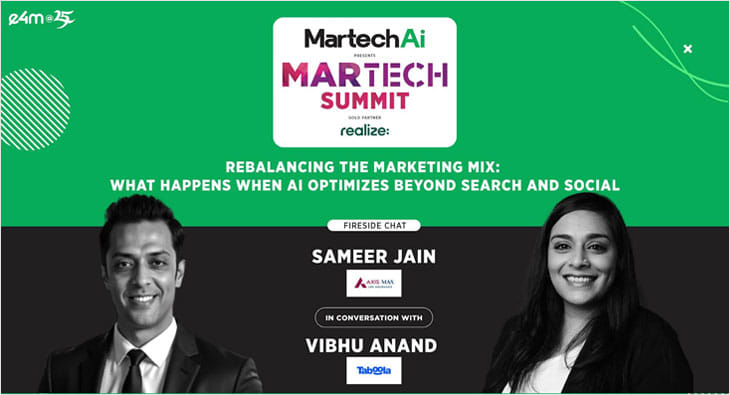

In an era where artificial intelligence is fundamentally reshaping how brands understand audiences, the marketing playbook is undergoing a profound shift.
At the heart of this evolution lies a move away from intuition-driven planning toward intelligence-led optimization. In a fireside chat at MarTechAI Summit 2025, Sameer Jain, CVP and Head of D2C Business and Digital Brand at Axis Max Life Insurance, unpacked how AI is challenging long-held conventions around media mix, audience discovery, and planning confidence.
Reflecting on how planning once looked, Jain, in conversation with Vibhu Anand, Advertising Account Director at Taboola, noted that the process was relatively straightforward just a few years ago. Marketing teams would start with the basics—category intent, Google search trends, projected intent growth, demographic filters—and then translate those into budgets for search, social, and secondary channels.
“That thinking is obsolete now,” he said during the fire side chat on ‘Rebalancing the Marketing Mix: What Happens When AI Optimizes Beyond Search and Social’.
“The consumer path to purchase isn’t linear anymore. Discovery can happen anywhere—on a news site, a social platform, YouTube, even a JNI platform. After that, users may interact with the brand on WhatsApp, visit the website, or compare options on aggregators. It’s unpredictable,” Jain said.
This unpredictability has pushed Axis Max Life to rely more heavily on algorithms. With the right business objectives and strong signal flows into campaigns, the algorithms do the “heavy lifting.”
Interestingly, even though online insurance search intent grew only 15–20 percent last year, the business grew 50–60 percent, evidence that category search intent is no longer a reliable proxy for market opportunity, Jain said.
When AI Surfaces What Linear Thinking Misses
One of the most telling examples of AI-led optimization came from a creator-driven performance campaign. Axis Max Life collaborated with a Telugu influencer whose content unexpectedly went viral across performance channels.
“The cost of acquisition halved for nearly two weeks,” Jain shared. “Without any geographic targeting, the algorithm concentrated almost 60–70 percent of our marketing spend in Telangana and Andhra during that period. Conversion rates doubled, and lead generation costs dropped.”
This kind of outcome, he added, would be impossible under traditional geo-based planning where budgets are pre-distributed across regions. AI, in contrast, spots emerging pockets of resonance and moves money in real time.
Cracking New Audience Segments on the Open Web
While social platforms often dominate performance conversations, the open web continues to play a crucial—and often underestimated—role.
Using Taboola’s AI-driven capabilities, Axis Max Life discovered new in-market segments that defied conventional logic. “We learned that users interested in self-help were highly likely to convert for insurance,” Jain said. “It wasn’t something we would have identified through linear planning. But once you think about it, it makes sense—people invested in improving their lives are more likely to value financial security.”
This ability to unearth micro-pockets of audiences illustrates where AI is most powerful: revealing behavioural patterns marketers weren’t even looking for.
As platforms like search and social move toward consolidated, algorithm-driven campaign structures, Jain pointed out that marketers are losing control over message tailoring. With fewer levers to pull and less visibility into audience contexts, these platforms increasingly behave like black boxes.
“The open web still allows us to have rich, contextual conversations,” he said. If a user is reading about global geopolitical tensions—say, the Ukraine–Russia conflict or India’s role in the global south—it signals a risk-aware mindset. In such moments, serving creatives that talk about low-risk investment options or portfolio diversification can be far more powerful.
“That level of personalization isn’t possible anymore on search or social,” he explained. “But on the open web, you can still closely align the user’s mindset with the brand’s message.”
One of the emerging challenges for marketers is that not all discovery moments translate into search behaviour. Many users consume content that signals intent, but never conduct corresponding searches—leaving gaps that search platforms simply cannot fill.
Jain argued that this is precisely why brands must maintain a balanced media mix. “If you over-index on search and social because it’s easier or because your team is comfortable, you miss out on contextual moments that only the open web can capture.”
AI-led open web platforms, he added, are turning consumption patterns into predictive signals for budget allocation—creating a planning layer that complements the black-box nature of search and social.
A Shift from Platform-Backwards to Consumer-Backwards Planning
Looking ahead, Jain sees a fundamental shift in how planning itself is structured.
“We’re moving away from platform-backward planning—where you decide allocations for search, social, and then everything else—to consumer-backward planning,” he said. “If the consumer is somewhere, consuming certain trends, having certain conversations, we have to be there. The plan starts with the consumer, not the platform.”
It’s a shift that AI is not just enabling but accelerating.
Read more news about Marketing News, Advertising News, PR and Corporate Communication News, Digital News, People Movement News
For more updates, be socially connected with us onInstagram, LinkedIn, Twitter, Facebook, YouTube & Google News