‘Programmatic advtg has shifted from niche to mainstream, driving efficiency & innovation’
The e4m Real-time Programmatic Advertising Conference 2024 saw a panel discussion on emerging trends, practical solutions, and best practices in the programmatic space
 by
by
Published: Sep 20, 2024 1:46 PM | 6 min read
 Follow Us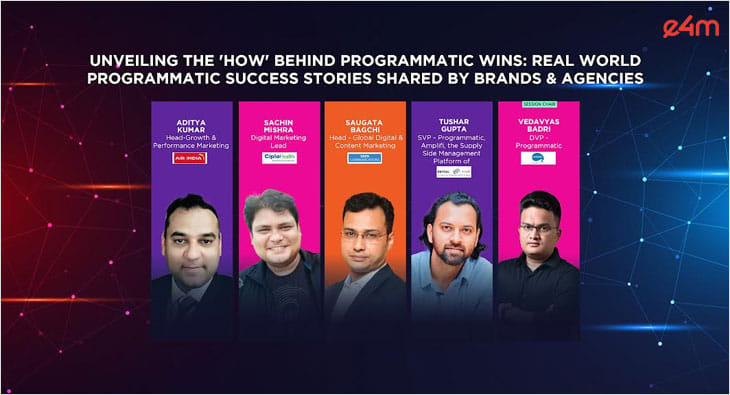

At the e4m Real-time Programmatic Advertising Conference 2024, Vedavyas Badri, DVP-Programmatic at LS Digital Group, chaired a panel discussion on “Unveiling the 'How' Behind Programmatic Wins: Real World Programmatic Success Stories Shared by Brands & Agencies.”
The panellists included Aditya Kumar, Head of Growth & Performance Marketing at Air India; Sachin Mishra, Digital Marketing Lead at Cipla Health; Saugata Bagchi, Head of Global Digital & Content Marketing at Tata Communications; and Tushar Gupta, SVP-Programmatic Growth & Partnerships at Amnet, Dentsu.
Badri opened the discussion by asking Bagchi about his first experience adopting programmatic as part of his media strategy at Tata Communications.
Bagchi responded by reflecting on his transition from the agency side to Tata Communications. He shared, “When you are on the agency side, one tends to think that programmatic is a way of life, right? Nothing can exist without programmatic in today’s digital-led marketing ecosystem. When I went to my boss for the first time with a programmatic plan, he was like, ‘We are in a different business.’”
He went on to explain that despite initial hesitation, Tata Communications has since seen strong growth in its programmatic efforts. “We’ve shown a very healthy CAGR of upwards of 30 per cent in outcomes and investments. Programmatic is not just for FMCG or D2C brands; it's relevant across industries because it delivers efficiency, precision, and cost-effectiveness with the right targeting and frequency,” he said.
Bagchi highlighted how the shift in mindset took time but ultimately allowed the company to move from a "spray and pray" approach to a more focused, targeted, and efficient strategy.
Badri then turned to Kumar, asking how programmatic advertising fit into their larger media strategy during the brand's transformation. Kumar explained, “As most of you know, Air India is in the midst of a huge transformation. Almost a million eyes are watching us, wondering what we’re doing and when things are going to change. With those kinds of expectations, it's crucial for us as a brand to communicate transparently with our consumers.”
Given this need for transparency, Air India sought a channel with vast global reach. “We’re not just talking about India; we're talking globally. The usual go-to channels for us have been Google and Facebook, but the sheer scale of what we needed to communicate—what we’re doing, what’s changing, and when—meant we had to evaluate something beyond that. This is where programmatic came into the picture.”
Kumar shared that the decision to integrate programmatic advertising was driven by the necessity to spread the message sharply and effectively. “We needed a programmatic ecosystem to help spread the word and generate the right kind of word of mouth,” he added.
Gupta brought in a different perspective, sharing his experience from the agency side, calling his introduction to programmatic "transformative" due to its data-centric approach. "Programmatic allows enhanced targeting with precision at scale," he explained, noting how many clients previously overlooked their first-party data until the shift towards cookie-less strategies.
Gupta emphasised programmatic’s transparency, stating, "It offers complete visibility into the supply chain, enabling control over where ads are placed and how they perform. This lets marketers optimise campaigns in real-time."
He also highlighted its efficiency, adding, "With AI automating tasks like campaign setup and reporting, marketers can focus more on strategy and creative innovation."
The session moved forward with Mishra sharing a media planner's perspective on programmatic. He highlighted the transition from inventory buying, where plans focused on specific websites and CPM-based deals, to audience buying through programmatic. "Before 2015-2016, it was all duplicated media and wasted money. Programmatic shifted us to audience buying, allowing effective targeting and eliminating wastage."
He added, "Programmatic has transformed media plans, making them far more efficient. It's no longer about publisher deals but leveraging audience data to add value to clients' advertising dollars."
Next, Bagchi described how programmatic has transformed digital marketing. Initially, the approach was scattergun, with funds allocated for leads without strategic targeting.
"Programmatic brought a shift to audience-based buying and targeting. During COVID, we secured a significant enterprise B2B deal online, which now contributes around 8% to our new business annually, amounting to billions."
Bagchi emphasised that programmatic has not only improved ROI and engagement but also boosted awareness among sales teams, leading to more successful deals. "It's not just about spending on marketing but reinvesting in priority business areas, yielding multiple benefits."
Badri then asked Mishra to build on success stories and audiences. “How crucial are creatives for the overall success of a campaign? Considering the evolution from pre-programmatic to programmatic, how have creatives changed, and how are we currently utilising them in programmatic to drive success?”
Mishra answered by discussing the challenges of integrating creatives into programmatic advertising. He highlighted that many brands struggle to grasp programmatic's potential, often repurposing TV commercials for digital without leveraging creative optimisation techniques.
“Dynamic creative optimisation is just one aspect. Programmatic allows for extensive creative optimisation, including A/B testing, which is typically time-consuming and costly in traditional methods. With programmatic, this process becomes faster and more cost-effective, enabling brands to test and understand what works best with different consumer segments.”
He noted that while creative optimisation is a powerful tool, it remains underutilised, especially in sectors like FMCG and healthcare. “There’s a significant opportunity to explore and experiment with creative strategies that go beyond the usual practices, but many brands stick to their comfort zones.”
Kumar shared insights on Air India's use of programmatic advertising, particularly in international markets such as Europe, the USA, and Canada. The results have been positive, with brand lift studies showing increased awareness and improved presentation.
Regarding creative strategies, Kumar highlighted a shift in approach. “Instead of adapting a TV commercial for various mediums, we now start with the channel and develop our creative strategy accordingly. For example, whether it's a digital platform or an audio service like Spotify, our creative strategy is tailored to the specific channel.”
This method has proven effective, allowing Air India to better align their creative with each channel's unique characteristics.
Gupta highlighted the significant impact of programmatic advertising over the past decade. “In 2015-16, programmatic adoption was minimal, but now, industry reports show that nearly 46% of media budgets are allocated to programmatic. At Dentsu, we've seen legacy brands shift from spending just 2-5% on programmatic to dedicating up to 80% of their budget to it.”
He also shared a success story from Dentsu: “For a white goods brand, we implemented a weather-triggered ad campaign in the APAC region. This innovation, which displayed ads in a CTV ecosystem based on specific weather conditions, reached over a million unique households with impressive viewability and a 90% completion rate. It proved to be a highly relevant and effective approach.”
Read more news about Digital Media, Internet Advertising, Marketing News, Television Media, Radio Media
For more updates, be socially connected with us onInstagram, LinkedIn, Twitter, Facebook, YouTube & Google News
