‘Consistency and relevancy key to cross-channel integration’
At the e4m Real-time Programmatic Advertising Conference 2024, industry experts discussed the importance of consistent and relevant brand messaging across multiple advertising channels
 by
by
Published: Sep 20, 2024 2:02 PM | 8 min read
 Follow Us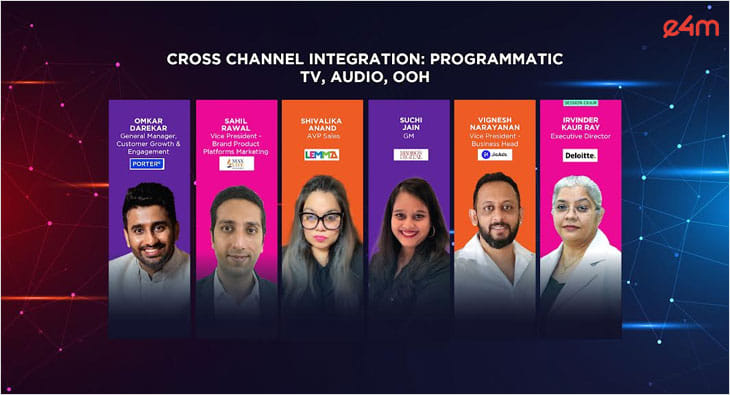

At the e4m Real-time Programmatic Advertising Conference 2024, a panel discussion on “Cross-Channel Integration: Mastering Programmatic Advertising Across TV, Audio, and OOH”, featured insights from Omkar Darekar, General Manager of Customer Growth & Engagement at Porter; Sahil Rawal, Vice President of Brand Product Platforms Marketing at Max Life Insurance; Shivalika Anand, AVP of Sales at Lemma; Suchi Jain, GM at Madison World; and Vignesh Narayanan, Vice President and Business Head of Media at JioAds.
The session was chaired by Irvinder Kaur Ray, Executive Director at Deloitte India.
The discussion delved into key areas, including the benefits of cross-channel integration, the programmatic capabilities across TV, Audio, and OOH, and real-world success stories of integrated campaigns.
Ray began the session by noting the omnipresence of today’s consumer. "Consumers are everywhere—consuming content, engaging with educational programs, and interacting with e-commerce platforms and brands across multiple channels. So, is this a problem or an opportunity for brands?" Ray asked. She invited the panellists to talk about the benefits they’ve observed from cross-channel integration.
Darekar highlighted the significance of cross-channel integration by talking about the numerous touchpoints modern consumers interact with. "There's a marketing principle that suggests it takes seven or more touchpoints for a brand message to be internalised or prompt action," he explained.
"Given the multitude of advertising platforms and content available, it is essential for brands to maintain consistency and relevancy across all channels. This consistency helps ensure that brand messaging is heard and creates a seamless experience for users, which can enhance ad recall, brand awareness, and potentially boost customer loyalty."
He also noted the advantage of integrated analytics that cross-channel strategies offer. "Integrated analytics allow us to understand better consumer behaviour across platforms and how it impacts a brand's image," Darekar said. "This not only improves campaign assessment and measurement but also enables more strategic investment into channels that offer better ROI."
Rawal discussed the complexities of building consumer trust in life insurance and how cross-channel integration is crucial. "A life insurance relationship typically spans 10 to 40 years—longer than many marriages today," he noted. "Building a consistent level of trust is essential for reassuring customers about the brand's reliability. Additionally, the product is complex; many people might not fully understand terms like term insurance or non-par savings insurance, making education crucial."
He further elaborated on the challenges associated with long customer journeys, which often involve filling out extensive forms and navigating post-payment onboarding issues.
"Cross-channel media helps us seamlessly stitch together these various stages of the customer journey," Rawal explained. "It allows us to educate, engage, and maintain consistent customer interaction, ultimately leading to better conversions. So, despite the challenges, cross-channel engagement is instrumental in creating a smooth and effective customer experience."
The discussion then moved to the evolving landscape of digital advertising and the role of emerging platforms in cross-channel integration. Anand said, "From a sales perspective, media planners and marketers often face the challenge of navigating a complex digital ecosystem," she said. "They must engage with numerous vendors to create a seamless user journey."
She discussed the shifting trends in digital advertising, mentioning, "Five years ago, selling TikTok was a challenge, and YouTube budgets were hard to come by. Now, platforms like OTT and CTV have their dedicated budgets due to their evolved status."
Anand then pointed to Digital Out of Home (DOOH) as an emerging format. "Digital Out of Home has traditionally been a black box regarding measurability and reporting," she observed. "However, as we digitise offline audiences and integrate them into cross-channel strategies, DOOH plays a significant role. It enables a full-funnel approach, capturing users' attention across multiple touchpoints, whether on a one-to-one or one-to-many basis."
Agreeing with Anand, Jain shared her agency perspective on cross-channel integration. She said, “It makes our life a little difficult because I have two clients to justify strategies to and a publisher ecosystem to navigate.”
However, she highlighted the benefits, saying, “Cross-channel integration builds trust and awareness through consistent messaging across mediums. If the same narrative is visible everywhere, it constantly reinforces the brand in the consumer's mind.”
Jain also emphasised the analytical advantage, “It provides detailed insights into consumer behaviour, allowing us to optimise media based on where we see the highest return on investment.”
She concluded, “It also leads to hyper-personalisation and addresses key benefits effectively.”
Continuing the conversation, Narayanan discussed the crucial principle of targeting: delivering the right ad to the right person at the right time. “That premise stays true all the time,” he stated. He stressed the growing need for cross-channel integration, as nearly all platforms are now monetising.
“Advertising is seen as a core revenue channel for almost every platform now. I don't think there is any platform nowadays which is not monetising in one way or another,” Narayanan observed. He highlighted the challenge of reaching customers across numerous touchpoints without causing ad fatigue, noting, “Yes, it’s great to reach the customer at so many points, but how do you ensure you’re not causing fatigue?”
Modern marketing budgets are increasingly ROI-focused. “Brand budgets are equivalent to performance budgets nowadays. How do we ensure that you get value for the buck?”
He raised concern about the trial-and-error nature of cross-channel optimisation “How do you figure out which channel works and how do you optimise at the right time?”
When asked about the programmatic potential of television and audio channels, Narayanan outlined two primary uses of programmatic advertising. “One objective is to consolidate billing through a single DSP, rather than dealing with multiple publishers,” he explained. “The other is for performance-oriented brands seeking advanced bidding and data capabilities.”
He acknowledged progress in areas like Connected TV (CTV), noting, “CTV has remarkable targeting capabilities that we didn’t know were possible. The ecosystem and network of OTTs have enhanced our ability to leverage first-party data.”
However, he pointed out that while some elements are advancing, others are lagging behind. “Is it truly programmatic in terms of biddability, targeting, and measurement? Not really, but it does meet some of the objectives.”
Jain addressed the constraints of Connected TV (CTV) and programmatic TV. “Scale is one challenge, as CTV is still evolving within the digital ecosystem,” she said. “Another issue is measurement. Co-viewing on CTV, similar to traditional TV, makes it difficult to determine who is actually exposed to an ad.”
She mentioned that while the use of first-party data is improving, CTV in India remains basic, focusing primarily on content and time-band targeting. “Programmatic capabilities are somewhat limited, though there is potential. For instance, some providers offer device data cuts that suggest high-net-worth or tier-one city audiences,” Jain explained.
She also shared innovative approaches like those in Australia, where experiments include measuring ad viewability through eye movement sensors on TV screens. “That’s an emerging trend in attention metrics and could reshape how we measure and monetise ads.”
Next, the evolution of programmatic Digital Out-of-Home (DOH) advertising was discussed by Anand. “Globally, 33% of advertisers have shifted from traditional DOH to programmatic DOH,” she said. “According to a GroupM report, DOH revenue is set to reach $105 million this year and is expected to double in the next two years.”
She highlighted the challenges traditionally associated with DOH, such as lack of measurement and real-time reporting. “Programmatic DOH addresses these issues with a streamlined approach. For example, we recently launched a campaign on 15,000 screens in a single day, showcasing significant scalability.”
She also emphasised the benefits of real-time reporting and cost efficiency. “With programmatic DOH, you pay only for the impressions delivered, not the entire day. This, combined with third-party studies and the use of first-party data for retargeting, enhances measurement and performance.”
With respect to future advancements, she noted that while current technology is evolving, the potential for even more precise audience measurement exists. “In the future, AI-driven technologies could allow screens to count viewers directly, making programmatic DOH even more ROI-driven and transparent.”
Rawal then took the stage and reflected on the evolution of programmatic advertising, sharing a well-known marketing adage: “50% of your money is wasted, you just don’t know which half.” He explained that the programmatic journey at MaxLife Insurance began as an experiment aimed at reducing this waste. “Over time, this approach has significantly scaled our D2C business,” he noted.
He highlighted the expansion of programmatic spending into traditional media, such as TV++, which includes both linear TV and newer formats like CTV and OTT. “The goal remains the same: to ensure every dollar spent reaches the right viewer and maximises the efficiency of our first-party data,” Rawal concluded.
Darekar outlined their approach to budget allocation in media planning, dividing it into two key parts. First, he emphasised the importance of defining the campaign objective, whether it’s awareness, quality of awareness, consideration, or preference. “Understanding your target audience goes beyond demographics to include media consumption habits,” he added.
He then explained the need to assess media channels for overlap to optimise cost efficiency. “Once the campaign is live, we evaluate the cost efficiency of each channel, reallocating the budget as needed,” Darekar said. He also noted the importance of reserving funds for new and emerging channels, helping decide between reach versus frequency and performance versus brand orientation.
Read more news about Marketing News, Advertising News, PR and Corporate Communication News, Digital News, People Movement News
For more updates, be socially connected with us onInstagram, LinkedIn, Twitter, Facebook, YouTube & Google News
