How GenAI is rewiring content production from speed to scale
Even as AI unlocks unprecedented speed and scale, a panel at the e4m MarTechAI Summit & Awards warned that authenticity, brand guardrails and rights management remain non-negotiable
 by
by
Published: Dec 11, 2025 7:26 PM | 5 min read
 Follow Us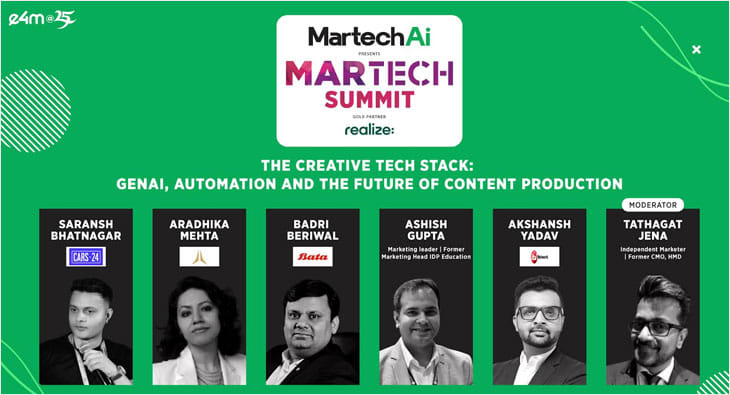

At the e4m MarTechAI Summit & Awards 2025, marketing leaders examined how generative AI and automation are reshaping content production, from hyper-personalised campaigns to vernacular adaptations and the risks that come with speed.
The session, moderated by Tathagat Jena, was titled “The Creative Tech Stack: GenAI, Automation and the Future of Content Production”. It featured insights from Aradhika Mehta, Marketing Leader & Founder (ex-Aditya Birla Fashion & Tasva); Badri Beriwal, Chief Strategy and Business Development Officer, Bata India; Ashish Gupta, former Marketing Head, IDP Education; and Akshansh Yadav, CEO Digital, iTV Network.
Opening the conversation, Jena set out the problem, i.e. the demand on marketers to produce vastly more content has surged because of social and D2C channels, shorter content cycles and the need for faster, smarter regional adaptations.
He said, “Earlier, we used to produce one piece of content after a lot of research and it would run its course for two to three months, sometimes six months,” noting that today the volume and specificity required have gone up phenomenally. He asked where CMOs see the demand for generative AI and automation, whether for launches, regional adaptations, always-on social activity or hyper-personalised retargeting.
Yadav responded that production pipelines have reached a tipping point. “If you have to go from the production table to going live with a news piece or a news video, the time has practically come down by 99.5%. AI has been a big enabler there,” he said, adding that AI becomes especially useful when running thousands of campaigns and testing thousands of creatives and artists. “AI basically lasts three to five minutes, as is the game completely, at least in the news media.”
Mehta welcomed that view but flagged limits. “The point of inflection for conventional CMOs is personalisation, particularly hyper-personalisation at scale, and India needs vernacular adaptations,” she said, calling that the lowest-hanging fruit.
At the same time she warned of pitfalls in relying solely on AI for creative output. “There was a recent case when an AI-generated picture of a public figure looked nothing like the person. So driving content primarily with AI has its pitfalls.” She emphasised that the space is evolving and that practitioners are still figuring things out.
Beriwal described how Bata is already using AI for localisation and creative stitching. “We shot with our celebrity and needed vernacular lip-sync across languages. AI did the lip-sync absolutely perfectly,” he said. He cautioned, however, that AI today is often a “plan B”: “I don’t think we’ve reached a stage where plan A is AI, but I think for 2026 teams will increasingly think of AI as plan A.” He argued the landscape is fast-moving, with new frontiers unlocked every quarter, and encouraged marketers and agencies to stay watchful and learn from one another.
Taking the discussion forward, Gupta illustrated the utility, and the authenticity challenge, from the student recruitment funnel. “Personalisation is very important for student placements because each student has unique choices,” he said. “By hyper-personalisation we can send a very personalised message to a particular university student as per the criteria.” Yet he warned that the proliferation of AI content raises questions of authenticity. “The only problem we are facing is the authenticity of the content.”
Jena then steered the debate to the tension between speed and enduring brand storytelling. Some content needs to be short-lived and CTA-driven, while other creative must be enduring and true to brand values. He asked what guardrails panellists keep in mind when producing content that is completely made in AI.
Mehta replied that guardrails are essential. “Until you keep them, there is a huge tendency for whatever tool you are using to take it beyond a certain acceptable level. The story or the brand authenticity has to be watertight,” she said, arguing that big ideas or storytelling must come from serious consumer insight and that AI can be used as a research aid but will only surface what data allows.
She offered a metaphor: “If you think of AI as a spider spinning a web, you need to clearly define the boundaries. If you do not, it tends to go all over the place.” She also noted that, for now, Indian audiences are discerning enough to detect AI-generated creatives.
Beriwal separated two concerns: the brand and the technical possibility. “From a brand side, it is no different to how you would treat your agency partner or director. Your brief and idea has to come alive in the true sense,” he said.
On rights and talent he pointed out a practical benefit that when a brand ambassador gives one day’s shoot and one-year rights, AI lets marketers extend that creative without re-shoots, provided they have the permissions. Advising fellow CMOs, he urged hands-on experimentation. He said, “Get your hands dirty, subscribe to tools, put your own prompts, do it yourself, and you will understand how fast this space is evolving.”
Yadav closed with a reminder of commercial realities for many B2C players. “While AI might be vanity for some brands, for a lot of B2C players it’s about survival. Your Instagram or Facebook cataloging is being generated, and there’s a big market for prompt engineers,” he said, suggesting that writing the right prompts is already a valuable skill.
Throughout the session, the panellists struck a pragmatic balance. AI and automation are accelerating production, enabling scale and vernacular reach, but brand guardrails, rights management and authenticity checks remain crucial as marketers integrate the creative tech stack into their workflows.
Read more news about Digital Media, Internet Advertising, Marketing News, Television Media, Radio Media
For more updates, be socially connected with us onInstagram, LinkedIn, Twitter, Facebook, YouTube & Google News