MarTechAI Summit 2025: Industry leaders push for ethical, empathetic data use
Experts unpacked why brands should offer solutions rather than flooding customers with marketing messages, and why AI-driven personalisation must begin with contextual understanding
 by
by
Published: Dec 11, 2025 8:50 AM | 6 min read
 Follow Us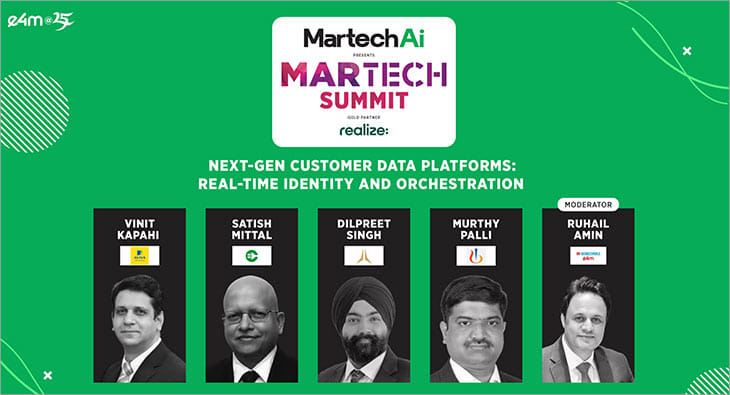

At the MarTechAI Summit 2025, industry leaders unpacked how brands can use identity-driven insights to deepen customer understanding without crossing the line into intrusive monitoring.
The session titled “Next-Gen Customer Data Platforms: Real-Time Identity and Orchestration” featured perspectives from Vinit Kapahi, Chief Marketing Officer, Aviva Life Insurance India; Satish Mittal, Co-Founder and Chief Digital Officer, Chargeup; Dilpreet Singh, Head of CRM, ITC Hotels; and Murthy Palli, Group Head – MarTech Products, Novartis. The discussion was moderated by Ruhail Amin, Senior Editor, BW Businessworld and exchange4media.
Amin opened the discussion by asking how brands strike the balance between insight-led personalisation and over-surveillance. Kapahi acknowledged the tension. “In today's context, there's a very fine line by which you can actually separate what is the customer's need and what is intrusion,” he said, noting that Aviva puts strong emphasis on values while interpreting intent signals.
To illustrate, he described a case where a customer repeatedly searched for a simple term product late at night. “We thought that it is a great time to go back and pitch to a consumer,” he said. But a deeper look revealed that the customer was actually trying to add a nominee to the policy. “One way is that I go back and flag them with a lot of messages… The other is that I actually find what the problem is and empathetically source it,” he explained.
Instead of pushing product-led communication, his team chose to assist the customer with the nominee update. “We draw a simple line between what is the customer's need and look at that empathetic sort of solution rather than flooding marketing messages,” he said.
For Kapahi, resolving the issue with a human call was more valuable than reacting to the data trail.
Amin then steered the conversation towards identity-driven insights and emotional connection. Representing the EV ecosystem, Mittal highlighted the unique needs of drivers working in markets that are not digitally native. “This is a segment which is not digitally enabled. English is not the first language. They are not comfortable typing; they are comfortable talking,” he said.
For this audience, AI-driven personalisation must begin with contextual understanding. “How do you bring an intelligence which matters to the driver?” he asked. Through conversations and local data, the Chargeup team discovered mobility patterns. Drivers in tourist cities like Mathura, Jaipur, or Agra would cover 100 kilometres on weekends, while those in cities like Panipat or Ludhiana would not. Such insights helped tailor decisions around service centre availability. “That personalisation matters to them,” he said, adding that the priority was solving drivers’ real problems rather than acting out of brand convenience.
Turning to the interplay of technology and human judgement, Amin asked how the human element retains its value in martech-heavy environments. Singh stressed that hospitality relies fundamentally on people. “It is by the people, for the people. Human element is something which you will definitely not be able to take out,” he said.
He acknowledged that hospitality has been a late adopter of technology and data, but the shift is now well underway. “We have come a long way in terms of understanding the importance of the data,” he said, emphasising the strength of real-time interaction data available across the guest journey.
For Singh, data enhances but does not replace human sensitivity. “No matter how strong your processes are or how good your technology is, at the end of the day, you have to deal with people,” he said. Whether dietary preferences, allergies, or personalised service, the system must consolidate that information while humans interpret and act on it.
Amin next turned to the healthcare lens, asking Palli about capability gaps that emerge when companies shift to real-time CDPs, and how leaders can build agility across an industry governed by strict regulations and high-stakes outcomes.
Palli underscored the sensitivities inherent to pharma. “Our industry is very important… we are actually looking at life-saving medicines,” he said, noting that while the commercial model begins with a doctor’s prescription, it extends far into patient education.
With doctors and patients now digital natives, missing the right channels comes at a cost. The challenge, he explained, lies in adapting FMCG-style models to a highly restricted environment. “How can you be present in your digital channels… and ensure that you are getting the right level of information that they actually need at that point in time?” he said.
For Palli, the biggest shift required is mindset. Marketers must learn to build empathy maps and use data ethically, adding that the industry is evolving and the journey remains continuous.
The conversation moved to how a brand’s personality and core values should influence the type of data it collects and the way experiences are orchestrated. Kapahi responded that the question is not about the breadth of data collected but its meaningful application. “I can collect a lot of data but ultimately if I'm not able to give any substantial solution to a consumer, it doesn't matter,” he said.
He stressed that data must be used in ways that genuinely matter to customers. Offering a contextual example, he said, “I should be able to greet a consumer at the point of time that makes sense to him/her.” But overstepping into private space does not help.
Shifting to organisational fairness and reducing bias, Mittal drew from the EV ecosystem. He highlighted the harsh realities drivers face: extremely high interest rates, costly battery upkeep, and frequent replacement cycles. “The driver who delivers at our home in 10 minutes is not able to make even 10 dollars a day,” he said.
By focusing on the problems rather than preconceived notions about the drivers themselves, Chargeup built solutions that uplifted the entire ecosystem. “Once we provide 100% uptime to the EV driver, it directly impacts the NBFC reports. So he runs more and hence he gets paid well,” he said. Data also helped segment “situational defaults versus intentional defaults,” allowing fairer decisions and greater trust.
Amin then asked Singh how real-time data can spark creativity and help brands tell better stories. Singh explained that hospitality, at its core, is a comfort-driven business. “You are coming to the hotels just to get the comfort,” he said. He recalled a dataset showing repeated guest feedback about pillows and mattresses not suiting different body types.
That insight triggered extensive research, resulting in ITC’s “Sleep Boutique,” a curated range of linen, mattress options, and pillow choices available in its luxury collection hotels. The initiative also expanded into a full-fledged sleep menu with scientifically backed ingredients. “There was a complete exercise based on that feedback,” he explained.
Closing the segment, Amin raised the question of regulation and whether fear of the regulatory layer influences how technologies are built or deployed. Mittal emphasised that pharma is among the most tightly governed categories. “We actually follow the most stringent GDPR criteria, even for non-market, where there is no GDPR,” he said.
For him, compliance is an extension of brand values. “It goes back to the brand values, i.e. transparency, service, and trust of the data.”
Read more news about Marketing News, Advertising News, PR and Corporate Communication News, Digital News, People Movement News
For more updates, be socially connected with us onInstagram, LinkedIn, Twitter, Facebook, YouTube & Google News