Marketers eye agentic AI for context, precision and scale
At the MarTechAI Summit 2025, marketers unpacked how agentic AI is shifting from event-triggered automation to moment-driven intelligence
 by
by
Published: Dec 11, 2025 8:34 AM | 9 min read
 Follow Us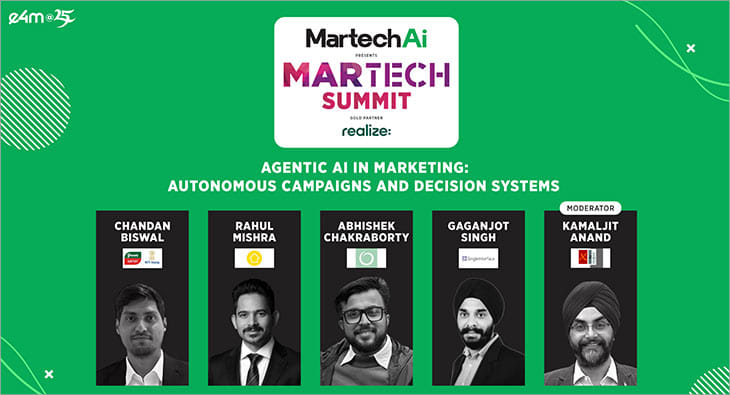

In an age where consumers and professionals are bombarded with choices and tools, the promise of artificial intelligence is often matched by uncertainty about where, and how fast, to place real bets. At the MarTechAI Summit 2025, the session titled “Agentic AI in Marketing: Autonomous Campaigns and Decision Systems” brought this tension into sharp focus.
Moderated by Kamaljit Anand, Managing Director, KIE Square, the panel featured Rahul Mishra, Head – Performance & CRM, Housing.com; Abhishek Chakraborty, Head of Brand Communication, Digital and PR, Oriflame Cosmetics; and Gaganjot Singh, VP, New Business Development, SingleInterface.
Setting the context, Anand spoke about the overwhelming pace at which technology is moving and the choices confronting both consumers and enterprises. He added that while the excitement around adopting new systems is evident, decision-makers are equally cautious. “Maybe they’re very happy about the scenario or maybe they aren’t because when you have too many choices and you have to spend real money on that, it’s not an easy decision,” he said.
He highlighted the gap between supply and demand. “The market is flooded with capabilities and skill sets. But if you look at demand, it’s growing slowly. It is judging, it is evaluating, because it’s not sure whether this is the technology to invest in or whether to wait it out.”
Anand illustrated the dilemma with an example from a decade ago, when his team built algorithms for a hedge fund that traded on second-bar data, enabling capital to be reused up to 60 times an hour. “We were startled to know that in the US, the data was at millisecond level,” he said. “You can actually enter and exit within the same second, technically 3,600 times in an hour.”
But when he recently revisited the fund to propose newer systems, he encountered deep reluctance. “I don’t know about this technology… It’s a complete black box. I’m not sure I would put real money into it,” he was told, a resistance he said also persists in marketing, where “what is very definitive has great value,” and anything less certain risks losing credibility despite its speed and agility.
With that, he invited the panel to share their experiences with current systems and implementations.
Singh answered by noting a surge in demand post-AI adoption, especially from tier-three and tier-four markets seeking to scale campaigns and insights. He cited a large Indian electronics retailer where SingleInterface manages around 3,000 stores. “For each location, there are eight agentic AI flows,” he said. While generative AI handles content like text or images, agentic AI, he explained, is “goal-oriented. You give it a goal, it works on complex data systems, and then it comes out with an output.”
He illustrated how these workflows autonomously analyse competitive activity, customer-posted images, reviews of new technologies like smartphones or earbuds, and more; all feeding into store-level recommendations. “Imagine a brand spending millions on a TV campaign during IPL or a World Cup, but the last mile is at the store or e-commerce or quick commerce,” he said. “These agentic AI workflows give you the next best actions.”
With enterprises moving from an “AI curiosity era to an AI accountability era,” Singh said clients now demand measurable ROI. “Gone are the days when they were so happy just using AI as a technology. Now the question is: what is the ROI and what is the accountability?”
Some outcomes, he shared, were surprisingly actionable. In certain tier-three towns, stores opening at 10:30 or 11 a.m. were losing almost 20% of early-hour customers. “They started opening earlier and saw a jump in revenue,” he said. In other cases, reviews revealed hyper-local issues like hygiene or lack of parking.
These insights, replicated across nearly 4,000 physical touchpoints and among insurance advisors operating at a national scale, reinforce the need for structured autonomy. “Whenever there is scale, you require AI, and you have to give the right goals,” Singh concluded.
Next in line, Mishra talked about how businesses today are essentially seeking the same intent as a local shopkeeper, someone who does not treat you as an event, but as a moment. “It’s about the moment of you; what stage you are in, how you’re doing it. It’s tough to do at scale, and that’s why AI,” he said. Every micro-moment on a platform is difficult to judge manually, and agentic systems help interpret these moments at scale.
He explained that Housing.com operates as a classified platform, enabling consumers to explore properties and connect with developers, but the decision itself is made offline by families. “It’s one of the most expensive decisions a family takes,” he said. The journey is long and fragmented, moving across apps, web, offline brokers and conversations. “When you deal with such a fragmented system, it’s important to collate everything in a way.”
Mishra said that his team recently built Ultimate, an in-house performance marketing co-pilot that ingested three years of campaign data, attribution signals and Meta’s Profit Modelling, layered with brand and seasonal guardrails. Its goal-seeking engine let marketers set targets — “I want X CPC in Y budget”, and early outputs reached 70–80% of objectives. But reliability remained a challenge, he noted, prompting the team to manually verify every campaign recommendation before trusting the system fully.
He noted that beyond conversational bots or creative generation, performance marketing needs autonomous optimisation. “If something has broken at midnight, you want the co-pilot to be on top of it and try to fix it on its own,” he said. “That is the aspiration as we build our internal model.”
From the product angle, Chakraborty shared a conversation with Oriflame’s R&D head in Ireland. “He was saying formulations and product creation are now so fast with AI, and with agentic AI, it’s going to be way faster,” he said. This sits outside his department, yet every team is integrating AI in some form. “Agentic AI is empowering the industry as a whole.”
The second dimension, he said, relates to leadership mindset. “It’s not an option. Agentic AI is transforming the way we work,” he said. Traditionally, managers functioned through control and command, delegating tasks and supervising their completion. “The onset of agentic AI is like hiring another being. It’s not a human, but a being,” he said.
This shift changes managerial behaviour. “From command and control, you become more cool and observant,” he said, agreeing with earlier points. Leaders must set guardrails rather than micromanage, because an agentic system has “a brain in itself.” For example, if he is overseeing brand guidelines, an agent might flag something as inconsistent based on patterns in big data. “Negative guardrails need to be taken care of,” he said. “Little things matter. It’s about how we manage, and how we create transformation and technology.”
Taking the discussion forward, Anand asked the panel to highlight examples, whether already implemented or envisioned, that demonstrate the potential of agentic AI within their organisations.
Mishra reflected on the aspirational nature of consumer journeys. In real estate, the decisions families make involve multiple explorations, and platforms strive to remain relevant without sounding repetitive or transactional. “We want to be warm, because that’s how the brand feels,” he added.
He pointed to how CRM systems today are predominantly event-oriented. “A customer comes on the platform, looks for a 3BHK in Gurgaon and drops off. The CRM goes behind that, after five minutes send a message, after ten minutes drop a follow-up, after fifteen minutes give a call,” he said. “You become so pushy.” If a customer ghosts the platform for five days and returns on the sixth, the journey resets as though it is a new event. “They will just block you,” he remarked.
His aspiration is a shift from event to moment. “If a customer is coming back after five days, checking the same locality, the same project, looking more at price points, downloading the brochure, and seeing competitive properties, that’s a silent event, but the agent can understand it’s a moment for the user,” he said. Communication, he added, should not be autonomous in a templated way but contextual.
Turning to Chakraborty, Anand asked how agentic AI could influence softer areas such as brand, where tone and values cannot be compromised.
He avoided naming specific tools but shared a concrete example from Oriflame. “There is a small tool which can predict your skin in the next couple of years,” he said. Seeing how the skin may wrinkle or develop blemishes gives users an understanding of what they might experience. “I’m talking at a very micro level,” he said, noting how agentic AI elevates this dramatically at scale.
For instance, if data suggests that a person with a certain skin profile has been searching for anti-ageing products and travel essentials over three days, AI can infer need states. “Imagine that we create bundles automatically. The agent is creating bundles and sending them to the customer,” he said. Even before the customer books a flight, the system could recommend a skincare regimen or pack. “This is exactly how agentic AI, from offline experience to online experience, completes a 360 with personalised feedback,” he said. “That is very important.”
Anand then shifted the conversation to adoption barriers. While supply is abundant and use cases are emerging, uptake remains uneven.
Singh observed that adoption challenges are not unique to AI. “Any new tool becomes a real challenge, especially at the ground level,” he said. A survey revealed that only 20% of physical stores, whose livelihood depends entirely on the outlet, were adopting available technologies.
“Adoption is one of the biggest challenges, and it’s a mindset problem,” he said. With so many tools in the market, choosing which to adopt and which to drop is difficult.
Read more news about Digital Media, Internet Advertising, Marketing News, Television Media, Radio Media
For more updates, be socially connected with us onInstagram, LinkedIn, Twitter, Facebook, YouTube & Google News