Industry leaders on attribution, incrementality and marketing ROI in AI era
At the MarTechAI Summit 2025, experts explain why the previous measurement tools can’t keep up with today’s data-heavy decisions
 by
by
Published: Dec 11, 2025 1:44 PM | 3 min read
 Follow Us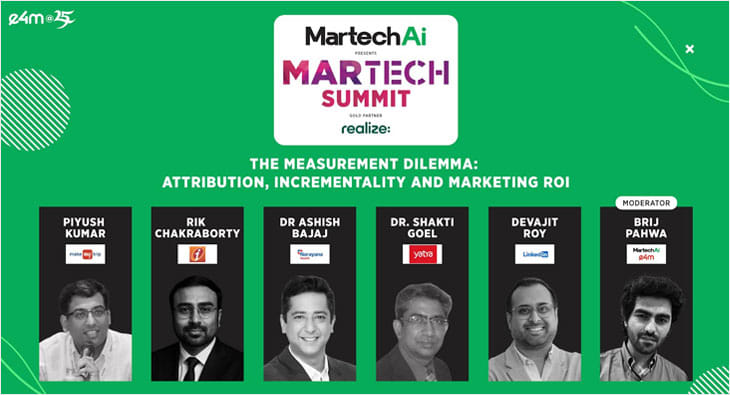

At the MarTechAI Summit 2025, the session titled “The Measurement Dilemma: Attribution, Incrementality and Marketing ROI,” brought together leaders from banking, travel, healthcare and data science to explain how brands can measure marketing impact in a world flooded with signals, automation and AI-driven journeys. The discussion was moderated by Brij Pahwa, Editorial Lead at MartechAI.com and Exchange4Media.
Speaking first, Piyush Kumar, Head of Data and Personalisation at MakeMyTrip, said that marketers are no longer judged only by what each channel delivers. He explained that the company has moved from channel-level ROI to “user-level and trip-level matrices,” adding that leadership expectations have changed. According to him, “people want to see a lot more cuts,” meaning deeper analysis of journeys, conversions and share of wallet. AI tools have made dashboards easier to generate, but they have also increased the need for more detailed, nuanced reporting.
Rik Chakraborty – ICICI Leadership, Martech ICICI, followed with the financial sector’s lens. He said that banking relationships grow slowly and need long-term measurement rather than instant attribution. “We do not value the weekends, but the long day,” he said, describing how ICICI studies signals across mobile, web and offline transactions to understand customers better. He added that the bank avoids making assumptions based on a single action because “if you beat data, it will tell the truth you want to hear,” stressing the need to separate correlation from actual causation.
From the healthcare side, Dr. Ashish Bajaj, Group CMO of Narayana Health, highlighted that most healthcare spending is planned, not impulsive. He said only 25 percent of decisions are immediate, so brands need to understand contextual signals such as local disease trends or what users read online. He noted that with scale, AI allows the organisation to communicate with millions of users without creating fear. “If you are able to move those events and create journeys for information, not scaring, that is where AI can help you,” he said.
Dr. Shakti Goyal, Chief Architect and Data Scientist at Yatra Online, traced how data science has evolved since the late 1990s. With storage and computing becoming cheaper, companies can now collect far richer behavioural signals. He said travel brands track every user action to refine personalisation, from what hotel amenities people click on to how they interact with reviews. “Data was always there, but now you can use it for true hyper-personalisation,” he said, giving the example of predicting a customer’s preferences to increase the “look-to-book” ratio.
The panel also discussed agentic AI, operational efficiency, and the future of automated campaign creation. Speakers noted that AI is reducing manual work, improving conversions, and enabling personalised creatives at scale. However, they stressed the importance of monitoring costs, especially token usage in large language models.
The session ended with a reminder that ROI should be viewed holistically rather than channel by channel. As AI becomes central to marketing, the need for clear measurement, strong data foundations and the right use cases will only grow.
Read more news about Marketing News, Advertising News, PR and Corporate Communication News, Digital News, People Movement News
For more updates, be socially connected with us onInstagram, LinkedIn, Twitter, Facebook, YouTube & Google News