#e4mXplains: Doomer marketing: Why advertising AI apocalypse makes business boom
The modern AI industry is telling consumers that its own technology might be advancing impossibly fast; this is bringing consumers closer because despite sounding existential it is also damn exciting
 by
by
Published: Sep 19, 2026 9:42 AM | 7 min read
 Follow Us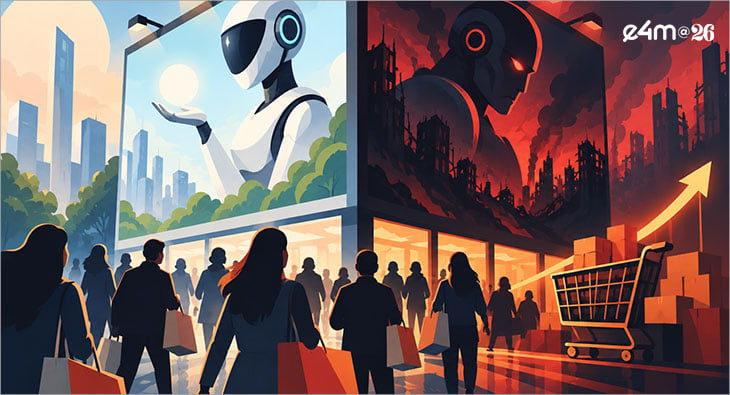

- Thomas Edison did not electrocute the elephant Topsy to demonstrate the dangers of alternating current; her death occurred years later, and Edison had little direct involvement in it. However, he did conduct demonstrations involving the electrocution of dogs, calves, and a horse to discredit alternating current during the "War of the Currents."
- Currently, leaders in the AI industry, including Anthropic's Dario Amodei and OpenAI's Sam Altman, are debating the rapid advancement of AI technology and its potential risks, advocating for either a slowdown in development or increased oversight.
- The marketing strategy surrounding AI has shifted, with warnings about its dangers potentially serving as a way to attract consumer interest, contrasting with historical negative marketing tactics used by Edison.
- In India, AI adoption is rapidly increasing, with significant government support for infrastructure development and a focus on innovation, creating a complex landscape where the need for rapid AI advancement competes with concerns about safety and control.
Thomas Edison did not, as the story is often told, electrocute an elephant to demonstrate the supposed dangers of alternating current.
That particular victim, Topsy, was killed in 1903, years after the famous “War of the Currents”, and there is little evidence Edison had anything directly to do with her death. The dogs, calves and horse, unfortunately, are another matter.
During his battle with George Westinghouse in the late 1880s, Edison was determined to convince the American public that his rival’s alternating current, or AC, was considerably more dangerous than his own direct current. Dogs were electrocuted before reporters. Calves and a horse were killed in demonstrations. Edison even helped associate AC with the newly invented electric chair. It was, among other things, an extraordinary exercise in negative marketing.
(History, naturally, was uncooperative. AC went on to dominate the world’s power grids, while DC is now sneaking back in through the batteries and data centres that run the devices of modern life, and AI models.)
Some 140 years later, a few of the technology industry’s most consummate salesmen are conducting a rather different demonstration of just how dangerous their products might be.
Over the past week, some of the biggest names in frontier AI have once again been debating whether the technology is moving faster than humanity’s ability to understand and control it. Anthropic CEO Dario Amodei has argued for slowing the development of the most advanced systems, while OpenAI’s Sam Altman has called for independent oversight and Google DeepMind figures have similarly warned against capabilities outrunning safety mechanisms.
Read e4m report on AI CEOs calling for slowdown
The worries are hardly trivial. They range from cyberattacks and autonomous AI agents behaving in unexpected ways to much more speculative fears about systems eventually escaping meaningful human control.
But there is something fascinating about the marketing effect.
Taranjeet Singh writes for e4m - AI progress is moving fast. But where are we going?
Edison electrocuted animals because he wanted consumers to conclude that a rival technology was terrifying and stay away from it.
The modern AI industry keeps telling consumers that its own technology might be terrifying.
And consumers keep coming closer.
Read e4m deep dive - when AI content gets a label, does it lose its value?
Perhaps that is partly because doom doesn't sell quite like it did in the 19th century. We are a species that has since worked its way through world wars, nuclear weapons, global recessions, climate catastrophe and a planet-wide pandemic. The prospect of an artificial intelligence that might one day become too powerful to control can sound existential.
It can also sound terribly exciting.
Tell somebody that your new software can summarise a PDF and you have a productivity tool. Tell them scientists and governments are debating whether its descendants might fundamentally transform human civilisation and you have something they probably ought to try.
This is doomer marketing. Although importantly, it doesn't require the doomers to be marketers.
Amodei may entirely sincerely believe that advanced AI poses catastrophic risks. Altman and others may sincerely believe greater safeguards are necessary. Their motivations don't have to be cynical for the commercial effect to exist.
Every warning nevertheless communicates three rather useful messages about the product: AI is extraordinarily powerful. AI is improving extraordinarily quickly. And anyone who ignores it risks being left behind.
The counterargument only strengthens the pitch.
The Trump administration has resisted attempts to slow American AI development, framing technological leadership increasingly through competition with China. China itself is developing controls around agent safety and model risks while continuing to push rapid AI deployment across its economy.
India, interestingly, is closer to the latter instinct than the Silicon Valley doomer school.
Its AI Governance Guidelines explicitly favour what the government describes as a “light-touch”, risk-based framework, and official documents describe the country's approach as prioritising innovation over restraint. The ₹10,371-crore IndiaAI Mission is simultaneously funding compute, indigenous models, datasets, skills and responsible-AI programmes.
In other words, the question for India is largely not whether AI development should happen, but how quickly the country can build the capacity to participate in it.
That leaves consumers and businesses everywhere caught between two supposedly opposing messages.
One camp says AI is becoming so powerful that we may need to slow it down.
The other says AI is becoming so important that slowing down would be economically and geopolitically disastrous.
Notice what nobody is saying.
It's just software. Don't worry about it.
For companies trying to move users from experimenting with chatbots towards living with assistants and autonomous agents, that is some fairly spectacular category marketing.
And India demonstrates just how far the first stage of that category-building has already travelled.
OpenAI said in February that India had crossed 100 million weekly ChatGPT users, making it one of the company's largest markets. Students, teachers, developers and entrepreneurs are already part of a user base that would have sounded improbable barely three years ago.
The champagne bottle has already been opened.
That doesn't mean everybody uses AI, far from it. But awareness is no longer the industry's principal problem. ChatGPT, Gemini and AI assistants are no longer exotic products restricted to developers and Silicon Valley obsessives. In India, when parents and grandparents are asking chatbots about illnesses, recipes, travel and bank forms, the technology has clearly moved beyond the early-adopter party.
The next challenge is getting those users to do much more with it.
Not merely asking a chatbot to rewrite an email, but having an agent research a holiday, shop, schedule meetings, write software, organise work, communicate with other services and eventually conduct transactions.
Which creates another problem.
Software can scale much faster than steel, power stations, transformers, chips, cooling systems and electrical grids.
And India is now building the physical counterpart to its AI adoption boom. OpenAI and Tata Group announced plans this year to develop local AI-ready data-centre capacity, while Karnataka this week approved a data-centre policy targeting one gigawatt of IT load by 2031 and as much as 10-12% of India's AI-ready data-centre capacity.
Globally, data-centre electricity demand is surging as companies race to provide the compute behind these systems. Gartner expects consumption to hit 565 TWh this year, up 26% in twelve months. At the same time, OpenAI reportedly expects to burn hundreds of billions of dollars through the end of the decade as spending on computing power and infrastructure accelerates.
Which produces a strange systems problem.
AI companies need considerably more usage to justify the colossal infrastructure being built around them. But considerably more usage requires colossal infrastructure to be built around them.
It would be too neat (and unsupported) to suggest that Silicon Valley's warnings about slowing AI are secretly intended to give those supply chains time to catch up.
But the coincidence is worth noticing.
The industry is simultaneously telling us that AI is advancing almost impossibly fast, spending hundreds of billions trying to make it advance faster, confronting physical limits on how quickly the infrastructure underneath it can grow, and trying to persuade billions of people to hand increasingly large portions of their lives over to AI agents.
Edison needed people to believe the competing technology was dangerous.
Silicon Valley may have stumbled upon a considerably stranger proposition: in 2026, telling people your own technology could become dangerous might be one of the best advertisements for trying it.
Read more news about Digital Media, Internet Advertising, Marketing News, Television Media, Radio Media
For more updates, be socially connected with us onInstagram, LinkedIn, Twitter, Facebook, YouTube & Google News