Adidas Employee says 40% Workforce Fired, Internal Chats Reveal Shocking Details
Adidas employees challenge the company’s account of India technology layoffs, with internal chats raising questions over the scale of cuts, redeployment and leadership decisions.
 by
by
Published: Sep 18, 2026 9:09 PM | 4 min read
 Follow Us

- Adidas has confirmed layoffs within its India technology organization, stating that the impact affects less than 20% of its workforce, while some employees claim the figure is closer to 40-50%.
- Employee discussions reveal frustration over leadership assurances regarding job security, allegations of preferential treatment for executives, and dissatisfaction with the restructuring process.
- Concerns have been raised about the criteria used for redeployment and the lack of transparency regarding the layoffs and the future of the technology hub.
- Adidas maintains that the changes aim to simplify the organization and strengthen capabilities, while offering support and guidance for affected employees seeking new roles.
This story was originally published on MartechAI.com.
Screenshots obtained by MartechAI show anger over layoff figures, leadership assurances and alleged preferential redeployment. Adidas says fewer than 20% of its India technology organisation was affected.
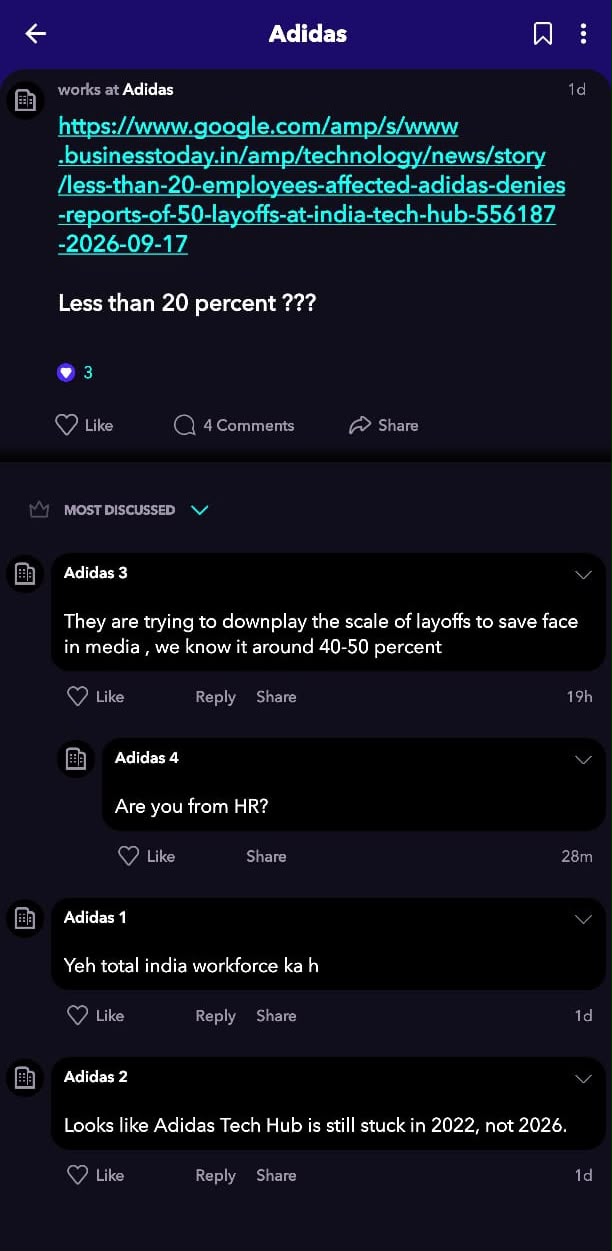
“Less than 20 percent ???”
That question, posted beneath a news report about Adidas’ India technology layoffs, captures the disbelief running through screenshots of an Adidas employee discussion group reviewed by MartechAI. One participant alleges that the cuts affected around 40–50 per cent, challenging the company’s account of a smaller impact.
The exchanges go beyond a dispute over numbers. Posters question earlier assurances about the technology hub’s future, allege that leaders secured alternative positions while employees below them lost jobs, and criticise how the restructuring was handled. A senior AI transformation leader at Adidas is also named in the chats. (name blurred for privacy)
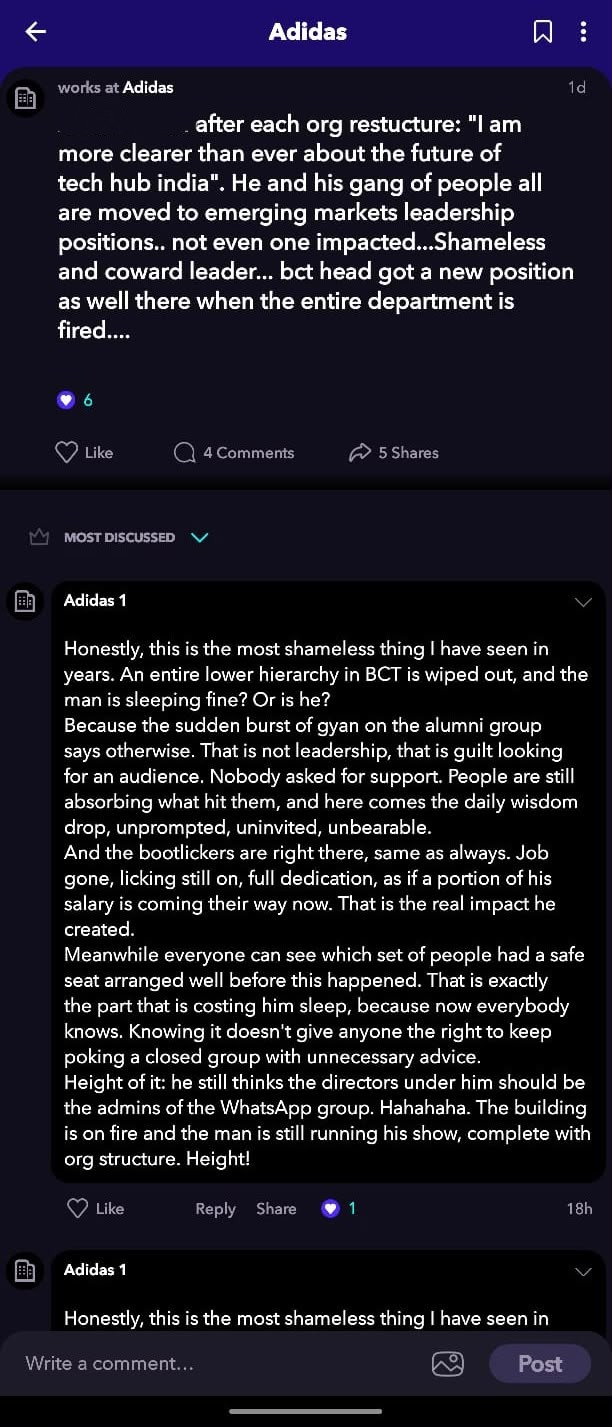
The screenshots contain anonymous posts, including accounts labelled “works at Adidas”. They do not independently establish the posters’ identities or the accuracy of their allegations.
Adidas has confirmed reductions within its technology organisation in India. However, its statement published by Business Today on September 17 says: “The impact of these changes is less than 20% of our India Technology organization.” Company response.
Another commenter alleges that the company is understating the scale, writing: “we know it around 40-50 percent”.
Behind this arithmetic lies a more personal argument about trust.
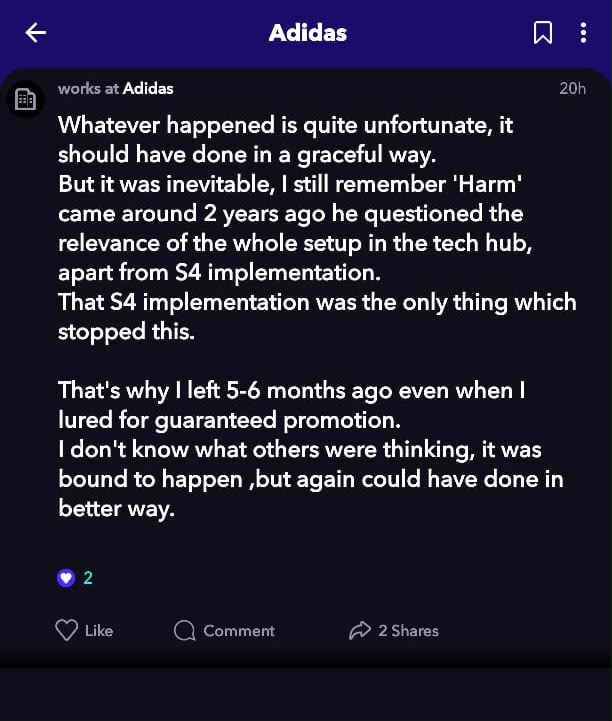
One poster, who says they left five or six months earlier, claims that a visiting senior figure questioned the relevance of much of the technology hub around two years ago. According to that account, an “S4 implementation” was the exception and delayed the eventual cuts.
The screenshots contain no dated record of that discussion, and the claim remains uncorroborated. If substantiated, however, it would raise questions about how long the hub’s future had been under review and what employees were told during that period.
The same poster says they left despite the prospect of a guaranteed promotion. Their criticism focuses partly on the manner of the restructuring: “Whatever happened is quite unfortunate,” the post begins, before arguing that it should have been handled more gracefully.
A separate thread challenges the relationship between leadership assurances and subsequent personnel decisions. Its author alleges that executives moved into emerging-markets leadership positions while other employees were affected.
Another commenter claims that lower levels of a team described as “BCT” were wiped out while its leader secured another position. The screenshots do not establish the team’s full name, its staffing numbers, the extent of any reduction or the circumstances of individual transfers.
These allegations raise a specific question about the restructuring process: what criteria governed access to alternative roles? The existence of a leadership transfer would not, on its own, demonstrate preferential treatment. Establishing that would require records of available positions, eligibility and selection decisions.
The frustration also extends to communications after the cuts. One commenter objects to advice appearing in an alumni group while people were still processing the loss of their jobs.
“People are still absorbing what hit them,” the comment reads.
That sentence conveys the emotional tenor of the exchanges. For those posting, explanations about organisational change appear insufficient without clarity about why particular roles disappeared and how affected colleagues were treated.
Adidas’s published response says the changes are intended to simplify the organisation and strengthen critical capabilities. It also says India remains strategically important, promises transition support and points affected employees towards open roles across the organisation. Company response.
What the material provides is a view of the anger surrounding the cuts, alongside competing accounts of their scale.
For the people behind these posts, the questions reach beyond how many jobs disappeared. They concern what employees were promised, when decisions were made and whether the process was fair.
Read more news about Marketing News, Advertising News, PR and Corporate Communication News, Digital News, People Movement News
For more updates, be socially connected with us onInstagram, LinkedIn, Twitter, Facebook, YouTube & Google News