AI progress is moving fast. But where are we going?
Guest Column: Senior business leader Taranjeet Singh asks while we are getting very good at making AI more capable, are we getting equally good at deciding what all that capability is for?
 by
by
Published: Sep 16, 2026 8:54 AM | 4 min read
 Follow Us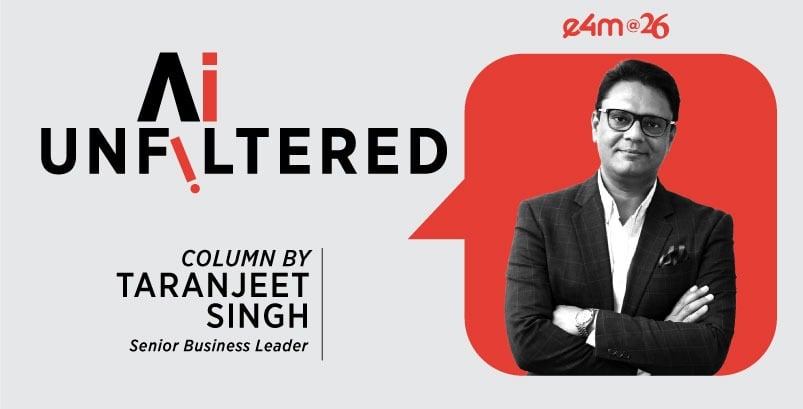

- A safety researcher from Anthropic has left the company, raising concerns about the potential risks of increasingly powerful AI technologies.
- Anthropic CEO Dario Amodei, along with other AI leaders, has suggested that the industry may need to "buy time" to better understand and manage AI risks as capabilities advance.
- The article emphasizes the importance of not just focusing on AI's capabilities, but also considering the purpose and implications of its applications in business and society.
- It raises critical questions about the direction of AI development, urging stakeholders to contemplate what they want AI to achieve rather than solely what it can do.
Two things I read about Anthropic over the last few days have stayed with me.
First, a safety researcher leaving the company publicly, citing concerns about where increasingly powerful AI could ultimately take us.
Second, Dario Amodei, Anthropic’s CEO, co-signing a statement with other AI leaders and researchers about the possibility that the industry, governments and society may need to “buy time” to better understand and manage the risks as AI capabilities advance.
I do not know whether AI development should slow down.
I am not sure anyone really knows.
But it did make me think about something we don't seem to talk about enough:
We are getting very good at making AI more capable. Are we getting equally good at deciding what all that capability is for?
Progress is everywhere. Purpose, perhaps less so.
It's difficult not to be impressed by how quickly AI is moving.
Every few months, something that seemed impossible becomes a product feature.
Models get better at reasoning. They write. They code. They create. They analyse. They increasingly act.
And every breakthrough seems to lead immediately to another question:
What else can it do?
I find myself asking a slightly different question these days:
What do we actually want it to do?
Maybe that's an unfair question at this stage. We're still discovering what's possible.
But I wonder if that's also the point.
I see a smaller version of this in business
A lot of my conversations these days are about AI.
And I've noticed that many of them start with capability.
Can AI automate this?
Can AI generate that?
Can we use AI to make this faster?
All good questions.
But increasingly, I find myself wanting to ask:
Should we?
Not in a philosophical or existential way.
Just in a very practical business sense.
If AI can generate ten times the content, do we need ten times more content?
If it can automate a customer interaction, was that interaction something the customer wanted automated?
If it can make a sales team dramatically more efficient, what happens to the quality of the relationship?
If it can make something cheaper, does cheaper necessarily make it better?
I don't have simple answers to these.
But perhaps that's what makes them worth asking.
The race is an interesting thing
The other thing that struck me about the Anthropic story is the race itself.
Nobody wants to be the one who slows down if everyone else is accelerating.
I think businesses understand that feeling very well.
A competitor launches an AI product.
A client asks what you're doing with AI.
An investor asks about your AI strategy.
Suddenly, the question becomes:
“How quickly can we get there?”
And somewhere along the way, perhaps the more interesting question gets lost:
“Where exactly are we trying to go?”
I've seen this happen with technology before.
We sometimes get so caught up in not wanting to miss the next wave that simply being part of the wave becomes the objective.
Maybe AI will be different.
Maybe it won't.
Capability can be a strange thing
The more capable AI becomes, the more possibilities we have.
But more possibilities don't necessarily make decisions easier.
They may make them harder.
Because when something becomes possible, there is an understandable temptation to find a reason to do it.
I'm beginning to wonder if the real challenge of the next phase of AI isn't just figuring out what machines can do.
It is figuring out what we want them to do for us.
And perhaps, occasionally, what we don't want them to do.
I keep coming back to one thought
We've spent a lot of time asking:
“What can AI do?”
That's probably the right question when you're building such technology.
But for the rest of us, perhaps another question is becoming equally important:
“What do we want AI to change?”
For a business, that might be revenue, productivity, customer experience or cost.
For society, it could be something much bigger.
And for individuals, perhaps it's even more personal.
I don't think we have figured this out yet.
In fact, I'm not sure we're supposed to.
But as AI becomes more capable, I'm finding the conversation about purpose at least as interesting as the conversation about progress.
Because progress is about what we can do next.
Purpose is about what we want to do with it.
And perhaps the most interesting AI question isn't how far we can take it.
It's where we want to go.
Disclaimer: The views expressed here are solely those of the author and do not in any way represent the views of exchange4media.com.
Read more news about Digital Media, Internet Advertising, Marketing News, Television Media, Radio Media
For more updates, be socially connected with us onInstagram, LinkedIn, Twitter, Facebook, YouTube & Google News