AI & creativity must grow in harmony: Ashwini Vaishnaw at AI Impact Summit
At India AI Impact Summit, Vaishnaw outlines India's strategy to protect creators' rights while harnessing AI as a tool to enhance, not replace, human creativity
 by
by
Published: Feb 16, 2026 4:24 PM | 6 min read
 Follow Us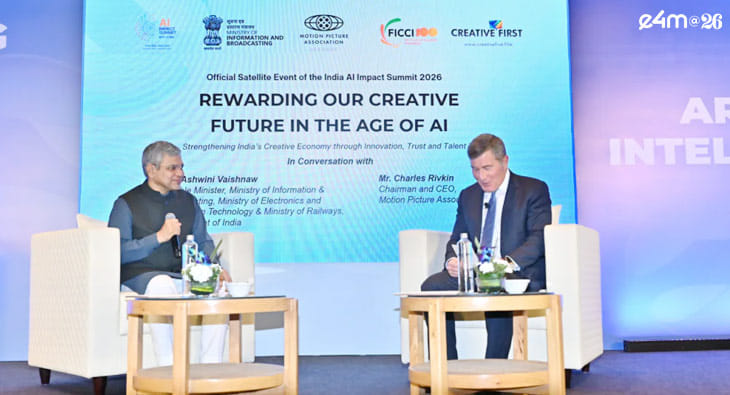

Union Minister Ashwini Vaishnaw positioned India at the forefront of responsible AI adoption while emphasizing the critical need to protect human creativity, as global technology leaders gathered at the India AI Impact Summit 2026 in New Delhi.
Speaking with Charles Rivkin, Chairman and CEO of the Motion Picture Association, Vaishnaw outlined India's comprehensive approach to balancing AI's transformative potential with safeguards for creators, jobs, and cultural values in an exclusive conversation that explored the intersection of technology and the creative economy.
"When the world's entire AI leadership is collected here in India and they discuss all the pertinent questions, look at the opportunities, look at the challenges, we intend to come out with the basic theme: impact," Vaishnaw explained. "The first summit was based on safety, the second one was Seoul, then Paris, and now we are basically measuring and looking at what the impact on human society is going to be."
The minister acknowledged AI's dual nature, highlighting positive applications in agriculture, weather forecasting, climate change, discovery of new materials, and productivity enhancement. However, he stressed the need for equilibrium: "Simultaneously there is a negative impact also, potentially negative impact also. How do we balance the two so that we can get the good, the benefits while we can contain the harms."
On the crucial issue of intellectual property rights (a growing concern among creators worldwide), Vaishnaw offered strong assurances. "We as a country believe in IP rights, we as a country believe in the creators, the value that the creators have brought in, either through their content or through their different ways of expressing themselves, different ways of telling the story," he stated.
The minister emphasized that India's respect for IP rights has made it a preferred destination for global capability centers. "The challenges between AI and copyright are very, very complex and we are, in this summit, looking at some sort of consensus on this, because if the creators get a chance to deploy their skills, protect their copyrights, protect the fruits of their creative energy, then the growth between today and tomorrow will be very high."
Vaishnaw articulated a clear vision for AI's role in creativity: "AI can be used as a tool. AI doesn't become a competitor to human creativity and we believe that human creativity is the most important thing that we have in our entire civilization. So we must protect it, we must make sure that any system which protects human creativity and enhances it is a better system. There shouldn't be a dilutive effect, there should be more of a complementing effect on human creativity."
The minister highlighted India's rapid progress in creating world-class infrastructure for creative technology education. He announced that immediately following the WAVES summit, the government inaugurated the first Indian Institute of Creative Technologies (IICT) campus. "The feedback that I'm getting from many of the industry participants is, it has today some of the most advanced laboratories in the entire world," Vaishnaw noted. "Probably many of the developed countries would be looking at that as a benchmark, is what the industry says."
The government's ambitious plans extend to establishing content creator labs in 15,000 schools and colleges nationwide, ensuring access to cutting-edge tools across India's diverse linguistic and cultural landscape. "Students will get access to the world's best tools, so that this entire pipeline keeps getting updated, keeps getting broader, the talent pipeline and the people who are already working in the industry, they get an opportunity to upskill themselves," he explained.
Addressing the thorny issues of misinformation, disinformation, and deepfakes, Vaishnaw warned of existential threats to social institutions. "Misinformation, disinformation, deepfakes, they are attacking the foundation of our society. The foundation of our society is the trust between institutions," he said. "The rapid spread of deepfakes, misinformation, disinformation is basically striking at the root of these institutions."
He called for a collaborative approach: "The social media platforms, the AI models, the creators, all of us will have to take the responsibility for making sure that the new technology is strengthening the trust rather than belittling it." The solution, he emphasized, would require "technical and legal solutions which have to be there."
On child safety, Vaishnaw was unequivocal, saying, "This should be non-negotiable for the entire country. This should be non-negotiable for the entire human society and we believe that this will require very strict legal as well as technical measures."
The minister concluded by emphasizing India's focus on AI diffusion and adoption: "We are very focused on making sure that the productivity gains come, both in the creative industry as well as the other industries."
Speaking about the intersection between the creative economy and AI, Minister Vaishnaw said, “The challenges between AI and copyright are very, very complex, and we are, in this summit, looking at some sort of consensus on this”.
“If the creators get a chance to deploy their skills, protect their copyrights, protect the roots of their creative energy, then the growth between today and tomorrow will be very high. Then AI can be used as a tool.” Vaishnaw added.
On enforcement mechanisms, Rivkin pressed further, asking what practical steps could translate policy intent into action. Vaishnaw stressed the need for collaborative frameworks. “That would require a lot of technological tools to be created. Our understanding so far is that for such complex problems, we have to have techno-legal solutions.”
When asked by Rivkin on the risks of misinformation and deepfakes, the minister warned of broader societal consequences.
“Foundation of our society is the trust between institutions,” he said. “The rapid spread of defects, misinformation, disinformation is basically striking at the root of these institutions.”
“The social media platforms, the AI models, the creators, all of us will have to take the responsibility for making sure that the new technology is strengthening the trust rather than reducing it.” He added.
On safeguarding children online, when Rivkin asked what principles should guide regulation in this particularly sensitive area, Vaishnaw struck a firm tone. “Protecting kids should be non negotiable for the entire country and the entire society.”
Turning to OTT platforms and global streaming services, the minister urged sensitivity to local norms.
“In the digital world, there are no physical boundaries,” he said, cautioning that platforms must not “forget the cultural context.”
“What is normal in one society may not be normal in another society,” he added. “Global platforms must make sure that the cultural context of the countries in which they are operating is fully taken care of.”
He emphasized that companies should “work by the constitution and the legal framework of that country, rather than the framework of another country.”
As AI accelerates across industries, the summit underscored a central message: innovation must move forward, but with consensus, cultural sensitivity, and safeguards firmly in place.
Read more news about Digital Media, Internet Advertising, Marketing News, Television Media, Radio Media
For more updates, be socially connected with us onInstagram, LinkedIn, Twitter, Facebook, YouTube & Google News