Implement it or regret it: The AI warning from India’s brand leaders
At India Brand Conclave 2026, industry leaders discussed how adoption of AI should balance speed with governance, automation with human judgment, and innovation with measurable ROI
 by
by
Published: Feb 12, 2026 5:45 PM | 13 min read
 Follow Us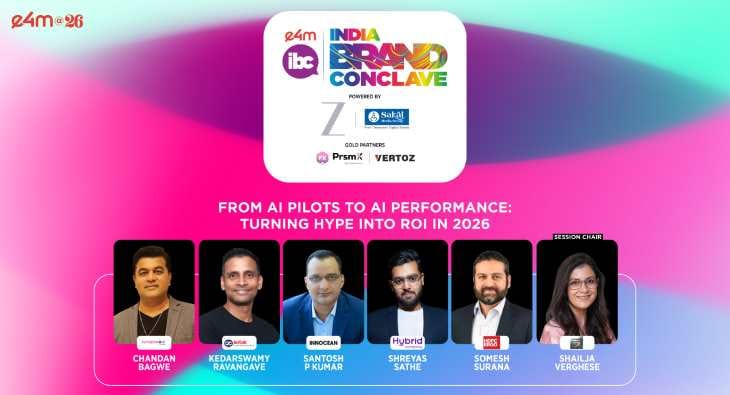

AI may be accelerating at breakneck speed, but organisations are learning that speed alone does not build sustainable value. At the India Brand Conclave 2026, industry leaders debated how to convert AI from fragmented pilots into compounding systems.
The panel, titled “From AI Pilots to AI Performance: Turning Hype into ROI in 2026”, examined where AI truly works, how it scales, and what it takes for organisations to let it shape decision-making without eroding trust.
Moderated by Shailja Verghese, Founder, Unstoppable Network, the session featured Chandan Bagwe, Founder & Managing Director, CCom Digital; Kedarswamy Ravangave, Executive Vice President – Marketing, Kotak Mahindra Bank; Santosh P Kumar, Chief Operating Officer – India, Innocean; Shreyas Sathe, CEO, Hybrid INSEA; Somesh Surana, Joint President – Digital Business Group and Marketing at HDFC ERGO General Insurance; and Prateek Gour, Co-founder, Footprynt.
Setting the context, Verghese clarified that the debate was no longer about whether AI works. “It’s largely about where it works, how it scales, and how leaders are looking at a future where AI will start making decisions,” she said, inviting the panel to share real use cases and learnings.
Kumar reflected on Innocean’s early experiments. “It’s not one or two projects. There were multiple projects where we tried to experiment, learn, and fail,” he said. Nearly two-and-a-half years ago, the agency established its own AI lab. “Everybody was experimenting, more out of curiosity than with a defined solution.”
The team broadly classified their AI applications into three buckets. These were generative AI for content creation and automation at scale, personalisation to enhance resonance and relevance using media audience signals, and predictive-diagnostic use cases to assess what would emotionally resonate with consumers. “AI has helped us identify the potential success of communication even before entering production,” Kumar noted, calling it a significant shift.
On the predictive side, particularly in market research, he said AI introduced both efficiency and richer data. “Rather than intent coming out of research, actual behaviour comes out in the research play,” he explained, adding that such learnings have now become embedded in the organisation’s workflow.
Bagwe built on this, admitting that his organisation initially adopted AI in a fragmented manner. “We started using AI at the task level, at individual levels. That bottom-up approach was not the correct one,” he said. The realisation came later that AI needed to be embedded at a value-chain level. “It should have been a top-down approach, at the department or organisation level. That was our learning and unlearning.”
When asked whether the gap lay in leadership or technology, Gour was unequivocal. “It’s the gap in leadership understanding the technology,” he said. He pointed to the rapid pace of change, noting that innovation was happening “on every microsecond basis,” while corporate decision-making remained slow. “To get a bill passed can take 15 to 20 days. Vendor payments can take months. Decisions are very slow,” he said, adding that AI implementation cannot be treated as a symbolic exercise. “We have to accept it and implement it immediately.”
The conversation then turned to content creation and the future of human relevance in an AI-driven ecosystem. Gour cited a recent social media trend where users believed an AI-generated singer was real. “Almost 90% of the viewers believed she was real,” he said, describing how the illusion unravelled days later. Yet it was a human creator’s parody of the episode that garnered even more traction.
“There’s always going to be a human touch when it comes to content creation,” Gour argued. “Things we relate to, we immediately pick up. AI has not reached that stage.” He cautioned that an overabundance of AI-generated content could backfire. “Very soon, especially in content creation, AI is going to disgust us. There will be so much AI-based content everywhere that everybody will be confused.”
Moving on, Verghese pressed on brand trust in high-sensitivity categories such as banking. Ravangave emphasised that AI must be viewed as a system, not merely a tool. “AI is not just about efficiency. Think about the way it unleashes when you look at it as a system as opposed to a tool you’re trying to infuse into your workflow,” he said.
In banking, he noted, trust is foundational. “You keep your money with the bank because you trust the bank,” he said. “If it starts becoming invasive, you begin losing trust. That’s a big watch-out.”
He also underscored the governance layer in high-involvement categories. Communication in banking, he said, cannot be “left to imagination”. Striking the right balance between autonomous systems and defined organisational contours is critical.
Reflecting on his organisation’s AI journey, Ravangave acknowledged an early misconception. “We made the common mistake of thinking of AI as just bringing in a tool,” he said. The evolution has moved from assistant, to accelerator, and now towards compounding systems. He revealed that the bank is preparing to launch a semi-autonomous marketing function.
“We’ve reimagined the five steps in marketing: understanding your consumer, creating content, deploying media, fulfilling journeys, and measuring it,” he explained. The goal is to design a system where “the job of a marketer is only to make that system better and let it improvise itself.” The organisation is also collaborating with AI-native agencies that can convert a single event input into full-spectrum content outputs.
In the insurance space, Surana addressed whether AI should remain invisible in trust-heavy scenarios such as claims. “Claims is one area where, irrespective of AI, you are not in the right frame of mind,” he said, referring to situations involving hospitalisation, accidents, cyber fraud, or the loss of a loved one.
For him, the key question is not whether human touch is required, but whether AI can improve the experience. “If AI can give a better experience in terms of getting discharged from a hospital or taking a vehicle from a garage, why should the customer not be happy?” he asked.
Surana argued that wherever AI can solve a use case effectively, it should be adopted. “Where AI is not able to solve, humans will be required,” he said. HDFC ERGO has been investing in AI since 2017–18, particularly in areas such as video-based vehicle inspections. What once required physical surveys and manual approvals can now be completed within seconds through AI.
“From a consumer perspective, it is a wow experience. Why would they want to talk to you?” he said. However, he emphasised the long-term investment required to reach accuracy benchmarks. “It took four to five years to reach 97% accuracy. You cannot not invest and expect the model to be good.”
He also reminded the audience that human-led systems are not error-free. “Humans were also 85–90% accurate,” he noted, citing an example of a clerical discharge-date error leading to claim rejection. “You expect AI to deliver 100%, but humans also have error rates.”
For Surana, the path forward is clear. “You will have to stay invested, train your models properly, and work on them to give a better experience.”
As the discussion progressed, the focus shifted to specific use cases and how AI maturity is shaping decision-making.
Sathe reflected on early deployments centred on optimisation. “Initially, we were using AI for dynamic optimisation in areas like radio,” he said. However, a major inflection point arrived when Google announced a cookieless future. “We decided to go contextual,” he explained. The company began scanning articles, keywords and images using AI to place ads more precisely.
The real challenge emerged during international expansion. “We were using the same model across different cultures. Something was working, something wasn’t,” Sathe admitted. Training algorithms for cultural nuance became essential. “AI is helpful in many ways, but you need to train it, give it direction. Only then does the magic come.”
Verghese then framed AI’s evolution in tiers, from execution to delegated decision-making, and the growing need for leadership judgement to shape organisational culture.
Bagwe argued that the industry has now entered the performance era. “The application layer is where the ROI is. Having LLMs alone does not give you results,” he said. His organisation had attempted to launch a similar product in 2018, before LLMs existed. “LLMs came in 2022, and as soon as they did, the application layer got set. That’s when we could build our dream product.”
He described their AI virtual assistant, developed entirely using AI systems. Alongside it, the company offers AI Ads Author and predictive analytics solutions. “All three are completely developed using AI systems. Even the ads, avatars, marketing collaterals and go-to-market assets were created using AI,” he said, noting that everything, including 3D presentations and creatives, was executed within a month. “In 2008, it took us nine months to develop a product. Now we can launch in three months. That’s the speed.”
Kumar acknowledged the acceleration but raised a broader question. “If today it takes one month, tomorrow it could be ten days,” he said, citing an example of computational capability that once required “25 septillion years” now being completed in five minutes. For him, the real issue is distinguishing human value from AI capability.
“AI can bring volume, speed and agility. But what the brand voice should be is where human hands are required,” Kumar said. It is not merely about what AI can solve, but why a brand exists. “End of the day, brand trust is about human connection. It’s about meaningfulness and purpose.” Routine tasks can be automated but humans must bring sharpness and meaning.
Returning to his earlier point on leadership disconnect, Gour cited large Indian IT firms as examples of hesitation. “They are very important for our country, but they did not take this challenge very seriously,” he said, referring to early warnings about AI-driven transformation. With rapid developments like Claude Co-Worker, he predicted continued disruption. “Things will change. It might be one month, ten days, or even three days,” he said, suggesting that leaner teams could soon run billion-dollar companies. “Leadership needs to take it seriously. There is absolutely no escape.”
Sathe echoed the sentiment on pace. “AI is really fast and developing rapidly,” he said, comparing the current shift to the early days of computers. While job roles may change, he believes some elements remain uniquely human. “What AI misses is the gut feeling. Leadership positions won’t be replaceable because AI is very logical and misses that part.”
Next, the panellist talked about cognitive overload and whether leaders are facing decision fatigue in the AI era.
Bagwe said AI is increasingly being used for leadership-level functions. “Leadership requires a lot of data to make decisions. AI can do that research extremely fast.” Beyond analysis, AI offers perspectives and scenario reactions, reducing dependence on external consultants.
Ravangave approached the issue through frameworks. “Decision fatigue happens when you try to think during execution,” he said. The solution lies in establishing principles beforehand. With AI, frameworking has been democratised. “Someone just one year into the job can have these frameworks,” he said. The key question is whether leaders return to first principles before execution.
In the era of generative AI, interpretation burdens have reduced. “Gen AI has been able to process and put it out for you,” he said. Cognitive overload, he suggested, arises only when leaders fail to identify what they truly want to act upon.
Kumar pointed to a different leadership challenge. “AI has simplified decision-making because research and data are available so fast,” he said. The real struggle lies in mindset and people's readiness. “There is anxiety and ambiguity. Some people deny AI,” he observed. Guardrails, he argued, must prevent fear-mongering and help teams understand that they can still lead, even in an AI-driven environment.
As the session moved into its final leg, Verghese asked how organisations were bringing AI into their workforce, and whether teams were keeping pace with the speed of execution.
For Surana, AI is a reality, not a choice. It should not be viewed as a threat to jobs, but as a lever to improve efficiency.
Drawing from earlier examples around ad creation, he noted that while AI can reduce cost and time, “somebody still needs to write the concept.” Brands must first understand the consumer and define the proposition before using AI to amplify execution. “Tomorrow, AI may reach a level where it writes concepts as well. Then there will be something else you’ll have to do,” he said.
From a leadership standpoint, Surana stressed that AI is a board-level discussion. “If this is not a board topic in your organisation, you’re going to face a problem very soon,” he warned, adding that at HDFC ERGO, AI occupies significant time during board meetings. With an AI lab running at IIT Bombay and structured change management processes in place, the company is attempting to stay ahead of the curve.
Looking ahead 12 months, the panel was asked what AI decision leaders would either regret or thank themselves for.
Gour did not hesitate. “Not implementing it at all,” he said. Referring again to large organisations that may have delayed action, he argued that experimentation, even if imperfect, is essential. “Implement it, regret it, change it, come back, go to a hybrid model. You have to do it.”
Surana echoed the sentiment on urgency, but tied it firmly to investment and use-case clarity. Leaders across functions, marketing, distribution, call centres, must identify where AI can drive measurable value.
Sathe introduced a more nuanced caution. “Leaders might regret not giving AI enough trust, but also over-trusting AI,” he said. Sharing a hiring example, he described uploading two candidates’ resumes and case studies into GPT. The system strongly favoured one candidate, yet in-person interviews revealed the other to be far better suited. “We should trust AI, but not completely,” he concluded.
“Our focus should shift from output to outcomes,” Kumar added, arguing that AI initiatives must unify processes to build efficiency rather than merely generate volume. He also pointed to a growing trend of agent-to-agent communication. “That will be a very big parameter,” he said, urging leadership to pay attention beyond traditional notions of agents or call centres.
Ravangave closed with two insights shared by an AI-native solutions firm. “The biggest risk with AI is not moving slowly, but moving without understanding it,” he said. Equally important, he cautioned against outsourcing thinking. “The thing you will regret most is if you outsource the thinking to someone else. The thing you will thank yourself for is building capabilities in-house.”
Bagwe offered the final takeaway. “Don’t use AI tools to solve yesterday’s problems,” he said. Investment should be directed towards solving tomorrow’s challenges. Otherwise, he warned, AI becomes a debt rather than an asset.
As the session concluded, it was unmistakable that AI is in systems, in culture, and in leadership accountability.
Read more news about Marketing News, Advertising News, PR and Corporate Communication News, Digital News, People Movement News
For more updates, be socially connected with us onInstagram, LinkedIn, Twitter, Facebook, YouTube & Google News