Reimagining radio in AI era: Archana Kapoor shares key insights at The Radio Festival
Archana Kapoor, Founder of SMART and The Radio Festival, shares insights on radio as critical infrastructure in the age of AI, roadmap for the future and more
 by
by
Published: Feb 16, 2026 11:14 AM | 5 min read
 Follow Us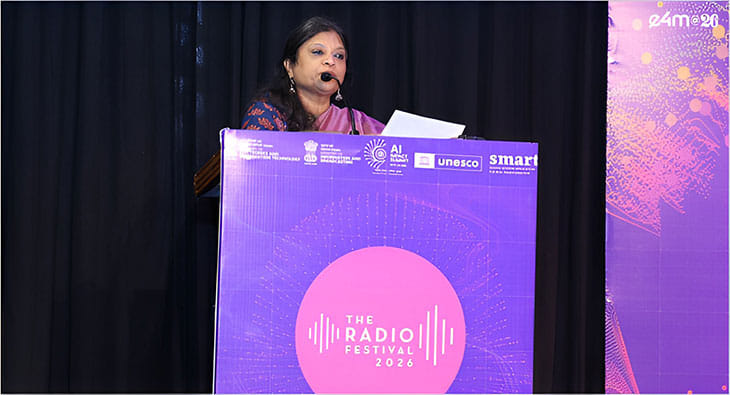

In 2012, UNESCO announced February 13 as The World Radio. In 2018, SMART along with UNESCO and the Ministry of Information and Broadcasting, Government of India, came together to celebrate the soul of audio by launching The Radio Festival. The idea was to bring together all those invested in audio- broadcasters, podcasters, radio enthusiasts, including community radios—the only medium that reaches the last mile, speaks in local tongues, and listens as much as it broadcasts.
The Radio Festival, saw the participation of over 300 participants and over 30 panelists who dwelled on themes like The Future of Radio with AI with James Cridland, the only Audio Futurologist, AI and Radio: Power, Access, and the Future of Public Voice, Audio Storytelling and Artificial Intelligence: The new revolution?, Music by AI: An art form or a well-written code?, Decoding Gen Z: Strategising for an ever-evolving audience along with a master class on The New Frontiers of Communication.
On the occasion of World Radio Day, the question we sought to answer was: ‘As we stand on the threshold of AI reshaping every sector, will AI include the 120 million people that community radio already reaches—or will it bypass them, like so many technologies have before?
This question is pertinent because consumption of AI is increasing every day. It is no longer futuristic - it is part of our daily lives. It is being used in agriculture, education, health, banking—even storytelling. But if it is trained on urban data, global English, and dominant narratives, it will replicate the exclusions we’ve fought so hard to overcome.
That’s why we believe this moment is urgent. And that’s why we are here—not just to celebrate radio, but to reimagine radio as critical infrastructure in the age of AI.
Community radio stations—like the 550 across India - aren’t just media outlets. They are civic nodes, lifelines that carry information where roads don’t go, in languages that official systems don’t speak. They are trusted. They are local. They are human. And in an age of deepfakes, distrust, and disinformation, trust is everything.
Imagine if every one of these stations had access to AI tools—to transcribe and translate their shows, to generate text-to-speech messages on government schemes, to answer health queries via voice bots, to make podcasts in multiple languages, or to track listener engagement. This isn’t a dream. It’s within reach.
But to get there, we must build a public-interest AI ecosystem—and that requires political will, infrastructure, and inclusive design. It requires us to work closely with the Ministry of Information and Broadcasting (MIB) and the Ministry of Electronics and IT (MeitY) to ensure that community radios—serving 120 million Indians—are not just users of AI, but co-creators.
We must build tools that work offline. That understand not just languages- but dialects- like Bundeli, Bhojpuri, Santhali, Oraon, Seharia, and Mewati. That are open-source, affordable, and locally governed. We must train community RJs as AI practitioners. We started the process yesterday. And we must co-create datasets from the ground up—because AI that doesn’t include us, can never represent us.
Let me give you a vision of what’s possible if we get this right:
- A woman in rural Bihar can listen to verified health information in her dialect, and call into an automated helpline that answers FAQs on immunization or nutrition—voiced by her local RJ.
- : A CR station in Odisha can produce interactive learning modules for children out of school, using voice-based AI tutors.
- Farmers in the coastal areas can receive early warnings, advisories, and weather updates through community radio bulletins, generated by AI scraping satellite and meteorological data.
- Survivors of violence can access referral services, legal info, and safe reporting channels via voice-based systems—anonymously and in-language.
In each of these, community radio is not an add-on—it is the anchor.
What we need now is:
- A national roadmap for AI integration in community media.
- Shared ethical frameworks rooted in rights and representation.
- Investment in capacity-building—from AI labs to voice libraries.
- And above all, a permanent seat at the table—where community voices shape AI governance and design.
As the country moves towards becoming a global leader in the creator economy and digital innovation, it is equally important to ensure that this transformation remains inclusive, multilingual, and rooted in community realities. We cannot be passive recipients of a system that is trained on others’ realities, but become active architects of a future that sounds like us, speaks to us, and is built by us.
This is not just about tech adoption—it is about ensuring that AI speaks our truths. It is intelligent but it needs to be inclusive so that it reflects the diversity of India, not just its data-rich elite. Radio gave us a voice. AI can give it scale.. Together we hope to build this future where AI doesn’t replace the storyteller, but amplifies the community. And that is how we reimagine radio for tomorrow.
Read more news about Radio Media, Digital Media, Television Media, Marketing News, Advertising India
For more updates, be socially connected with us onInstagram, LinkedIn, Twitter, Facebook YouTube & Google News