AI can make India the creative capital of the world: Uday Shankar at AI Impact Summit
Uday Shankar described AI as a catalyst that fundamentally rewires the three core pillars of the industry: content, the consumer and commerce
 by
by
Published: Feb 20, 2026 2:30 PM | 7 min read
 Follow Us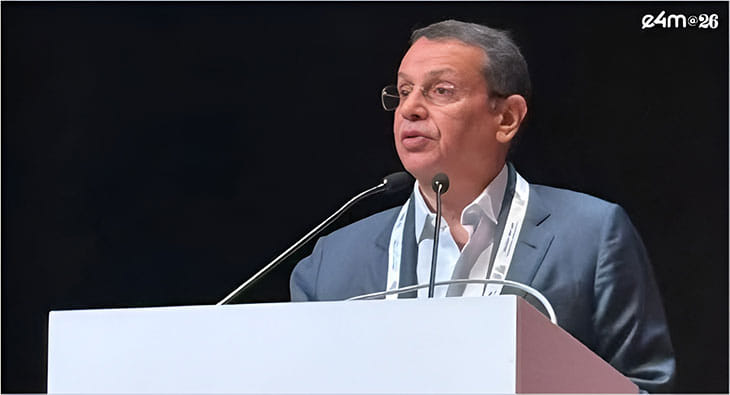

“For decades, the sheer cost of infrastructure has been a constraint on the business of media and entertainment in this country. Today, that barrier is coming down. AI-powered production is not just reducing costs; it is unlocking an unprecedented volume of high-quality storytelling.”
With these words at the India AI Impact Summit on Thursday, JioStar Vice Chairman Uday Shankar set the tone for what he described as a once-in-a-generation inflection point for Indian media.
Citing JioStar’s recent production Mahabharat: Ek Dharmayudh, a 100-episode live-action series exhibited at the Summit, Shankar said the company achieved “the visual scale and emotional depth of a global production, three to five times faster than a traditional pipeline,” demonstrating that the old barriers are vanishing and that the only binding constraints left are imagination and creativity.
Congratulating Prime Minister Narendra Modi for centring the country’s growth agenda around artificial intelligence and complimenting Union Minister Ashwini Vaishnaw, the Ministry of Electronics and Information Technology, and the IndiaAI team, Shankar said he has long believed in the power of emerging technologies to transform societies, businesses and consumer experiences.
“Over three decades as a media professional, I have had a ringside view of technology's transformative impact, starting with the introduction of the first personal computer in newsrooms and the launch of India's first digital news platform at Aaj Tak,” he said. “At every stage since, technology has allowed the businesses I've been involved with to operate with speed, agility, and efficiency that fundamentally changed our relationship with audiences.”
According to Shankar, this willingness to adopt cutting-edge technologies enabled India, a late entrant to the world of audio-visual entertainment, to rapidly become one of the most exciting media markets globally. In just 25 years, the industry has grown from a few billion dollars to the fifth-largest media and entertainment market in the world, contributing more than $30 billion to the economy. The ecosystem has expanded from a single state broadcaster to more than 900 channels across dozens of languages, reaching over 210 million television households and more than 800 million video consumers.
“The content itself has evolved beyond recognition,” he said, describing a journey from tentative family dramas to a vast, multilingual ecosystem serving what he called the most heterogeneous audience on earth. “In this process, we have built an ecosystem that has helped ignite the ambitions of India. The aspirations of a generation of Indians — what they wanted to become and what they thought was possible — have been shaped as much by what they watched as by what they were taught.”
The economic stakes, he argued, are equally compelling. “At JioStar alone, we have invested over $10 billion in content over the past three years. Every major global media enterprise is competing fiercely for the Indian viewer. Those who are not here are absent because they could not crack this complex market.”
Yet, despite domestic success, India has not fully emerged as a global content powerhouse. Invoking the Prime Minister’s call to “create in India, create for the world,” Shankar said the ambition has long existed within the industry but has remained largely aspirational.
He pointed to structural constraints — limited capital, challenges in attracting global talent, and a largely domestic target audience. “The average Hollywood studio production commands a budget of $65 to $100 million. A major tentpole runs $150 to $300 million. The average Indian film? Three to five million dollars. And this is equally true of television production,” he said. “A single episode of a marquee series from HBO or Paramount costs $20 to $30 million to produce. A typical Indian television serial? Seven to ten lakhs per episode — roughly ten thousand dollars. This is an order-of-magnitude chasm.”
The paradox, he noted, is that India possesses world-class creative and technical talent. The VFX of Life of Pi was largely created in Mumbai and Hyderabad. Indian artists have worked on Avatar, The Dark Knight and Game of Thrones. “The talent was always here. But our own producers and directors, who had the quality and ambition, could not afford their services at the rates global productions commanded.”
While there have been notable breakthroughs such as RRR at the Oscars and Dangal’s global box-office success, Shankar described them as exceptions rather than a sustained pattern. Limited capital and a primarily domestic audience, he said, have constrained global competitiveness, which in turn limits the industry’s ability to attract more capital.
“This is not to lament what we have achieved. We have done remarkably well with what we had. But the opportunity at hand is much larger.”
That opportunity, he asserted, lies in artificial intelligence. “AI provides India a once-in-a-generation opportunity to become the creative capital of the world. Not the back office for the world’s content. The leader. The standard-setter.”
He described AI as a catalyst that fundamentally rewires the three core pillars of the industry: content, the consumer and commerce. On content, AI-driven production lowers infrastructure costs and accelerates storytelling at scale. On the consumer side, AI enables conversational discovery, interactive storytelling and deeper regionalisation that captures the authentic texture of India’s distinct markets. On commerce, it allows genuine segmentation, dynamic pricing and packaging tailored to an audience of 800 million viewers with vastly different economic realities.
Taken together, he said, this disruption could power the Orange Economy envisioned by the Prime Minister and dramatically increase India’s share of the nearly $3 trillion global media market, projected to reach $3.5 trillion by 2029. India’s current share is less than two percent. “Even a modest shift in our share of global revenue — from two percent to five — would represent tens of billions of dollars in new value creation. But opportunity and outcome are not the same thing. We need all stakeholders pulling in the same direction.”
Shankar outlined three commitments to seize the moment. First, the industry must be willing to disrupt itself. “When digital newsrooms were introduced, senior editors resisted. When OTT arrived, traditional broadcasters looked the other way. The pattern is always the same — incumbents defend the fortress until the walls come down. We cannot afford that mistake today.”
He argued that Hollywood’s defensive approach to AI, marked by legal battles and protectionist reflexes, presents India with a strategic opening. “We can design the revenue models that actually work for everyone — the writers, the actors, the technicians, and the producers. This is not a zero-sum game; it is a larger pie.”
Second, India must become the global hotbed for AI-native creative talent. The future, he said, belongs to hybrids — storytellers who can command AI tools to realise world-class ideas. The task now is to fuse India’s deep creative traditions with its engineering strength through large-scale skilling and upskilling.
Third, policy must act as an accelerator rather than a brake. “Our creators do not need a roadmap handed to them; they simply need the obstacles removed.” As regulatory frameworks evolve, he cautioned against importing Western constructs wholesale, urging instead that India craft policies aligned with its unique ambitions.
Calling the Summit significant beyond symbolism, Shankar said AI changes the global equation. “For too long, the intersection of technology and media has been dominated by a handful of countries and companies. The tools were made elsewhere. The platforms were built elsewhere. The rules were written elsewhere. AI changes that equation forever.”
When barriers collapse across the value chain, he argued, the advantage shifts away from those with the deepest pockets to those with the deepest cultural wells and the scale to define new markets. “And no country on earth is better positioned for that shift than India.”
“The stories have always been here. Now, the scale of our market and the power of our technology have finally aligned. This technology is the ultimate leveller. Let us not just participate in this new era. Let us lead it.”
Read more news about Digital Media, Internet Advertising, Marketing News, Television Media, Radio Media
For more updates, be socially connected with us onInstagram, LinkedIn, Twitter, Facebook, YouTube & Google News