AGI could arrive within five years: Google DeepMind CEO Demis Hassabis
At the India AI Impact Summit 2026, Sir Demis Hassabis delivered a speech that ranged from the mysteries of ancient philosophy to the imminent arrival of Artificial General Intelligence
 by
by
Published: Feb 19, 2026 12:50 PM | 4 min read
 Follow Us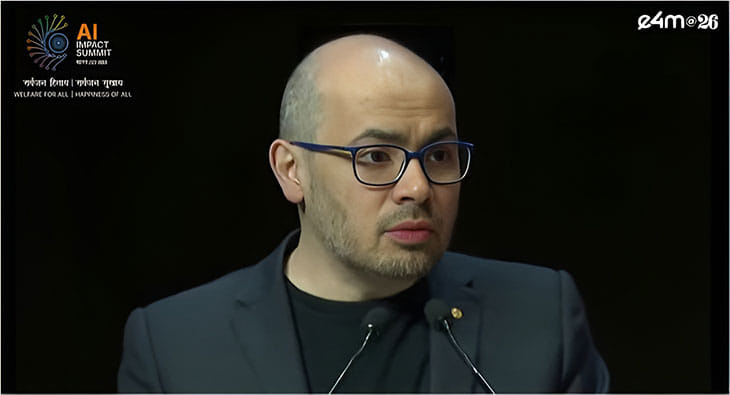

When Sir Demis Hassabis takes the stage, he doesn't talk like a tech executive. He talks like a scientist who happens to run one of the most consequential AI labs on the planet. At the India AI Impact Summit 2026, the Google DeepMind Co-Founder and CEO delivered a speech that ranged from the mysteries of ancient philosophy to the imminent arrival of artificial general intelligence, and left little doubt that he believes humanity is approaching a turning point unlike anything in recorded history.
"I think it's going to be one of the most momentous periods in human history," he said, "probably something more like the advent of fire or electricity." If that sounds hyperbolic, Hassabis had numbers to back it up. "I think it's going to be something like 10 times the impact of the Industrial Revolution, but happening at 10 times the speed, probably unfolding in a matter of a decade rather than a century."
The centerpiece of his address was a prediction that is sure to reverberate well beyond the summit hall. AGI (Artificial General Intelligence), the long-theorized threshold at which AI systems match or surpass human-level reasoning across domains, is, in his view, very close. "Now in 2026, we're at another threshold moment where AGI is on the horizon, maybe within the next five years," he said. "We're seeing these general purpose foundational model systems becoming increasingly capable almost week by week."
Hassabis traced his conviction back to the very beginning of his career. He co-founded DeepMind in 2010 at a time when, as he put it, "almost nobody was working on AI in industry. It was just a dream." What drove him then, and drives him now, is not the commercial promise of the technology but something more fundamental.
"My passion is to advance scientific discovery," he said. "I always felt that AI would be the ultimate tool for accelerating scientific discovery and being a force multiplier for human ingenuity." He described a lifelong fascination with what he called "the Greek questions of science: the nature of reality, the nature of consciousness, these deep mysteries that are in the universe. And I think AI can help us find answers to these questions that we've pondered over for thousands of years."
That philosophy gave rise to AlphaFold, DeepMind's breakthrough system for predicting protein structures, which Hassabis described as having been built "to solve the 50-year grand challenge of protein folding." He hopes it is only the beginning. DeepMind and others, he said, are now turning AI toward material science, fusion, physics, and mathematics. "Almost every branch of science and medicine can be impacted by AI," he said, "and we hope that AlphaFold will just be the first example of amazing advances that have been enabled by it."
But Hassabis was at pains to balance his optimism with a scientist's caution. The scale of what is coming demands humility, he argued. "This is something that we have to approach with humility and understanding that we don't have all the answers yet as to how this technology is going to develop and be deployed into the world." His prescription was methodical: "We should take a scientific approach, using the scientific method to understand what the capabilities of these systems are, to build good guardrails and monitoring systems, to understand more deeply what these systems are capable of and how we can make sure that they serve the purposes that we want."
India featured prominently in his vision of what a beneficial AI future looks like. Fresh from a visit to Google and DeepMind's Bangalore research office and a talk at the Indian Institute of Science, Hassabis was effusive. "I was incredibly impressed by the students and the faculty there, their enthusiasm and their energy for AI, and their ideas for how to use AI to improve India's standing in the world," he said. "I think that India will indeed be a powerhouse for AI across the globe." He also expressed pride in DeepMind's partnership with Reliance Jio to bring Gemini foundation models to users across the country.
He ended where the summit itself began, with a call for the kind of international dialogue that no single company or government can provide alone. "This can't just be left to technologists," he said. "We need to bring all of these debates into the tent: the technologists that are building it, governments and how to deploy it for the best use of their citizens, but also artists, social scientists, and philosophers." Get it right, he said, and the prize is extraordinary. "If we get these next steps right, I think we can usher in a new golden era of scientific discovery and improve the lives and health of everyone in the world.”
Read more news about Digital Media, Internet Advertising, Marketing News, Television Media, Radio Media
For more updates, be socially connected with us onInstagram, LinkedIn, Twitter, Facebook, YouTube & Google News
