Google CEO Sundar Pichai pledges an AI-powered future for India at AI Impact Summit
From a train ride through a quiet coastal town to a $15 billion AI hub, Google CEO came home with big promises and bigger ambitions
 by
by
Published: Feb 19, 2026 11:40 AM | 4 min read
 Follow Us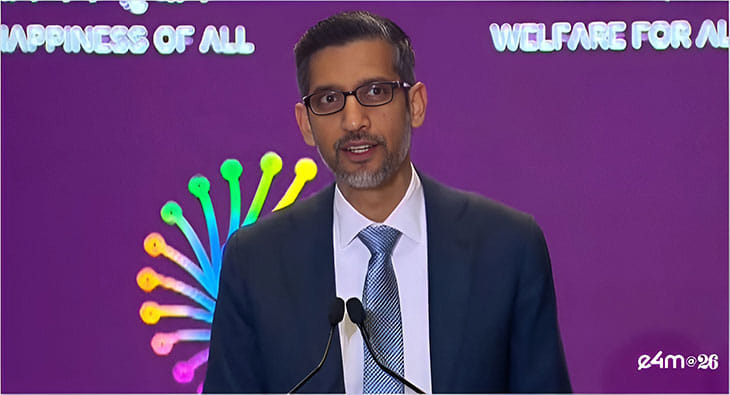

During a keynote address at the India AI Impact Summit 2026, Google CEO Sundar Pichai announced sweeping new infrastructure investments and outlined Google's vision for artificial intelligence as a force for global development, drawing on vivid personal memories of his student days in India to make the case for technology's transformative power.
The Google CEO opened with a striking piece of nostalgia. As a student, Pichai regularly rode the Coromandel Express from Chennai to IIT Kharagpur, passing through the coastal city of Visakhapatnam. "I remember it being a quiet and modest coastal city brimming with potential," he told the audience. "Now, in that same city, Google is establishing a full-stack AI hub, part of our $15 billion infrastructure investment in India. When finished, this hub will house gigawatt-scale compute and a new international subsea cable gateway, bringing jobs and cutting-edge AI to people and businesses across India."
The contrast between past and present clearly moved him. "Sitting on that train, I never imagined Vizag becoming a global AI hub," he said, "just as I couldn't have imagined that one day I'd be spending time with teams figuring out how to put data centers into space, or taking my parents for a fully autonomous car." He paused to add, with a laugh, "If it worked on India's roads — still working on that one."
The address struck a tone that was equal parts ambitious and cautionary. Pichai framed artificial intelligence as "the biggest platform shift of our lifetimes," arguing that humanity stands "on the cusp of hyper-progress and new discoveries that can help emerging economies leapfrog legacy gaps." But he was quick to temper the excitement with a note of realism. "That outcome is neither guaranteed nor automatic," he warned. "To build AI that is truly helpful for everyone, we must pursue it boldly, approach it responsibly, and work through this defining moment together."
On boldness, Pichai was expansive. He spoke about Google's work in El Salvador, "where Google has partnered with the government to bring affordable AI-powered diagnosis and treatment to thousands who could never afford to see a doctor," and described how AI is now reaching Indian farmers at scale. "Last summer, for the first time, the Indian government sent AI-powered forecasts to millions of farmers, possible in part because of our neural GCM model," he said. In Ghana, he added, Google is "collaborating with universities and NGOs to expand research and open source tools across more than 20 African languages."
Underlying all of it was a concern about who gets left behind. "Technology brings incredible benefits, but we must ensure everyone has access to them," Pichai said. "We cannot allow the digital divide to become an AI divide." To that end, he announced four new subsea fiber optic cable systems between the United States and India under a newly unveiled America-India Connect initiative, alongside the Vizag hub and additional infrastructure investments in Thailand and Malaysia.
He was candid about the economic disruption ahead. "AI will undeniably reshape the workforce, automating some roles, evolving others, and creating entirely new careers," he said, before offering a note of historical optimism. "20 years ago, the concept of a professional YouTube creator didn't exist. Today, there are millions around the world." Google, he said, has trained 100 million people in digital skills and is launching a new AI professional certificate to help workers adapt to the changing landscape.
On the question of trust, Pichai pointed to SynthID, describing it as a tool "used by journalists and citizen fact checkers globally to help verify the authenticity of the content you read and see." He framed trust not as an abstract value but as a practical prerequisite. "No matter how bold we are or how responsible, we won't realize AI's full benefits unless we work together," he said.
He closed with a call for governments to play a more active role. Not just as regulators, but as innovators. "Governments have a vital role that includes as regulators setting important rules of the road," he said, "and importantly, also as innovators, bringing AI to public services that improve lives." He cited Uganda's use of AI and satellite imagery to pinpoint areas for electrification, and AI-assisted road scanning in Memphis, Tennessee, as early signs of what that partnership could look like.
The speech drew a warm reception from an audience keenly aware of India's growing importance to the global AI landscape. For Pichai, it was clearly a homecoming with meaning. The boy on the Coromandel Express had come a long way, and if his vision holds, so too will the cities he once passed through.
Read more news about Digital Media, Internet Advertising, Marketing News, Television Media, Radio Media
For more updates, be socially connected with us onInstagram, LinkedIn, Twitter, Facebook, YouTube & Google News
