At AI Impact Summit, Kalli Purie shares 9-point charter to safeguard journalism in AI era
Purie addressed a gathering of top editors and media leaders during the session titled AI and Media: Opportunities, Responsible Pathways, and the Road Ahead
 by
by
Published: Feb 17, 2026 8:54 AM | 2 min read
 Follow Us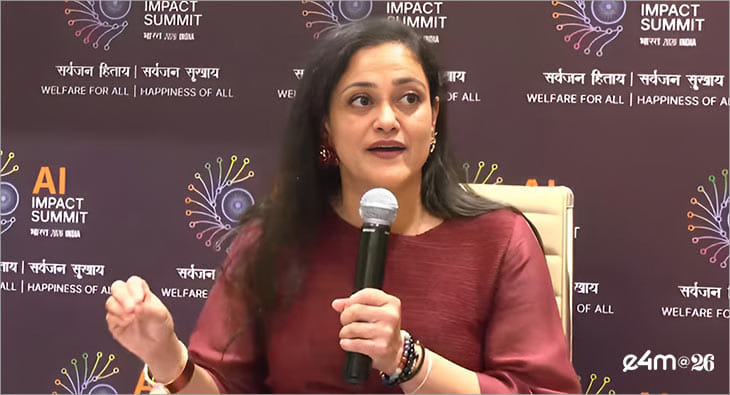

At the AI Impact Summit held in New Delhi, Kalli Purie, Vice-Chairperson and Executive Editor-in-Chief of the India Today Group, presented a forceful nine-point framework urging greater equity, responsibility and mutual value in the way Artificial Intelligence engages with news organisations.
Addressing a gathering of top editors and media leaders during the session titled AI and Media: Opportunities, Responsible Pathways, and the Road Ahead at Bharat Mandapam, Purie cautioned that without clear guardrails, AI systems risk reshaping public conversation in troubling ways. She stressed that journalism cannot simply be treated as free input for large language models, warning that doing so without transparency or safeguards could undermine the integrity of credible news.
“Fair value for journalistic content is non-negotiable. We need transparency in how AI systems digest and metabolise news,” Purie said, unveiling the charter that places journalism at the heart of democratic accountability.
The 9-point charter shared by Kalli Purie was:
1. Fair value for journalistic content, with transparency on how news is used by AI systems
2. Traceability and attribution as a democratic principle
3. Recognition of journalism as a public good
4. Rewarding stories that deliver social impact
5. Real valuation of verified content produced by credible institutions
6. Severe penalties for AI hallucinations
7. Ending asymmetry in reward and punishment between legacy media and social media platforms
8. Treating citizens’ attention as a rare and finite resource
9. Reciprocity from the ‘Magnificent Seven’ tech companies—if they access this “rare mineral” of attention and content, “what are they giving us back?”
Kalli Purie argued that news brands like India Today do more than distribute information. “News and verified media brands shape opinion. In a country like India, where literacy levels vary, that responsibility must rest with accountable institutions, not anonymous algorithms,” she said.
Kalli Purie raised concerns about what she described as a new form of “digital colonialism,” suggesting that multinational technology companies often apply different standards to Indian publishers compared to Western media organisations. She pointed out that Indian journalists spend time, money and effort reporting from the field, and argued that their original work should not be freely repackaged by influencers or AI-generated summaries without compensation. According to her, AI platforms must pay for the journalistic content they rely on.
She added that every stakeholder contributing to the news value chain carries a responsibility to safeguard public trust. Emphasising the need for technological self-reliance, she advocated building a sovereign AI ecosystem designed around the interests of citizens.
Read more news about Television Media, Digital Media, Advertising India, Marketing News, PR and Corporate Communication News
For more updates, be socially connected with us onInstagram, LinkedIn, Twitter, Facebook YouTube & Google News