AI Slop: Creators say the real battle is for taste and trust
At the AI Impact Summit 2026, Viraj Sheth, CEO of Monk-Entertainment, moderated a wide-ranging discussion on how creators are using artificial intelligence to move from average to the top 1 percent
 by
by
Published: Feb 18, 2026 1:22 PM | 5 min read
 Follow Us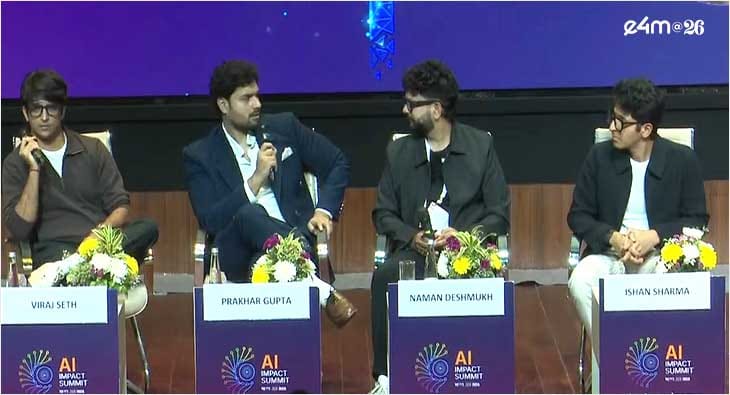

As AI-generated “AI girls” rack up billions of views and hyper-optimised avatars begin to dominate short-form feeds, creators are warning that the internet’s middle layer is about to be overwhelmed by what they call AI slop. Yet, they argue, the real competitive edge will not lie in access to tools, but in taste, trust and execution.
At the AI Impact Summit 2026, Viraj Sheth, CEO of Monk-Entertainment, moderated a wide-ranging discussion on how creators are using artificial intelligence to move from average to the top 1 percent. The panel featured Prakhar Gupta, podcaster and host of The Prakhar Gupta Xperience; Ishan Sharma, entrepreneur and career-focused creator; and Naman Deshmukh, tech and AI content creator.
AI Girls, Pattern Recognition and Execution
The conversation opened with the rapid rise of AI-generated influencer avatars, especially “AI girls” that are drawing massive engagement.
Ishan said the smarter approach is not resistance, but reverse engineering. “There are AI influencer girls getting billions of views. Instead of just reacting, I studied what worked. The first three seconds, the hook, the structure. If that format works, communicate your message in that format.”
He described building automated systems that analyse his past content, track what performs best in his niche, scan audience comments and monitor global conversations. “AI is not Google search,” Ishan said. “It is a collaborative partner. When you connect multiple tools and create workflows, it becomes like an agent. Every morning I get insights tailored to my audience.”
Naman added that creators who rely on simple copy-paste prompting will struggle. “Most people are just using AI for surface-level output. But if you build systems on top of it, that’s where leverage comes in,” he said. He revealed that parts of his own content engine are automated, from analysis to optimisation, while creative direction remains human-led.
Taste Will Outrank Tools
As models rapidly improve, Naman argued that the real differentiator will shift from technical skill to judgement. “The models are only going to get better,” he said. “We can build apps, avatars, songs, designs. But knowing what works, recognising patterns and applying taste, that is the ultimate skill.”
He emphasised that design thinking is not limited to aesthetics. “Design can mean writing better software, structuring better content or building better systems. The edge is not the tool. It is how you think.”
Prakhar expanded on this, warning that the middle of the internet will soon be saturated. “In the next five years, what we call AI slop will take over the grand middle of content consumption,” he said. “The dead centre, which is driven by dopamine hacking, will be dominated by artificial intelligence. Pattern recognition is something AI can already do better than humans.”
He predicted that while the middle 70 to 80 percent of content may become indistinguishable and synthetic, the edges will gain value. “Mistakes will become proof of truth,” Prakhar said. “If you do not make mistakes, people will suspect it is artificial intelligence. Imperfections will signal authenticity.”
Authenticity, Trust and the Human Edge
The panel also addressed concerns around digital clutter, ecological impact of data centres and the ethics of AI cloning.
Prakhar framed the content explosion as a demand-supply issue rather than a morality problem. “This is not about moral policing. The demand for content is high, so supply will increase. It is a market dynamic.”
However, he stressed that creators with skin in the game will self-regulate. “If I post trash, it affects my career. Professional creators cannot afford to dilute trust.”
On AI cloning and privacy, the discussion acknowledged the legal grey areas around training on raw data, but returned to storytelling as the ultimate moat. “Real storytelling and real values cannot be cloned easily,” one panellist noted, reinforcing that identity without depth will not sustain long-term influence.
India’s Leverage and the Numbers That Matter
Beyond individual growth, the conversation turned to India’s position in the AI ecosystem. Prakhar argued that India’s demographic advantage is unprecedented.
“We have the largest population in the world, the second largest English-speaking population and one of the largest technically trained populations,” he said. “The playing field has been levelled.”
He added that India is among the largest creators, uploaders and consumers of content globally. With AI erasing cosmetic differences like accent and appearance, he believes Indian creators can compete globally at scale.
“Content is soft power,” Prakhar said. “Media shapes global perception. With AI, the barriers are collapsing.”
From Average to Top 1 Percent
When asked how beginners can break through, Ishan offered blunt advice. “If you want to be in the top 1 percent, you have to go all in. You cannot treat content like a side hobby and expect elite results.”
Naman reinforced that access is no longer the constraint. “Everyone has access to the same models. What separates you is execution.”
Prakhar closed with a simple directive for individuals hesitant about AI. “Just use it. Open the app. Ask it questions about your daily life. There is almost nothing you cannot research deeply in 20 minutes with these tools.”
As AI-generated avatars trend and automation becomes invisible infrastructure, the consensus was clear. The middle of the internet may be flooded with AI slop, but the real battle will be fought at the edges, where taste, trust, judgement and unmistakable human presence still matter.
Displaying Infinix India Unveils ‘World Take NOTE’ Campaign, Launches NOTE Edge with Yashasvi Jaiswal as the Face of All Round Power.docx.
Read more news about Industry Briefing, Internet Advertising, Marketing, PR & Corporate Communication, Television Media
For more updates, be socially connected with us onInstagram, LinkedIn, Twitter, Facebook YouTube & Google News