India better positioned than most nations to lead open AI: Adobe CEO Shantanu Narayen
At the India AI Impact Summit 2026, Adobe CEO Shantanu Narayen, in conversation with Sunil Bharti Mittal, stressed that scaling AI adoption requires sustainable models and open standards
 by
by
Published: Feb 19, 2026 1:07 PM | 3 min read
 Follow Us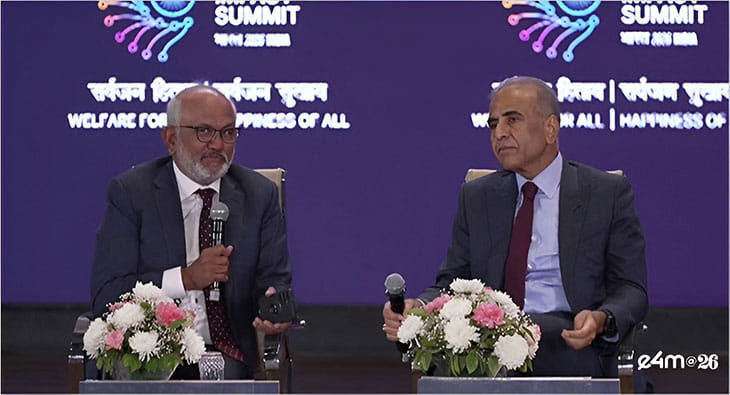

India is better placed than most countries to shape the future of open and trusted artificial intelligence, said Shantanu Narayen, Chairman and CEO of Adobe, during a conversation with Sunil Bharti Mittal, Founder and Chairman of Bharti Enterprises, on the fourth day of the India AI Impact Summit 2026.
Highlighting India’s scale and rapid adoption of technology, Narayen said the country could soon emerge as the world’s largest user base of AI. “Every student in India can have access to any of the world’s information on their device. How cool it is,” he said, adding, “Given the number of people who use AI in India will be greater than anywhere in the world over a few years, the leadership India can play in data, privacy, security and trust is huge.”
A major part of the discussion focused on the need to build trust in AI as content creation becomes increasingly automated. Recalling a meeting with Prime Minister Narendra Modi, Narayen said the government is keen to ensure authenticity of digital content. “His eyes really lit up when he said, ‘I want every piece of information that’s produced to have the provenance and the watermark so people can know what is real and what’s fake.’”
Mittal raised the importance of keeping AI open and accessible rather than concentrated in the hands of a few companies. Responding to the concern, Narayen acknowledged the tension between commercial interests and public good. “You’re going to have the inevitable challenge between commercial enterprises who want to keep information proprietary and how do you do good for humanity,” he said.
He pointed to Adobe’s experience with open standards as an example. “The reason PDF has been adopted so massively is because it was an open standard,” Narayen said, adding that long-term advantage in AI will come from real-world applications. “The sustainable advantage cannot be just a model. It has to be the use cases of what people are doing with that model.”
Mittal pointed to India’s space achievements as an example of the country’s cost-efficient engineering and innovation. He referred to India’s Moon mission and the stark difference in costs compared with global missions, prompting Narayen to underline the role of frugal innovation. “We use jugaad and that is the secret sauce that exists in India,” Narayen said, adding that global companies should look to India not just as a large market but as a learning hub for cost-efficient innovation.
Expressing confidence in India’s future, Narayen said he is “a lot more confident about what will happen in India,” underlining the country’s growing role in shaping global AI frameworks.
Read more news about Digital Media, Internet Advertising, Marketing News, Television Media, Radio Media
For more updates, be socially connected with us onInstagram, LinkedIn, Twitter, Facebook, YouTube & Google News