Microsoft's Brad Smith calls for AI to bridge global North-South divide
At the India AI Impact Summit, the Microsoft president warned that AI risks deepening global inequality unless the world invests in infrastructure, skills, and locally relevant solutions
 by
by
Published: Feb 19, 2026 2:27 PM | 3 min read
 Follow Us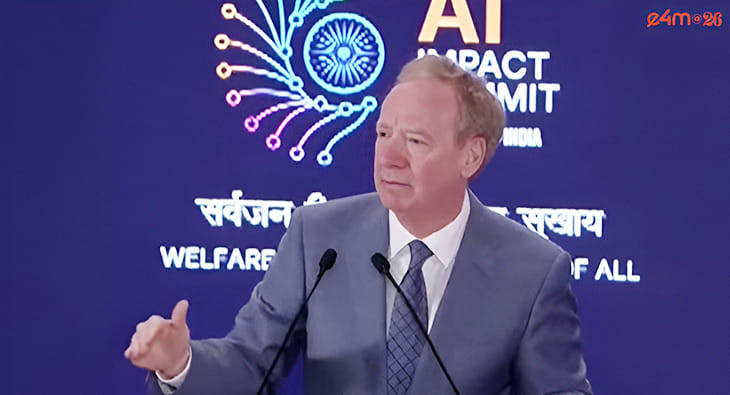

Microsoft President and Vice-Chair Brad Smith used his keynote address at the India AI Impact Summit to issue a sweeping call to action, urging governments, tech companies, and employers alike to ensure artificial intelligence closes rather than widens the world's deepest economic divisions.
"We live in a tumultuous time and in a fragmented world," Smith told the gathered delegates, "but I think in so many ways, the deepest and most enduring divide has been the economic divide between the Global North and South." He argued that this gap was not simply a product of history or policy, but of technology access; tracing the inequality back to the uneven spread of electricity over the past century and a half. "It was literally 144 years ago that the first electrical power plant started operating in Lower Manhattan," he said, "and yet we come together today and we still live in a world where 700 million people lack access to electricity."
With that backdrop, Smith positioned AI as a defining fork in the road. "AI, perhaps more than any other technology this century, will play a bigger role, either in closing this economic divide or in exacerbating it and making it even wider," he warned, calling it "perhaps the single most important question for us today."
To close that gap, Smith outlined three priorities. The first is infrastructure. Microsoft, he announced, is "on pace to spend $50 billion by the end of this decade to bring AI to the Global South," with India among its largest investment destinations. But he stressed that public and private capital must work together: "We'll need to harness private capital, investments from tech companies, other sources of private capital, government funding" to generate the demand necessary to get "the wheels of the market spinning."
The second priority is skills. "Infrastructure is not hardware, it's not only wires and grids, it's skilling for people," Smith said, describing workforce preparation as equally foundational to any physical build-out. Microsoft announced this week an expansion of its Microsoft Elevate initiative, including a new program for educators "to equip teachers with access to help their students learn how to use AI." Smith made clear the responsibility extends beyond the tech sector: "It takes employers today to open their doors to new AI tools. It will take employers to invest in the skilling of their employees. It's not just for the next generation, it's for every generation that this fully matters."
The third priority is relevance. Smith argued AI must be made to work in languages beyond English and applied to problems that matter most to developing nations: from agricultural productivity in India to food security across Africa. "We need to use AI in the Global South to solve the problems that matter to the Global South," he said.
Looking further ahead, Smith addressed growing public anxiety about AI and jobs with a characteristically optimistic framing, invoking the invention of the washing machine. Before it, he noted, laundry took six to eight hours. Afterward, thirty minutes, and the result wasn't idleness but higher expectations and more ambition. "Whenever technology advances, it creates a new platform, a new foundation that enables people to stand taller and reach higher if and only if we're committed to using that technology well."
He closed with a challenge to the summit community itself, calling for bridges between annual AI gatherings rather than isolated events. "We need to define clear goals. We need to have common measurement systems, and every year we need to ask the same question, did we make 12 months of progress in the year that just preceded our meeting?" Smith said. "Let's aim higher, not just for technology, but for what technology can do for people.”
Read more news about Digital Media, Internet Advertising, Marketing News, Television Media, Radio Media
For more updates, be socially connected with us onInstagram, LinkedIn, Twitter, Facebook, YouTube & Google News
