By 2028, AI could surpass human intellectual capacity: OpenAI CEO Sam Altman
Sam Altman, CEO of OpenAI, at India AI Impact Summit 2026 called AI the most consequential tech shift of our time, warning that job transformation will be its first major impact
 by
by
Published: Feb 19, 2026 1:35 PM | 3 min read
 Follow Us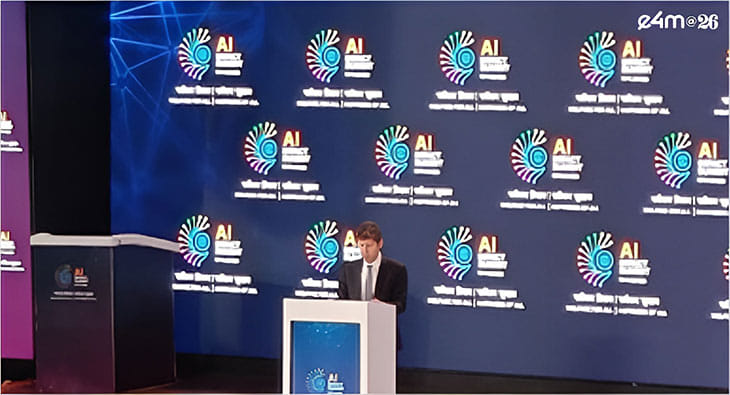

Sam Altman, CEO of OpenAI, took the stage at the India AI Impact Summit 2026 to outline what he called the most consequential technological shift of our time, and warned that the transformation of jobs will be one of its most immediate and visible impacts.
Altman said that while AI will dramatically expand access to healthcare, education and economic opportunity, it will also disrupt the nature of work at a scale and speed not seen before.
“If we are right and systems continue to improve at this pace, it’s going to change the economics of a lot of things,” Altman said. “It will be very hard to outwork a GPU in many ways.”
He acknowledged that many current roles, particularly those driven by cognitive repetition, data processing, and even parts of software development — will be reshaped as AI systems become more capable. “More than 100 million people in India use ChatGPT every week, and more than a third of them are students.” India, he added, is also the fastest-growing market globally for OpenAI.
In linking AI’s evolution to India’s democratic context, Altman said, “The world’s largest democracy is well positioned to lead AI — not just to build it, but to shape it and decide what our future is going to look like.”
However, Altman argued that job disruption is not a new phenomenon. “Technology always disrupts jobs. We always find new and better things to do,” he said, drawing parallels with previous industrial revolutions. He suggested that while today’s roles may appear essential, future generations may view them as stepping stones toward far greater capabilities.
At the same time, Altman stressed that AI-driven productivity gains could significantly lower costs across sectors. Automated supply chains and robotics could make physical goods cheaper. AI tutors and healthcare systems could widen access to essential services. Faster economic growth, he implied, may offset some of the shocks to employment.
Preparing societies for this shift, he said, will require new forms of governance, social contracts and policy innovation. “We may need superintelligence to help us design the systems that ensure fairness at scale,” he added.
Altman framed the future of work within a broader philosophical question: whether AI will centralise power or democratise opportunity. “The desirable future must look like a world of liberty, democracy, widespread flourishing and increased human agency,” he said.
At the Summit, his message was clear: disruption is coming, but with the right approach, it can lead to a more prosperous and empowered society.
Projecting forward, Altman made one of the boldest predictions of the session: “If we are right, by the end of 2028, more of the world’s intellectual capacity could reside inside of data centres than outside of them.”
“This is an extraordinary statement to make. And of course, we could be wrong. But I think it really bears serious consideration,” he added.
He went further, suggesting that a sufficiently advanced system “would be capable of being the CEO of a major company better than any executive or doing better research than our best scientists.” For India, where millions enter the workforce each year, the implications are profound. If AI systems can outperform humans in high-skill cognitive roles, the disruption will not be limited to entry-level or repetitive work; it could extend to leadership, strategy and advanced research.
The core question, he implied, is not whether jobs will change, they will, but whether societies can redesign education, skilling and governance quickly enough to ensure that AI augments human ambition rather than replaces it.
Read more news about Digital Media, Internet Advertising, Marketing News, Television Media, Radio Media
For more updates, be socially connected with us onInstagram, LinkedIn, Twitter, Facebook, YouTube & Google News
