Cinema advertising stabilises at Rs 877cr in 2025; upcoming releases elevate hope
Executives in the theatrical sector say the slowdown in ad growth over the past two years has been closely linked to inconsistent film releases and box office numbers
 by
by
Published: Mar 10, 2026 9:19 AM | 9 min read
 Follow Us

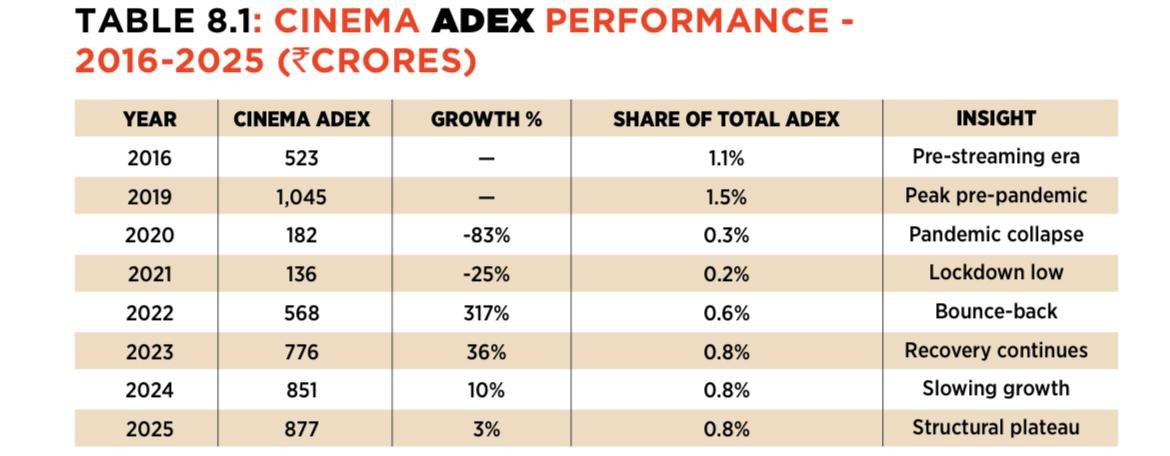
India’s cinema advertising market appears to have entered a phase of consolidation. According to the Pitch Madison Advertising Report (PMAR) 2026, cinema AdEx stabilised at around Rs 877 crore in 2025.
PMAR highlights that cinema ADEX had reached Rs 1,045 crore in 2019 with a 1.5% share of total advertising spend. However, the pandemic triggered a steep collapse, with revenues falling to Rs 182 crore in 2020 and further to Rs 136 crore in 2021 as theatres remained shut for long periods.
The reopening of cinemas in 2022 led to a strong rebound, with advertising revenues jumping to Rs 568 crore, a 317% year-on-year increase. Growth continued in 2023, when cinema AdEx rose to Rs 776 crore.
However, the pace of expansion has slowed since then. Revenues grew to Rs 851 crore in 2024 and Rs 877 crore in 2025, while cinema’s share of total AdEx has stabilised at around 0.8%. This indicates that although the medium has recovered significantly from pandemic lows, it has yet to regain its pre-pandemic share.
While theatrical advertising saw a strong rebound after cinemas reopened post the pandemic, cinema AdEx now appears to be moving within a narrow range, with blockbuster releases driving temporary spikes while quieter quarters moderate overall growth.
The current plateau, industry insiders say, reflects cyclical factors rather than structural fatigue.
Lights, Camera… Advertising?
PMAR figures prove that cinema advertising has always moved in sync with the strength of film releases - a strong slate can transform advertiser demand, while a weak quarter can cool enthusiasm just as fast.
Executives in the theatrical sector say the slowdown in ad growth over the past two years has been closely linked to inconsistent film releases and box office numbers.
Bhuvanesh Mehndiratta, who leads marketing and revenue at Miraj Cinemas, said the advertising market had stabilised largely because of limited content across industries.
“Cinema ADEX has stabilised over the last two years mainly due to limited content in Bollywood and some regional languages as well,” Mehndiratta said. “However, as operators we are looking at a strong content line-up this year and next year. From September 2025 onwards we have already seen momentum returning and we expect brand marketers to regain confidence in the medium.”
This dependence on film successes is also evident in financial disclosures by exhibitors. During an earnings call, Gautam Dutta, Co-CEO of PVR INOX, said advertising revenue during the December quarter remained soft due to the absence of enough “marketable” films.
The previous year’s quarter had eight films that attracted advertiser interest, whereas the latest quarter had only four. As a result, advertising volumes dipped even though box office collections remained healthy.
According to Dutta, the challenge was not pricing pressure but demand cycles linked to the perception of blockbuster titles.
Blockbusters still move the needle
Even as advertising volumes fluctuated, theatrical revenues remained strong. Ticket revenue at PVR INOX grew 14.4 per cent year on year, driven by the box office performance of films such as Dhurandhar, Kantara 2, Avatar 3 and Thamma.
The strong performance of these titles underscores the continued pull of theatrical entertainment and the cultural moments created by major releases.
For advertisers, associating with these moments can deliver high recall and impact. However, when the pipeline of such releases thins out, advertising demand tends to follow suit.
Counting the crowd
Another factor that has historically limited cinema’s share in media plans is measurement. Media planners have long been comfortable allocating budgets to platforms that offer granular data and verified impressions.
Cinema, by contrast, traditionally relied on estimated audience numbers, making it harder for advertisers to evaluate return on investment.
The industry is now attempting to address that gap through technology.
Cinema advertising network UFO Moviez has introduced ProCAT, a measurement platform that tracks actual cinema footfalls and allows advertisers to calculate verified cost per impact metrics.
The platform aims to bring cinema advertising closer to the accountability standards of television and digital media buying. By offering more transparent audience data, operators hope to unlock incremental advertising budgets from brands that previously remained cautious about investing in the medium.
Another challenge for advertisers evaluating cinema as a medium is the inherent unpredictability of film performance.Samir Sethi, Head of Bran
d Marketing of Policybazaar, said cinema advertising often involves a degree of uncertainty because brands typically commit budgets before a film’s theatrical run begins.
“Cinema advertising comes with a certain level of uncertainty, particularly when brands lock in deals before a film’s release. At that stage, it is difficult to predict how the movie will perform or what kind of occupancy levels theatres will see, so there is always an element of risk involved,” Sethi said.
He added that cinema advertising can also appear relatively expensive when compared with other mass media channels.
“At the same time, the cost per reach in cinemas tends to be slightly higher compared to other mediums such as television or digital. However, there are factors that partly justify this premium. The audience in theatres is captive, the viewing environment is far more immersive, and the larger screens and superior sound create a highly engaging experience,” he noted.
According to Sethi, brands ultimately need to assess whether the medium aligns with their campaign objectives and return expectations.
“Ultimately, brands need to evaluate this based on their category dynamics and return on investment expectations to determine whether cinema advertising delivers value for them,” he added.
Attention in a distracted world
Even as measurement improves, cinema’s strongest advantage continues to lie in its immersive environment.
Unlike other media platforms where audiences multitask across screens, cinema provides an environment where viewers are fully engaged with the content on a large screen and have limited distractions. Industry executives argue that this level of attention has become increasingly valuable in a fragmented media ecosystem.
Pritam Sawant, General Manager of Marketing at UFO Moviez, noted that several global brands are recognising the medium’s impact.
Companies such as Google, Netflix, OpenAI, Canva and Amazon have experimented with cinema advertising to tap into this undivided attention environment.
Sawant said cinema today represents more than just film viewing. Outings to theatres increasingly involve a broader social experience that includes premium formats, food and beverage consumption and shared entertainment moments with friends and family.
In some cases, ticket prices for major releases have reportedly touched as high as Rs 2,500, highlighting the aspirational positioning of theatrical entertainment.
A premium audience emerges
The growth of streaming platforms has also subtly reshaped cinema audiences.
Casual viewers often choose to watch films at home, while those who visit theatres tend to be more deliberate in their choices. This has resulted in an audience that is often more engaged and willing to spend on the overall experience.
For premium and aspirational brands, this shift can be attractive. The cinema environment allows brands to reach consumers who are actively participating in an entertainment experience rather than passively consuming content.
An industry executive at a large media agency, speaking on condition of anonymity, said cinema is increasingly viewed as a strategic add on rather than a core reach medium.
“Cinema may not deliver scale week after week like television or digital, but when the right film comes along it offers a level of impact that is difficult to replicate elsewhere,” the executive said. “For certain campaigns that want memorability rather than just impressions, it becomes a powerful layer.”
Box office bets from the Street
Market analysts believe the upcoming film pipeline could play an important role in determining the next phase of growth for cinema operators.
Karan Taurani, Senior Vice President at Elara Capital, said the slate of upcoming big budget releases could improve visibility for multiplex chains.
“Large titles such as King and Battle of Galwan should help drive footfalls and provide some near term visibility for multiplex chains. Occupancy levels could sustain at around 26 per cent in FY27 for PVR Inox, with regional cinema offering an additional upside if content performs well,” Taurani said.
He added that screen expansion across the industry appears to have stabilised after a period of rationalisation, particularly for PVR INOX.
“We expect fewer screen closures going ahead, while a larger share of new additions could come through asset light models,” he noted.
However, Taurani pointed out that advertising revenue remains one of the few areas yet to fully recover for multiplex operators.
“Ad revenues are still roughly 30 per cent below pre-Covid levels, which continues to limit margin expansion for multiplex operators,” he added.
It’s Showtime
Despite its current stabilisation, industry stakeholders see several factors that could support long term growth for cinema advertising.
India continues to have significantly lower screen density compared with markets such as the United States and China. As more screens are added across smaller cities and towns, the potential audience base for theatrical advertising could expand.
At the same time, the rise of multi language blockbusters and the growing national appeal of regional cinema are expected to create more high footfall weekends across the year.
To capitalise on this opportunity, experts say cinema operators will need to strengthen measurement systems, publish forward looking content calendars for advertisers and develop more contextual advertising products based on genre, language and geography.
Packaging big film releases as sponsorship properties rather than just selling traditional advertising spots could also unlock additional revenue streams.
For now, cinema advertising remains a medium defined by cultural moments rather than constant scale. As the film pipeline strengthens and measurement tools mature, the industry hopes the big screen can once again command a larger share of marketing budgets.
In an era dominated by scrolling feeds and shrinking attention spans, the theatre may still offer what advertisers value most. An audience that is present, attentive and ready to watch.
Read more news about Internet Advertising India, Marketing News, PR and Corporate Communication News, Digital Media News, Television Media News
For more updates, be socially connected with us onInstagram, LinkedIn, Twitter, Facebook YouTube & Google News