Marketers looking at value-oriented metrics: Sachin Sharma, LinkedIn Marketing Solutions
Sachin Sharma, Director, LinkedIn Marketing Solutions, India shares insights into how LinkedIn empowers marketers with data-driven insights to maximise revenue potential
 by
by
Published: Feb 26, 2025 8:46 AM | 5 min read
 Follow Us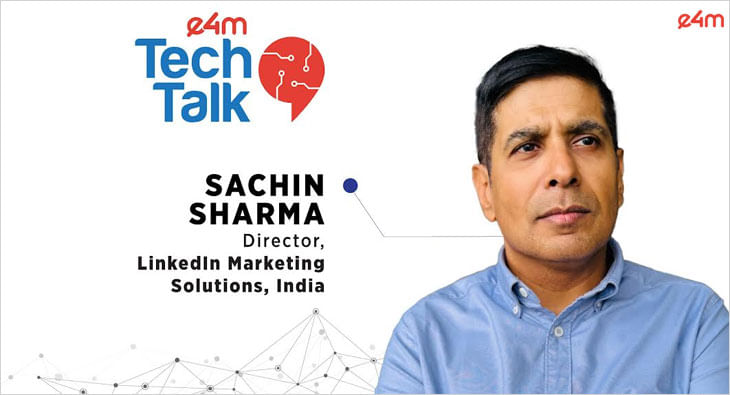

One of the biggest challenges B2B marketers face today is proving ROI and ensuring accountability for every rupee spent. CEOs, CFOs, and investors demand clear, data-driven evidence of how marketing efforts contribute to business outcomes. As the scrutiny intensifies, ROI has become the ultimate benchmark for measuring marketing’s impact and its role in driving incremental business value.
According to LinkedIn’s latest ‘B2B ROI Impact’ research findings, nearly half of B2B marketers in India say they have to justify marketing spend to C-suite every month.
Delving deeper into the data, Sachin Sharma, Director, LinkedIn Marketing Solutions, India shares, “You have to prove that there is a return on whatever is being invested in marketing. You should be able to show short-term and long-term gains. Short term is in terms of actual business delivery, long term is more in terms of brand value, and the credibility that you build in the market. People are facing challenges on how data is speaking across platforms and partners, and how they can go back and report that.”
There is also an evident shift in how marketers look at key metrics — from looking at just Customer Acquisition Costs and Cost Per Lead to a more nuanced understanding of value-oriented metrics that speak to the ‘revenue potential’ of marketing efforts.
“Marketing Qualified Leads (MQL) is typically the first stage. The second stage is where the sales team qualifies the lead as an Sales Qualified Leads (SQL). In the interim, either a demo or a first call would likely have happened. The third stage is where they look at their pipeline, its weight and velocity, to understand how many deals they are closing,” Sharma shares.
He adds that a data-driven approach is helping reduce the friction between marketing and sales teams, helping streamline the processes. LinkedIn uses signals from the first-party data of client companies to train its models and deliver quality leads. It helps LinkedIn solve for SQLs, establishing its value for the entire sales funnel, much beyond just marketing efforts.
When it comes to performance marketing, LinkedIn continues to be a platform with a higher cost of lead generation. It’s a hurdle for B2B marketers, who are pressed to justify returns on each rupee spent. Sharma feels that while it can be argued that LinkedIn is a slightly premium offering, it delivers value proportionally to the spends.
“We have this conversation with marketers almost every day that when you eventually go back and report these metrics to your CFO and investors, the one metric everyone’s interested in is ROI. The numerator in that equation is always revenue. Even if the lead is slightly more expensive but is a result of first-party data and intent signals, the probability of that lead converting is higher. When it comes to actual ROI calculations, the numerator is going to be higher with LinkedIn than what you would see from other platforms,” he explains.
In B2B marketing, customer acquisition is driven by two primary channels, renewing existing customers and acquiring new ones. Large enterprises rely heavily on renewals, but when it comes to acquiring new customers, which is crucial for profitability, there is always an incumbent vendor in place. To displace an existing provider, businesses must build trust and credibility, and mitigate risk for potential buyers.
Sharma highlights that in any B2B buying decision, the key challenge is eliminating doubt.
“Decision-makers want to ensure that choosing a new vendor is not just valuable but also low-risk. They need confidence that integration will be smooth, implementation timelines will be met, and the solution will drive measurable value. This is where LinkedIn plays a crucial role in helping brands establish credibility and bridge the trust gap,” Sharma explains.
Trust is at the heart of every major B2B decision. If a buying committee is evaluating a new CRM, for example, their primary concern isn’t just functionality, it’s ensuring that the decision won’t backfire. “Essentially, nobody wants to lose their job over a bad investment,” Sharma adds. “While businesses sell tools, systems, and AI applications, what buyers truly seek is assurance that their choice is safe and reliable.”
This need for credibility extends to both new acquisitions and existing vendor relationships. Even incumbent providers must continuously reinforce their value to prevent being replaced. “LinkedIn helps brands build awareness and establish thought leadership, positioning them as trusted partners,” Sharma explains. “It doesn’t stop at brand recognition. LinkedIn’s full-funnel approach ensures that trust-building translates into meaningful conversations, lead generation, and ultimately, business growth.”
What sets LinkedIn apart is its access to first-party data, allowing marketers to identify key decision-makers, track buying intent, and engage prospects at the right moment. “We know who is in the market, when they are looking to buy, and the factors influencing their decisions,” Sharma says. “This intelligence, combined with LinkedIn’s ability to nurture trust, makes it a powerful platform for B2B marketers looking to drive high-impact results.”
Read more news about Tech Talk, Marketing, PR and Corporate Communication, Internet Advertising, People Movement
For more updates, be socially connected with us onInstagram, LinkedIn, Twitter, Facebook, YouTube & Google News
