Mobile is the biggest companion now; TV chaos is over: Upendrra Rai
Speaking on the changing face of TV News at e4m NewsNext Summit, Upendrra Rai, Chairman and MD and Editor in Chief, Bharat Express, said the media’s transformation cannot be seen in isolation
 by
by
Published: Dec 15, 2025 12:57 PM | 4 min read
 Follow Us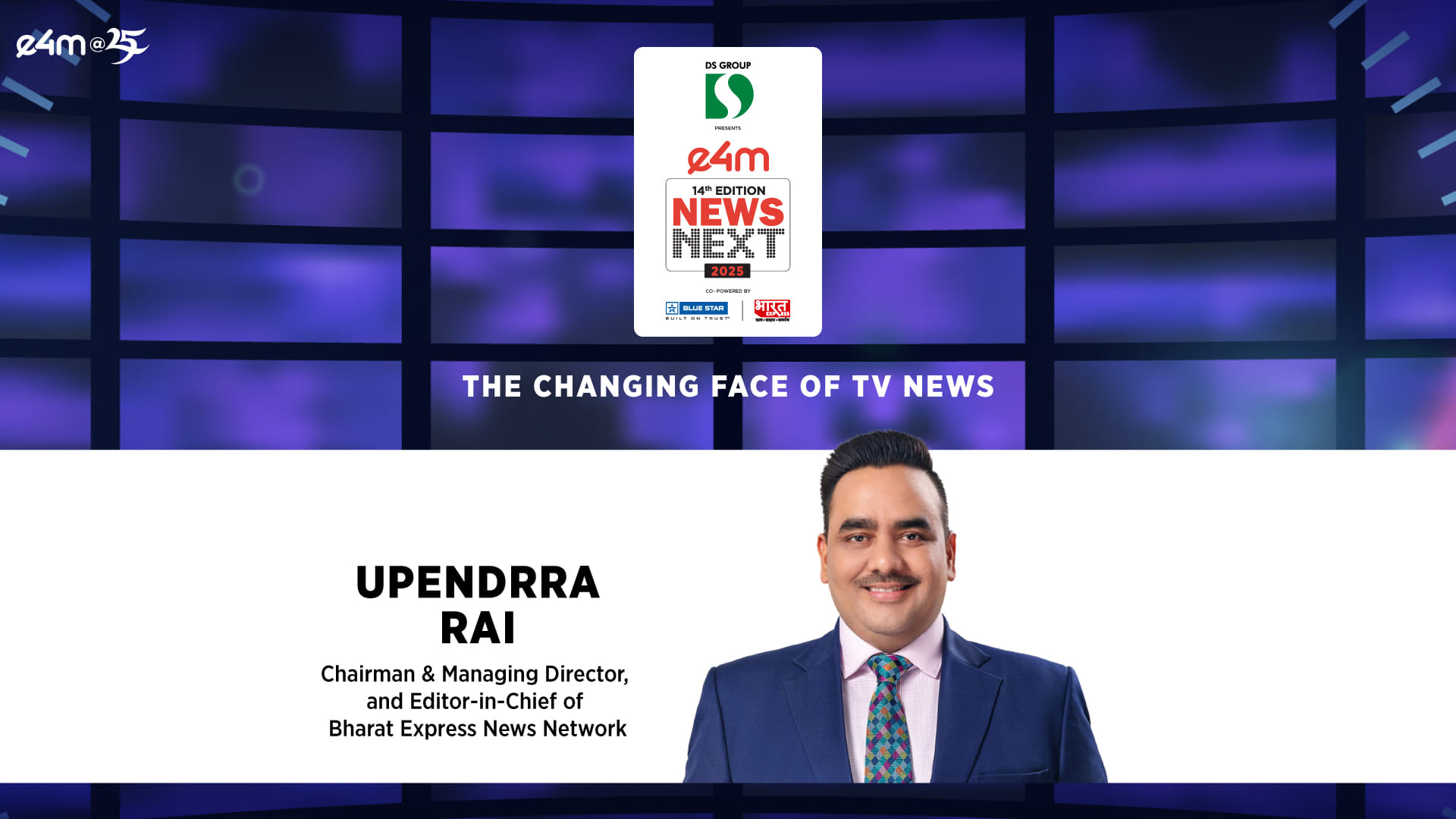

At a time when television news is struggling to retain relevance, Upendrra Rai, Chairman and Managing Director and Editor in Chief of Bharat Express News Network, delivered a blunt assessment of the future of TV news at the NewsNext Conference in New Delhi.
Speaking on the changing face of TV News, Rai argued that the media’s transformation cannot be seen in isolation from the transformation of civilization itself.
“In about 30 to 35 years the world has completely changed,” Rai said, placing the evolution of media within the arc of human development over nearly three lakh years. “Beyond civilization there is no TV media or any media. With that it grows, flourishes and moves forward.”
Rai said artificial intelligence has fundamentally altered how people think, work and live up to their expectations. Citing the rise of global technology giants, he pointed to NVIDIA’s meteoric growth as a signal of how power has shifted.
“There is a company in America, NVIDIA. Its economy is more than the economy of hundreds of countries. It has crossed a market cap of four trillion USD,” he said, adding that in a global village no country or industry can afford to stay away from technology.
Drawing a comparison between India and China, Rai said both economies stood at around one trillion dollars in 1986 but have diverged sharply since. “China’s economy has crossed twenty trillion dollars and our economy is still targeting five trillion dollars. How did this happen and why did it happen,” he asked. He attributed part of the gap to a cultural mindset in India that historically downplayed wealth creation. “A whole generation has been taught that money is an illusion.”
On television news, Rai said the medium enjoyed its peak power between 2000 and 2020 but has been overtaken rapidly in just the last two years. The reason, he said, is speed and accessibility. “No matter how fast TV media is, it cannot be faster than social media. Social media is a click away from you,” he said, explaining how TV’s structured workflows make it inherently slower than digital platforms.
According to Rai, this shift has had direct business consequences. “Viewership in the market is falling very fast. Ad revenue is ending very fast,” he said. “The entire business model of TV has been taken over by social media platforms and digital media.”
He also warned that mainstream media is drifting away from its responsibilities even as technology offers new opportunities. Rai said artificial intelligence allows seamless integration of small screens and big screens, creating convenience for audiences and efficiency for companies. “Those who have jumped in this direction will remain in the market. Those who have let this opportunity go will undoubtedly leave it,” he said, adding that AI’s advance is irreversible.
While optimistic about AI’s long term strength, Rai predicted a period of correction, similar to market cycles. He cited emerging legal and ethical challenges in the US, including cases where people sought medical advice from AI platforms and families later blamed them for tragic outcomes. He also referred to lawsuits by companies like Google and Meta over data usage and competitive imbalance. “The debate is still going on there between AI and old tech companies. This struggle is running because business is running,” he said.
Defining business in simple terms, Rai said, “Business is where you invest one rupee and expect to earn two rupees.” By that logic, he argued, traditional TV and print models are under severe strain.
In newspapers, Rai said print continues to survive but at a reduced scale. He noted that after COVID, even legacy brands became commodity products with readers shifting to PDF editions. “The circulation of big newspapers has come down from lakhs to thousands,” he said, adding that governments and policymakers have also recognised that the scale is moving decisively towards technology.
The core challenge for television news, Rai said, is demand. “Before starting TV you get all the news on your mobile. You become aware through the app. Google sends you news on your screen,” he said. “The system of TV, the big screen and the chaos of breaking news is over now.”
In one of his most striking remarks, Rai said the industry must urgently rethink its future. “The biggest challenge in front of TV companies is what business should we go into now,” he said, arguing that the need for a big screen has sharply diminished.
Recalling an earlier era when serials and appointment viewing defined television, Rai concluded that the centre of gravity has shifted permanently. “In the new age your mobile is your biggest companion,” he said, signalling what he believes is the end of television news as it has been known for decades.
Read more news about Television Media, Digital Media, Advertising India, Marketing News, PR and Corporate Communication News
For more updates, be socially connected with us onInstagram, LinkedIn, Twitter, Facebook YouTube & Google News