Rs 5 lakh a spot: World Cup finale marks women’s cricket’s big commercial leap?
With higher base rates expected next season, experts say women’s cricket is no longer a symbolic space for brands, it’s a growing powerhouse of emotion, engagement, and equity
 by
by
Published: Nov 5, 2025 9:10 AM | 6 min read
 Follow Us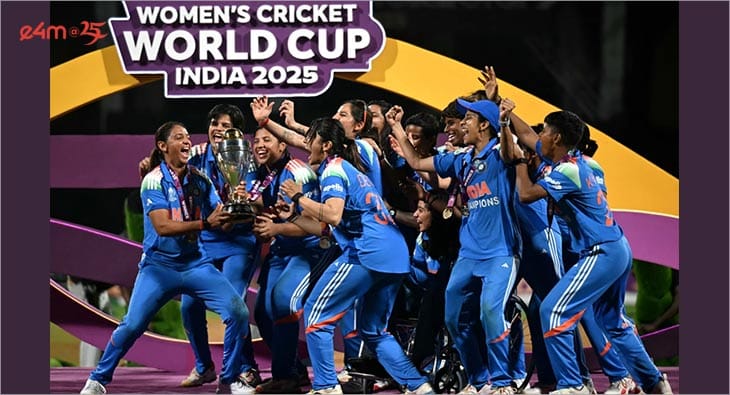

It wasn’t just India that lifted the trophy at the Women’s World Cup finale, it was the entire game. The showdown between India and South Africa wasn’t only a sporting spectacle but a statement. As the nation celebrated a landmark victory, the advertising world too had its own moment of triumph.
Television ad rates for the finale surged to around Rs 5 lakh for a 10-second slot, up from Rs 3 lakh earlier in the tournament, while OTT mid-rolls touched Rs 650–700 CPM, compared to Rs 400–500 before, industry sources said. For broadcasters, it was proof that women’s cricket had arrived as primetime entertainment, with brands clamouring to be part of the moment.
“The finale transformed from a sporting event into a cultural milestone,” said Vishal Prabhu, Creative Director, Strategy, White Rivers Media, adding that “With India lifting the trophy on home soil, brands saw an unmissable opportunity to align with national pride and record-breaking viewership.”
Also read: ICC Women’s T20 World Cup 2025: India’s entry into final sparks ad rush, rates rise 15–20%
The broadcaster reportedly charged 15–20% more for the finale than for earlier matches, while overall ad spends around the tournament were up nearly 50% compared to the 2022 season. Viewership soared, crossing 60 million within the first half of the tournament, underscoring the growing fandom around the women’s game.
Manesh Swamy, Co-founder and Director, FirstAI Consultancy Services, described the finale’s surge as the “Equal Pay innings officially beginning. The men’s 2023 final was the Shah Rukh Khan of ad rates, Rs 25–40 lakh for 10 seconds. The women’s one was more like Saiyaara, smaller budget, big impact,” he quipped. “Advertisers went from supporting cast to main character energy, and the finale sealed it. This win was the women’s cricket version of the men’s 1983 ‘Lehra Do’ moment.”
Also read: How Women’s World Cup final became India’s biggest brand game
With higher base rates expected next season and more integrated collaborations on the horizon, experts say women’s cricket is no longer a symbolic space for brands, it’s a growing powerhouse of emotion, engagement, and equity. The innings has just begun, and this time, it’s set to be a long one.
“Brands didn’t just cheer from the sidelines, they literally said ‘mauke pe chauka’. Now everyone wants to be part of the movement. FMCG, auto, fintech, even brands that didn’t care two seasons ago are suddenly feeling the FOMO,” Swamy said.
“Expect higher base rates next season (Rs 2–3 lakh/10s even for group games), OTT CPMs staying firm around Rs 500–700, and more integrated brand activations, not just ‘sponsor of the third umpire decision,’ but full-blown collabs, reels and content plays. The women’s game is officially done with singles; they’re clearing boundaries in the ad world too. Men’s cricket walked so women’s cricket could brand-collab and slay. Also, advertisers went from supporting cast (Rs 3 lakh spots) to main character energy (Rs 5 lakh spots). Men’s finals still command Rs 25–30 lakh, but the sequel’s clearly getting a bigger budget, bigger stage, and bigger fanbase. So yeah, humari chhoriyan chhoron se kam hain ke?” he added.
Also read: Viewership for ICC Women’s Cricket World Cup 2025 crosses 60mn in first 13 matches
For Vishal Prabhu, the growth in ad rates reflects how the finale evolved into something much bigger than sport. He said the gap between men’s and women’s cricket in terms of advertiser value is closing faster than anyone anticipated.
“This World Cup has proven that women’s cricket is now both a commercial and cultural force. For years, brands treated women’s sports as a symbolic investment, but the success of this tournament has changed that narrative,” Prabhu explained.
“Advertisers are recognising that women’s cricket attracts passionate, diverse audiences and represents the values of progress, ambition, and equality. If the momentum continues with better programming, sustained storytelling, and structured brand partnerships, this could evolve into one of the most powerful growth stories in Indian sport,” he said.
The ICC Women’s World Cup 2025 has in many ways rewritten advertising playbooks. With record viewership and engagement across platforms, brands didn’t just sponsor the game, they recalibrated how cricket advertising speaks to its audience.
Some new brands that came onboard this time include Kumari Jewellers, Singleton, International Gemological Institute (IGI), Crex, Baidyanath, and Maddock Films.
According to Dipshika Ravi, National Creative Director, Schbang, this edition marked a clear creative shift. “We are witnessing a powerful shift where women aren’t just the audience, they are the arena. For years, cricket was where men played and men paid. The Women’s World Cup changed that equation,” she said.
Ravi added that advertisers are no longer limiting themselves to women-centric categories. “The team’s victory hasn’t just ignited audiences; it has unlocked an entirely new way to market. Brands are no longer trying to sell to or through women, they are rewriting their growth stories with them,” she noted, citing the entry of finance, automobile, and lifestyle players into the women’s cricket ecosystem.
Examples like Surf Excel’s contextual ‘Daag Achhe Hai’ campaign and Puma’s association with Harmanpreet Kaur reflect this creative evolution, where storytelling is no longer about representation but participation.
On the brand side, Amit Bandi, CEO, Kumari Fine Jewellery, said the company’s campaign ‘Play Bold. Dazzle Always.’ drew directly from the energy of the tournament. “The Women’s World Cup was not just another sporting event, it was a defining cultural moment. We wanted to capture the strength and spirit of Indian women leading with courage, composure, and charisma,” he said.
Bandi added that the brand saw strong audience resonance. “It reaffirmed our belief that contextual marketing works best when it reflects authenticity and purpose. As India lifted the World Cup, it felt like a shared victory, for the country, for women everywhere, and for brands that celebrate something meaningful.”
Together, the creative and brand narratives indicate a significant turning point. Women’s cricket is no longer an add-on for advertisers, it is now a standalone arena driving new-age storytelling, inclusivity, and market growth. The ball, it seems, is now firmly in women’s court, and the industry is watching every over with growing admiration and investment.
Read more news about Television Media, Digital Media, Advertising India, Marketing News, PR and Corporate Communication News
For more updates, be socially connected with us onInstagram, LinkedIn, Twitter, Facebook YouTube & Google News