The golden age of strategic PR: Has the profession earned it?
Is Strategic PR really in its Golden Age, or is its biggest test still ahead? exchange4media spoke to India's communications leaders to find out
 by
by
Published: Jul 16, 2026 1:08 PM | 14 min read
 Follow Us

- World PR Day 2026 is themed "The Golden Age of Strategic PR," reflecting a transformative period in public relations driven by AI, social media, and evolving stakeholder expectations, which demand faster and more strategic communication.
- Industry leaders emphasize that the role of PR professionals is shifting from merely crafting messages to actively participating in business strategy and decision-making, highlighting the importance of trust and reputation in shaping organizational outcomes.
- The PRCAI SPRINT 2026 Report indicates significant growth in India's PR industry, projecting a shift towards strategic relevance over mere size, with a focus on integrating communications into business strategies.
- Future PR success will depend on professionals' ability to combine technology with human insight, emphasizing judgment, accountability, and a deeper understanding of business dynamics, rather than just increasing visibility.
World PR Day 2026 is being observed globally under the theme “The Golden Age of Strategic PR.” It is an ambitious phrase that suggests the profession has reached its defining era.
But has it?
For public relations, that moment may have already arrived.
The signs are everywhere. Artificial intelligence can draft press releases in seconds. Social media has weakened the traditional gatekeeping role of newsrooms. Every stakeholder, from investors and regulators to employees and consumers, expects instant answers. Corporate reputation can rise or unravel in a matter of hours, shaped by conversations that organisations neither initiate nor control.
For perhaps the first time in its history, public relations is being valued less for what it communicates and more for what it contributes before communication even begins. This evolution arrives at an interesting moment.
To uncover the true meaning of the theme and chart the future of Public Relations, we asked industry leaders to share their perspectives on where the field stands today, what changes we must prioritize, and where we are headed next
This feature traces those ideas, distilling them into what is fast becoming the industry’s blueprint for the decade ahead: The Strategic PR Manifesto.
If PR has changed so much, what exactly has changed?
Public relations has always adapted to change. It has moved from print to television, from television to digital, and from media relations to multi-stakeholder engagement. But leaders believe the current shift is different because it is being driven by several forces at once.
Artificial intelligence is changing how content is created. Social media has given every stakeholder a voice. Customers expect instant responses. Employees are shaping corporate reputation as much as CEOs. Investors and regulators are demanding greater transparency. And businesses are operating in an environment where a single decision can influence reputation across multiple platforms within hours.
These changes have expanded the role of communications.
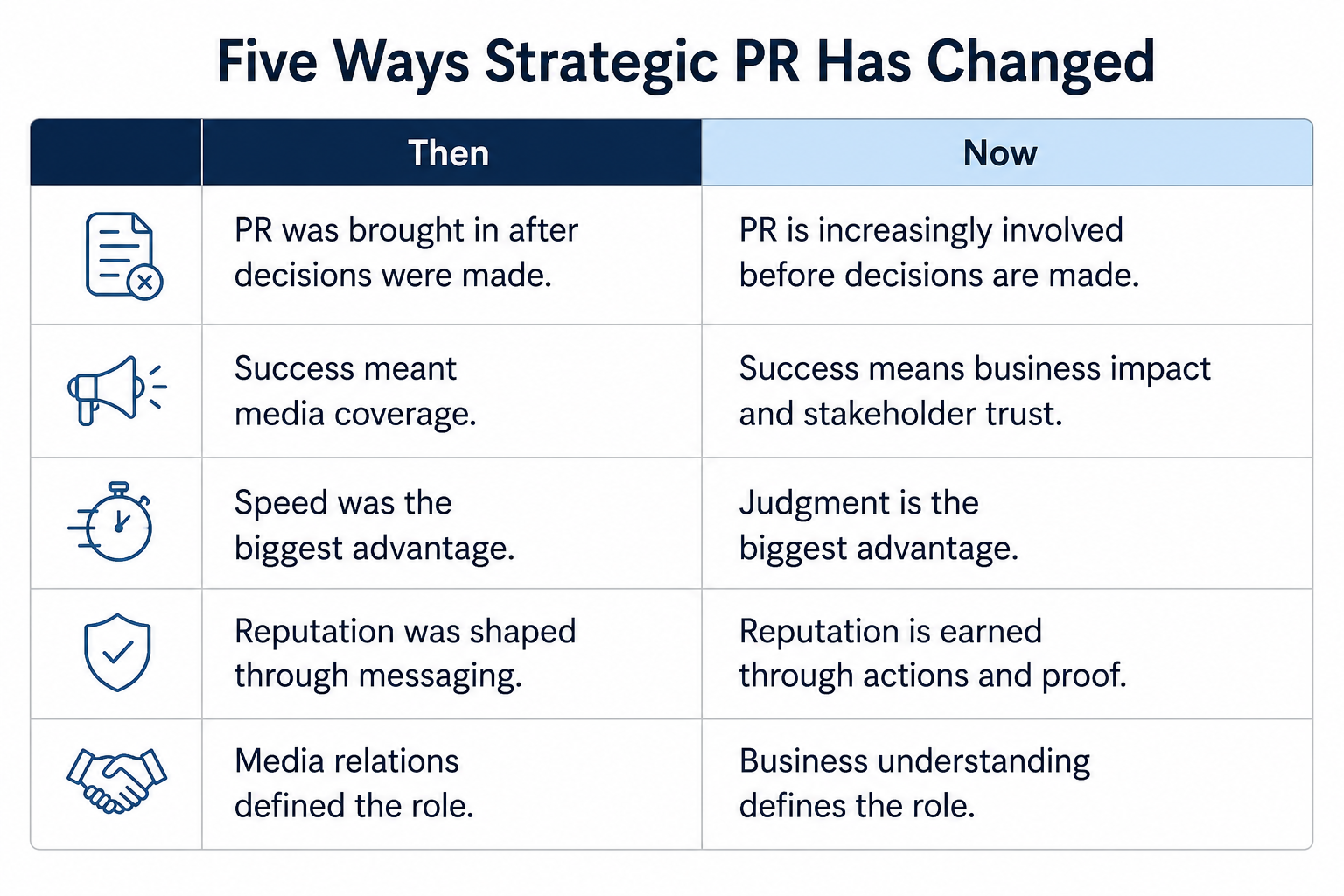
The communicator is no longer expected to simply craft messages. Increasingly, they are expected to understand business strategy, anticipate stakeholder reactions, identify reputational risks and advise leadership before those risks become public crises.
That evolution is reflected in industry data as well.
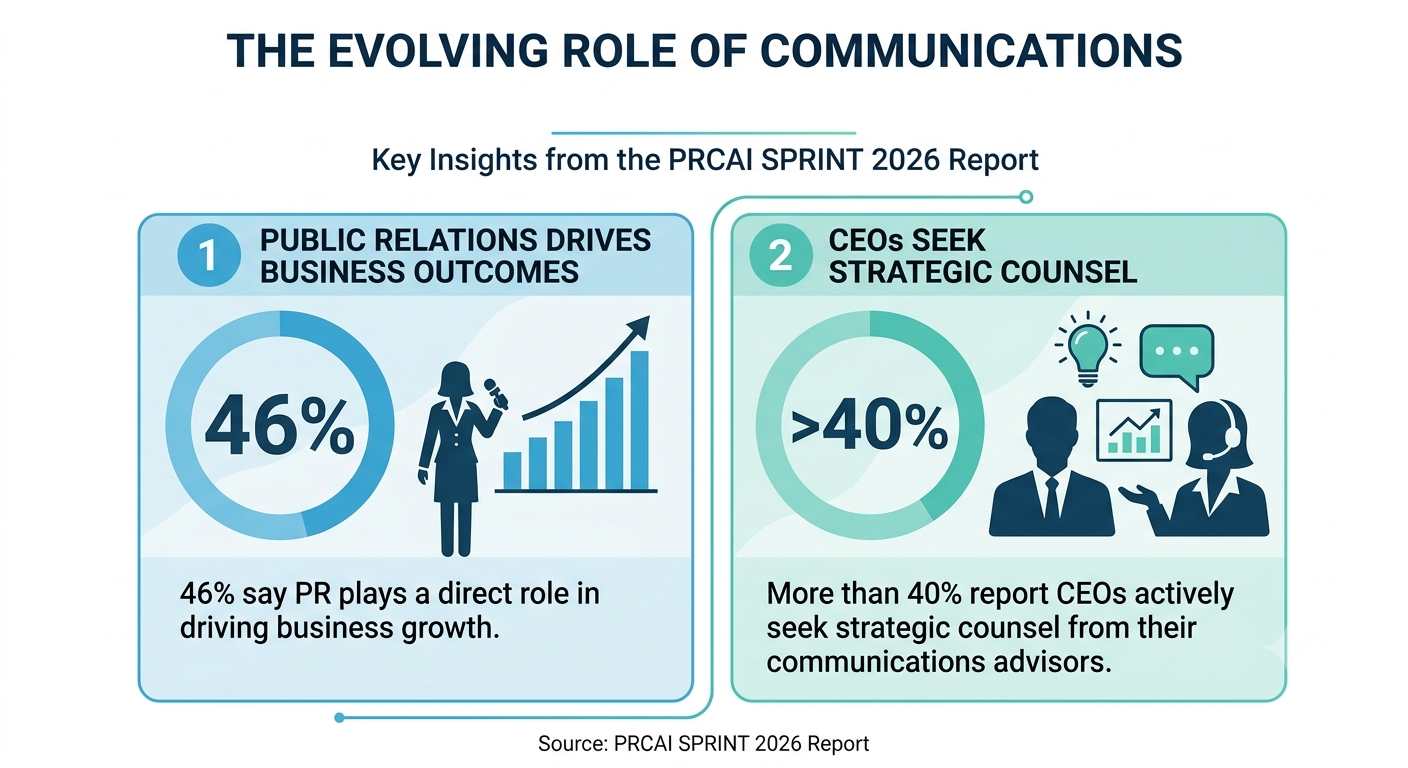
According to the PRCAI SPRINT 2026 Report, India's public relations industry has grown to ₹3,230 crore, with projections of ₹4,500 crore by 2030. The report also suggests that after years of double-digit growth, the industry's next phase will be defined less by size and more by strategic relevance. That is perhaps the biggest change of all.
- Strategic PR must become inseparable from business strategy
There is one idea that almost every communications leader comes back to: the future of PR lies inside the boardroom, not outside it.
The role of communications is steadily moving upstream. Instead of explaining decisions after they are taken, organisations are increasingly expecting professionals to contribute while those decisions are still being shaped. Reputation is no longer viewed as an outcome of business strategy; it is becoming one of the factors that influences business strategy itself.
For Bibhu Mishra, this marks the defining test of whether the profession can truly call this its "Golden Age." While AI and technology are accelerating change, he believes technology alone cannot earn PR that distinction. The profession must move beyond storytelling and become part of decision-making itself. He argues that communicators today need to understand markets, technology, regulation and stakeholder expectations just as deeply as they understand media. He says that organisations will increasingly value PR not for the stories it tells, but for the decisions it helps shape and the trust it helps sustain over time. As he succinctly puts it, "Strategic PR must become inseparable from business strategy."
Moving ahead, Naveen Soni believes communications professionals must first establish themselves as strategic business partners rather than remaining communication specialists. While technology has expanded the ability to reach audiences instantly through owned channels, social media and influencers, he says the real opportunity lies in helping organisations make smarter communication choices. Success is no longer about simply amplifying messages. It is about deciding what should be said, when it should be said and how different stakeholders are likely to respond.
Noopurr R. Chablani sees PR's future in helping businesses understand perception before it becomes a problem. As organisations operate in increasingly complex environments, she believes communications must become an integral part of business decision-making by helping leaders anticipate risks, navigate change and understand how perception influences trust, business decisions and long-term outcomes. In her view, the future of PR depends on whether organisations continue to see it as a function that communicates decisions, or one that helps shape them.
Sonalika believes this shift also demands a new way of measuring success. For too long, the profession has celebrated coverage, impressions and visibility. Those metrics, she argues, no longer capture the real contribution of communications. Strategic PR should be judged by the business problems it helps solve, the confidence it builds among stakeholders and the long-term value it creates. Agencies of the future, she says, will need to think beyond traditional media relations, bringing together reputation, digital, creators, brand experiences and data into one integrated communications strategy with clear business outcomes.
Apoorva Nijhara agrees that communications can no longer remain the final step in the business process. If strategic PR is to deserve its “Golden Age,” it must become more accountable. That means understanding technology, finance, public policy and customer behaviour as deeply as narratives, while embedding communications into business strategy from the very beginning.
“If we are entering the Golden Age of Strategic PR, it will not be because communications became louder. It will be because it became more accountable,” she spotlights.
Nidhi Verma makes another strongest case for why the profession must stop confusing activity with impact. She believes strategic has become one of the industry's most overused words, and the only way to reclaim its meaning is by proving communications' value where it matters most: in the boardroom. She asserts that reputation should be linked to business metrics rather than media metrics. As AI changes how content is created and discovered, the real differentiator will not be the ability to produce more communication, but the judgment to know which conversations deserve attention and the honesty to have them well.
The modern communications leader is no longer expected to simply answer the question,
"How do we communicate this?"
Increasingly, they are being invited into conversations much earlier to answer,
"Should we do this at all?"
- The New Currency Isn't Visibility. It's Trust.
There was a time when success in public relations was easy to count.
How many stories were published? How many interviews were secured? How much visibility did a campaign generate? Today, those questions feel increasingly incomplete.
In a world flooded with information, organisations have never had more opportunities to communicate. Yet they have never found it harder to be believed. It is perhaps no surprise, then, that almost every communications leader interviewed for this story returned to one word: trust, as the profession's most valuable outcome.
Swathi Gantellu believes the profession will earn its "Golden Age" not by generating headlines but by building trust through authentic storytelling, transparent communication and consistent action. In an environment where stakeholder expectations continue to evolve, she says communications professionals must become trusted advisors who protect reputation and influence business outcomes. Strategic PR, in her view, succeeds only when it puts credibility ahead of visibility, listens as actively as it speaks and creates narratives backed by action rather than intention.
For Danielle Gracias, trust is not an abstract idea. It has to be visible.
She offers perhaps one of the most compelling ways to think about modern communications: "The proof must travel as far as the promise."
The real responsibility of PR, she argues, is to ensure there is no gap between what an organisation says and what it does. In sectors like insurance, where every decision depends on confidence, communications is less about simplifying messages and more about helping people make informed choices. As AI continues to flood audiences with information, she believes the profession's greatest value lies in providing judgment, context and credibility—the human qualities that help people understand what truly matters.
Noopurr R. Chablani believes the growing influence of PR also brings greater responsibility. As communicators increasingly shape how businesses and leaders are perceived, they have to ensure those narratives reflect reality. The profession, she says, must continue raising the standards of ethical communication and thoughtful storytelling. Capturing attention may be easier than ever, but lasting credibility comes from helping people understand rather than simply persuading them.
That distinction also finds resonance in Vivek Pradeep Rana's perspective.
For decades, public relations relied on persuasion. Organisations could present their version of events and expect audiences to accept it. That era, he believes, is rapidly disappearing. Today's stakeholders rarely rely on a single source of information. Customers, regulators, employees and even AI-powered search tools compare multiple sources before forming opinions. Reputation is no longer what an organisation claims about itself. It is what survives independent scrutiny.
His observation captures the challenge facing communicators today: “What survives that scrutiny is what gets rewarded, not the reputation a company asserts, but the one that holds up when someone pulls the thread.”
Bibhu Mishra believes the industry has reached a point where visibility can no longer come at the cost of credibility. As organisations engage with increasingly diverse stakeholders, he argues that relationships with journalists, policymakers, investors, employees and communities must be built on insight, context and mutual trust rather than transactions. For him, the future of PR will be judged not by the volume of communication but by the confidence organisations are able to build over time.
In many ways, this changes the very purpose of public relations.
Communications can no longer manufacture credibility. It can only reveal it which makes trust the profession's most important currency. If the first chapter of modern PR was about capturing attention, the next may well be about deserving it.
- AI Has Changed the Job. Judgment Has Become the Skill.
If there is one force reshaping public relations faster than any other today, it is artificial intelligence.
From drafting press releases and analysing sentiment to monitoring media and generating content, AI has dramatically reduced the time spent on routine tasks. Technology is changing how communications is executed, but industry leaders believe it is also forcing a much bigger conversation: what is the real value of a PR professional when machines can do the work faster?
Dr. Sarvesh Tiwari believes the profession is reaching a turning point. He explains that for years, PR rewarded speed. The person who could produce more content, faster, was often seen as the most valuable. Today, that advantage is disappearing because AI can generate competent output in seconds. What remains, is the ability to exercise judgment, challenge assumptions and tell clients when a decision may be the wrong one. “The seat at the table cannot be claimed collectively. It is won, or lost, by one practitioner in one room,” he underscores.
Bibhu Mishra sees AI as an opportunity to elevate the profession rather than threaten it. As repetitive tasks become automated, he guides that communicators, now, have more time to focus on strategic thinking, leadership counsel and shaping business decisions. But he cautions that technology alone will not make this the Golden Age of PR. That distinction will depend on how well professionals use AI to create better thinking, not simply more content.
Naveen Soni agrees that while AI has transformed the speed and scale of communication, the fundamentals remain unchanged. Trust must continue to sit at the centre of every message. Technology can improve reach, but it should never compromise accuracy, creativity or sound judgment. The future, he believes, lies in combining AI with human insight to build integrated communication strategies across owned, earned and influencer platforms.
Vivek Pradeep Rana sums this up, stating, "Strategic PR will succeed only if what we build can be fact-checked by a machine and still stand. Everything else is a story waiting to get caught."
For Sonalika, the real competitive advantage will no longer be technology itself because everyone will have access to similar tools. The differentiator will be human qualities such as creativity, empathy, commercial thinking and the ability to connect communications with business outcomes.
The future belongs to communicators who can ask better questions, make better decisions and offer the kind of judgment that no technology can automate.
- The Communicator of Tomorrow Will Think Like a Business Leader
Every technological shift forces a profession to ask the same question: What makes us indispensable? The PR industry is asking that question today.
Today's communicator is expected to understand financial performance, public policy, technology, customer behaviour and regulation while advising leadership through uncertainty. Business literacy is becoming just as important as media literacy.
Dr. Sarvesh Tiwari challenge lands squarely on agency leadership. He asks, “Are firms actually developing people capable of occupying the strategic seat at the table, or only fill it?” He firmly states that “A Golden Age of Strategic PR will need strategists. Those take years to make.”
Ajit Pai believes that transformation must begin with the profession itself. He argues that the industry cannot talk about strategic PR without first strengthening its foundations. Better education, stronger relationships and continuous learning, particularly in an AI-driven world, will determine whether the next generation is equipped for the role. He describes these as the three capitals the profession must invest in: education capital, relationship capital and knowledge capital.
Apoorva Nijhara believes tomorrow's communicators will also need to simplify increasingly complex issues without losing accuracy. Whether it is technology, finance or policy, they must be able to advise leadership with confidence while helping organisations build credibility that grows over time. For her, communications should no longer be seen as the final stage of business planning, but as a discipline embedded into strategy from the very beginning.
Nidhi Verma argues that this future also demands greater commercial thinking. The profession, she says, has to stop treating "strategic" as a buzzword and start demonstrating how reputation influences business outcomes. As AI reshapes content creation, communicators will stand out not because they produce more messages, but because they know which conversations matter and can guide leaders through them with honesty and clarity.
Taken together, these perspectives suggest that the communications leader of 2030 will look very different from the communications leader of a decade ago.
They will be expected to challenge decisions, not simply communicate them. To understand business, not just branding. To build trust, not just visibility. And to bring judgment to conversations where technology can only provide information.
Perhaps that is what the Golden Age of Strategic PR really means. Not that the profession has reached its destination. But it has finally begun to redefine its purpose.
_page-0001.jpg)
The Golden Age won't be declared. It has to be earned.
The idea of a "Golden Age" suggests a profession that has reached its peak. But the perspectives of leaders point to something different. Public relations is not celebrating its arrival. It is still redefining its role.
Across industries, leaders are asking to be judged differently by the trust and reputation they help organisations build over time. Technology will continue to evolve. AI will become faster, smarter and more accessible. Stakeholders will demand greater transparency. Business decisions will face closer scrutiny than ever before.
In that environment, the value of PR will not lie in producing more communication, it will lie in helping organisations communicate with greater clarity, greater responsibility and greater purpose.
Perhaps, the real meaning of this year's World PR Day theme is that the golden age of Strategic PR is not a milestone the profession has already reached. It is a standard it must continue to live up to.
Read more news about PR and Corporate Communication News, Internet Advertising, Marketing News, Digital Media News, People Movement News
For more updates, be socially connected with us onInstagram, LinkedIn, Twitter, Facebook YouTube & Google News