In trust economy, communicators are the new strategists
Himani Rautela, Global- Communication lead, Redington highlights how the role of communications has evolved from media relations to a core business function, with trust and strategy at the centre
 by
by
Published: May 6, 2026 1:23 PM | 2 min read
 Follow Us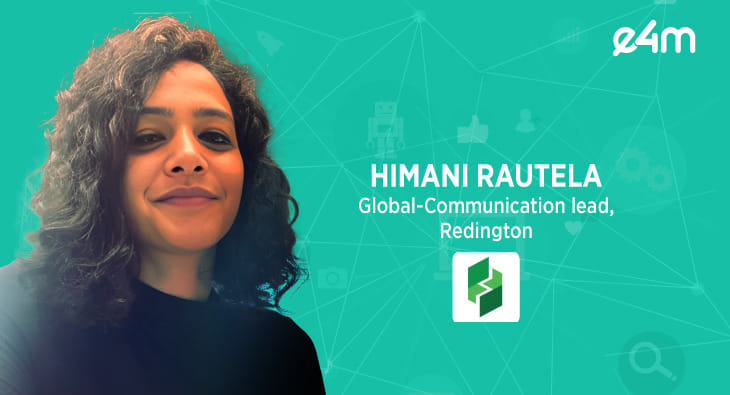

- The role of public relations (PR) has evolved significantly over the past 14 years, moving beyond traditional media relations to encompass crisis strategy, ESG storytelling, and business impact understanding.
- The global PR industry has surpassed $100 billion, with the Indian sector growing faster than several adjacent marketing disciplines, reflecting the increasing importance of strategic communication.
- Trust has become a critical business metric, with organizations investing in communications as a strategic lever to build credibility and value, rather than viewing it as a mere support function.
- The profession continues to face challenges, including the need for stronger measurement standards, more diverse leadership, and a focus on developing professionals skilled in both storytelling and business.
I interned across advertising, media houses, and PR agencies, convinced for the longest time that PR would not be my career. Somewhere along the way, I stayed.
Fourteen years later, having worked with leading PR firm, fast moving startups, and Fortune India 500 companies, one shift stands out clearly. PR has rewritten its own brief.
There was a time when the function was largely defined by media relations. Building journalist relationships, securing coverage, managing narratives. That foundation still matters. But it is no longer enough.
Today, communicators are expected to operate at the intersection of reputation and business. The role now spans crisis strategy, ESG storytelling, executive positioning, employer brand, and digital influence. More importantly, it demands a clear understanding of business impact. Getting the story out is only one part of the job. Knowing what it does for the organisation is what defines the role now.
The industry’s growth reflects this shift. Globally, PR has crossed the 100 billion dollar mark, and in India, the sector continues to outpace several adjacent marketing disciplines. But the more important change is this. Communicators are entering the room earlier. Not after decisions are made, but while they are being shaped.
At the centre of this evolution is trust.
Trust has moved from being an intangible outcome to a business metric. Studies like Edelman’s Trust Barometer have consistently pointed to declining institutional trust, making credibility a competitive advantage. Organisations that recognise this are investing in communications not as a support function, but as a strategic lever. Because when trust erodes, value follows. And when it is built intentionally, it compounds.
Technology has only accelerated this shift. The news cycle is real time. Artificial intelligence is beginning to reshape how content is created, monitored, and measured. Data has made it necessary to move beyond vanity metrics and demonstrate real impact. The communicator today is as comfortable reading a dashboard as they are shaping a narrative.
And yet, the core of the profession remains unchanged.
At its heart, communications is still about making the complex human. Finding the story inside the strategy. Creating clarity where there is noise. That is what continues to make the function indispensable.
On World PR Day, the reflection is not just about how far the industry has come. It is about what still needs to change. Stronger measurement standards. More diverse leadership. And a sharper focus on building professionals who understand both storytelling and business.
I did not plan this career. I grew into it. And the profession, much like the role itself, is still evolving.
Read more news about PR and Corporate Communication News, Internet Advertising, Marketing News, Digital Media News, People Movement News
For more updates, be socially connected with us onInstagram, LinkedIn, Twitter, Facebook YouTube & Google News